
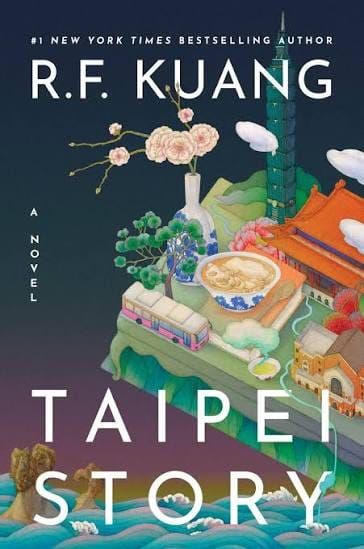
Taipei Story
By R. F. Kuang
William Morrow
Everyone knows that one person who studied abroad and made it their entire personality. One summer in England, and they’ve picked up an accent. A year in Thailand and they’re half way to becoming a certified yoga instructor. One immersive language study, and they’ve forgotten how to speak English because “it’s been too long.” Study abroad is one of those formative times precisely because it does expose you to new things, and those experiences change you.
In R.F. Kuang’s new book, “Taipei Story,” study abroad doesn’t go according to plan. The book follows Lily Chen, a college first-year at Yale, who is spending a summer studying abroad in Taipei to learn Mandarin Chinese. She, like many heritage speakers, is hoping to connect with her family and also to figure out her cultural identity without the pressure of actually being around them.
“I wanted to be Chinese here, on my own terms,” she says in the beginning. “The anonymity was the point – but that meant this place had nothing to do with me, that no cradle of belonging justified my missteps.”
As she keeps learning, it seems that the Chinese characters are falling out of her brain as fast as she can study them, her friendships grow complicated as her relationship with her roommate deteriorates, and her grandfather unexpectedly passes away. Her fantasy of blending in or being Chinese on her own terms never comes true.
Taipei Story is the most autobiographical of Kuang’s novels. She’s Chinese American, and according to a profile in the New Yorker, the book draws on experiences studying Mandarin in Taipei while her grandfather passed away. Like Lily, she’s studied at Yale (though not as an undergraduate). As a longtime fan of her work, I’ve always suspected that Kuang writes books that make people feel smart regardless of if they actually get them. I muddled through the math and philosophy references in Katabasis. I can’t be the only person who didn’t fully understand the mechanics of magic in Babel. And I think most of the internet missed the point of Yellowface.
But we feel better for reading it. It makes us feel like we’re part of something. Kuang is smart. She contains multitudes. Her work spans different genres and vibes, but each one comes with an intense attention paid to whatever subject she chooses.
This novel, focused on the experience of being Asian American while studying abroad in Asia, is well written and full of cultural references and chengyu, the four-character idiomatic phrases that all Chinese teachers insist make you sound more like a native speaker. Lily is a fleshed-out character who is down to earth and speaks authoritatively on many issues with varying degrees of self-awareness of her actual qualifications to speak on the issues. Kuang manages to write from the point of view of one much less knowledgeable than she is, so convincingly that many people think that the novel is meant to be instructive rather than an imperfect account from a limited perspective.
"Taipei Story is a novel about getting things wrong: almost every encounter in the pages to follow features mistranslation, miscommunication, and misunderstanding,” Kuang writes in an author’s note before the main text of the book. “It especially plays with diaspora claims to authority and authenticity, and the ways Taiwan has been mythologized within both American and mainland Chinese hegemonic fantasies.”
But the wrongs and mistranslations, while interesting, aren’t necessarily clear in the book, at least not to one without a substantial background in the subject. While Kuang executes a novel with better characterization than the many of her previous books, there isn’t much plot. This is typical of campus novels. But with Kuang’s history of writing books with interesting premises and so much plot, it’s disappointing, even if it’s just part of the genre.
Campus novels are constrained by the fact their narrators, who are 18-22, experience adulthood for the first time. You’re painfully unaware of your own blind spots and forced to brave what you’re told is supposed to be the best time of your life right when you have the least capacity to actually enjoy it. There are three kinds of people who would be reading a book like this: those who haven’t experienced it yet; those who have and can look back with empathy; and those who look back with judgment and annoyance. Your enjoyment of the book will largely depend on which you are.
Perhaps I’m just uncharitable because it brings me back to my own study abroad experiences, but I find Lily annoying. She’s painfully aware of how different Taiwan is from China but inexplicably believes that she’ll feel connected to Taipei, a place that even her immigrant parents have never visited. She’s angsty and singularly focused on her own angst at the expense of making clear-headed decisions.
But for fans of Heart the Lover and The Idiot, it could be a cool take on the angsty college novel with the added dimension of identity and politics. It just feels like Kuang is capable of a better execution.


