
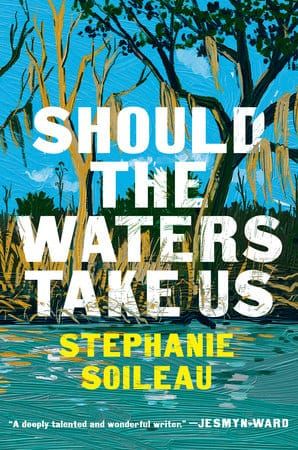
Should the Waters Take Us
By Stephanie Soileau
Doubleday
To live in Southern Louisiana is to live on borrowed time. The land has been underwater before, and it will one day be underwater again. There is so much working against the people who have made this stretch of land home, and yet, people choose to build and rebuild and rebuild again.
Spanning over 400 years of history through a fictionalized 2010, “Should the Waters Take Us,” a debut novel by Stephanie Soileau, imagines an alternate history where the Deepwater Horizon Oil Spill is followed up by a devastating tropical storm through the perspectives of a mosaic of different people. From a priest from the Niger Delta to the man barely scraping by fishing and hunting, Soileau weaves a beautiful tapestry of stories of betrayal, tragedy, resilience and unexpected kindness.
The novel mostly centers on the 2010 timeline around one family. Boy Broussard lives off land that he should have inherited but is lawfully his aunt's and uncle’s. He just met his daughter for the first time a few weeks ago. The uncle in question, Jacot, has his own perspective and own problems to deal with; his wife passes away unexpectedly, and he arranges to have her body donated to science. Meanwhile, Fabian, a reluctant priest from the Niger Delta, befriends Boy’s daughter despite having trouble connecting with the insular Louisiana community.
Soileau’s Louisiana complicates the narrative that people can subconsciously hold. It’s one where Chinese people stow away in barrels on ships going into New Orleans despite the Chinese Exclusion Act. African priests are dispatched to serve where there is a shortage of American clergy despite the racial tensions it may cause. And lots of people were pushed off the land they’d been working for generations. These groups of people, Soileau seems to say, are just as essential a part of the history as the Acadians or Cajuns. Louisiana is what it is because of a complicated web of migration, unlikely partnerships and a whole lot of persistence.
Though the novel is deeply researched and describes a lot of history, the 2010 timeline follows a worst-case reimagining of events. In 2010, Deepwater Horizon did explode, killing 11 and resulting in an oil spill. This oil spill impacts many in the book, and has had large impacts on the community here in Louisiana. In the book the spill is followed up with a severe tropical storm.
“Should the Waters Take Us” is just as much about the past as it is the future. Louisiana may have avoided the worst-case scenario when it comes to 2010, but it’s still on the front lines of climate change . Every year, people hold their breath when hurricane season comes around. This year, the Trump Administration rolled back a key finding that has been foundational to regulating climate change, which only makes a Katrina-like disaster more likely. “Should the Waters Take Us” is a must read for 2026 not just because it’s a binge-readable tale or because it sheds light on a part of the country that many don’t understand — though it is both of those things — but because it brings issues to life beyond statistics and alarming headlines and into the soul.


