
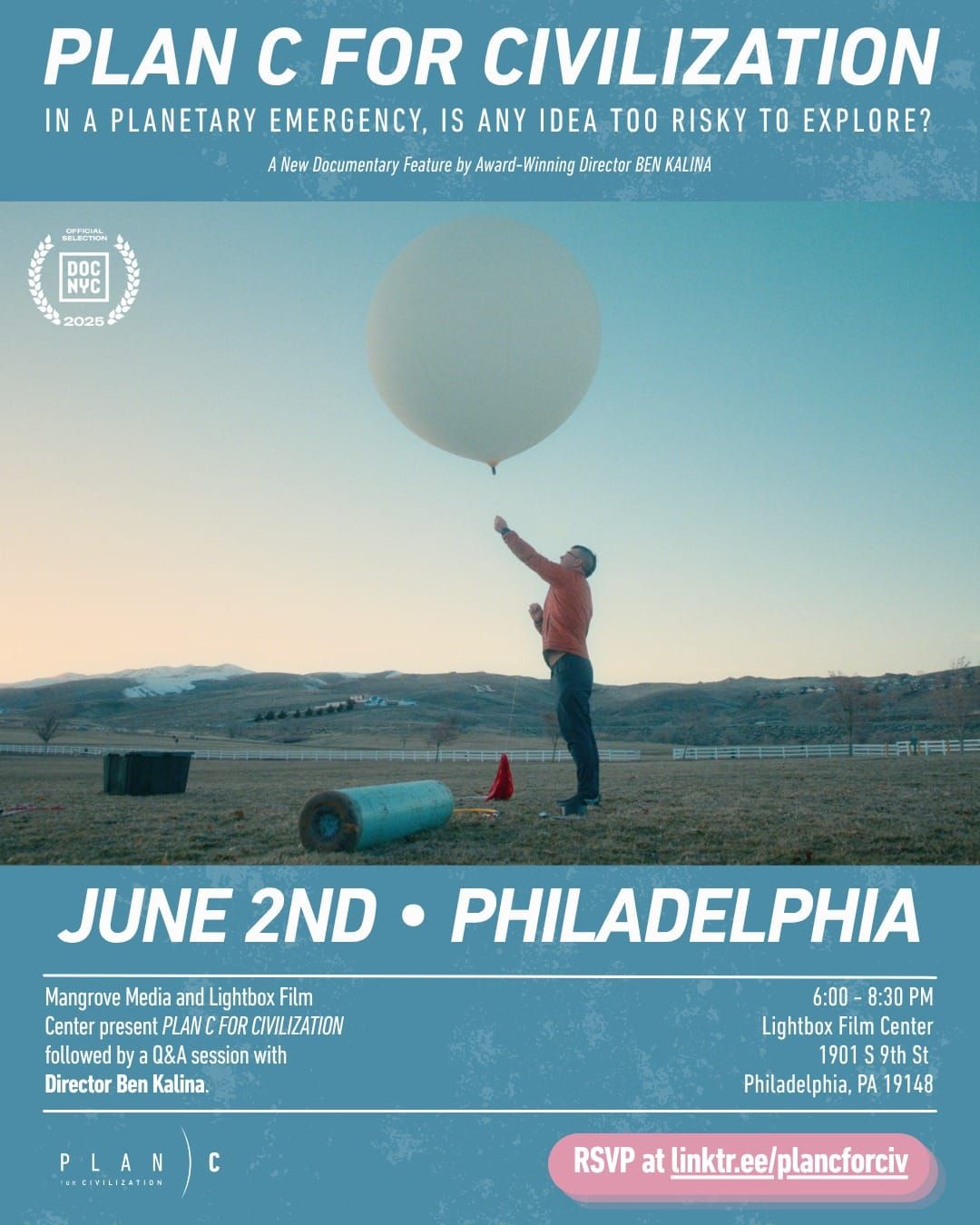
Plan C For Civilization
Lightbox Film Center
1901 S 9th St.
Philadelphia
June 2, 2026
Desperate times call for desperate measures. It is a widespread belief among many climate scientists that humanity has passed its point of stopping climate change and that the best we can do now is slow it down. But what if we did something radical, something new, something controversial? How far are we willing to go to preserve the planet for future generations? Is any idea too risky to explore? That’s the question that physicist David Keith posits in Philly filmmaker Ben Kalina’s new documentary, Plan C For Civilization. I caught a screening of that film last night at Bok's Lightbox Film Center.
Described as “part thriller, part wake-up call," the film follows Keith as he attempts to garner support for a divisive scientific practice known as "solar geoengineering," wherein plumes of sulfur dioxide are released into the stratosphere with the intention of creating a reflective shroud of shiny particles that could reflect sunlight back into space. Now, if partially blocking out the sun sounds like a hard sell to you, it’s because it is. Keith faces pushback from the media, politicians, and even fellow climate activists on this subject; there is uncertainty as to how solar geoengineering will affect the ocean, plants, and wildlife. Keith’s research, however, depends on an “all or nothing” approach. In order to implement this form of geoengineering, there would have to be worldwide agreement and participation. The chemicals that would be released in the United States could end up affecting countries across the world. Even if humanity could somehow consent to this plan, it would require a long-term commitment with no proposed end date. If we were to implement this plan and for whatever reason decided to change course, the effects of suddenly pulling back the amount of sulfur dioxide we’ve released would potentially be worse than doing nothing at all in the first place.
When David Keith visited communities in Bangladesh, one of the areas most vulnerable to the effects of climate change, the conversation pivoted from curbing future catastrophe to living through the horrors and hardships of "right now." How do you contemplate complex questions about the future when you're dealing with a day-to-day crisis? Although not comparable to what other areas are already enduring, Philly is also facing pressing problems related to our ever-changing climate. Just this year, we've experienced record blizzards and 80 degree days within the span of a few weeks. In 2023, Philly and much of the east coast were treated to harsh air conditions brought on by Canadian wildfires. Our children's children may not see the cherry blossoms in Fairmount Park or be able to dip their toes in the waters of the Wissahickon if something isn't done right now about the right now — but as we considered those issues from the comforts of an air-conditioned movie theater, I also thought about the unfairness of South Philadelphians like myself and director Ben Kalina talking about permanently changing the same Earth shared with people in South Asia, who have long been struggling just to survive through climate disaster in their communities.
All that said – we have to try something, right? That seems to be Keith’s driving reason for pursuing this contentious research. What we have been doing clearly isn’t working, and it’s time we explore the unorthodox. Keith isn’t alone with this thinking, as the film also follows the adventures of Luke Ismen and Andrew Song of for-profit startup Make Sunsets. Although guided by somewhat similar motives, the tactics of Make Sunsets differ wildly from Keith’s. Whereas Keith spends much of the film meeting with other scientists and at the very least hearing out their opposing views, Ismen and Song spend their time peforming unregulated, dangerous experiments. During the post-screening Q&A, it was revealed that during one of the aforementioned dangerous experiments, the cameraman had to suggest Ismen and Song wear personal protective equipment as they lit piles of sulfur on fire in a sealed hotel room. Their presence in the film presents another question to the audience: if we don’t do something potentially risky now, will someone with an even riskier idea get there first?
Ultimately the film doesn’t seem to want you to pick a side, but rather to engage in the conversation about the various degrees of desperation surrounding climate change, and the directions that despair could lead us. If you are for or against solar geoengineering is the less important question. The important question is: how much risk are we willing to take to combat climate change?
You can attend an upcoming screening and Q&A on June 5th at The Schuylkill Center for Environmental Education.
Find more information about Plan C For Civilization here.


