
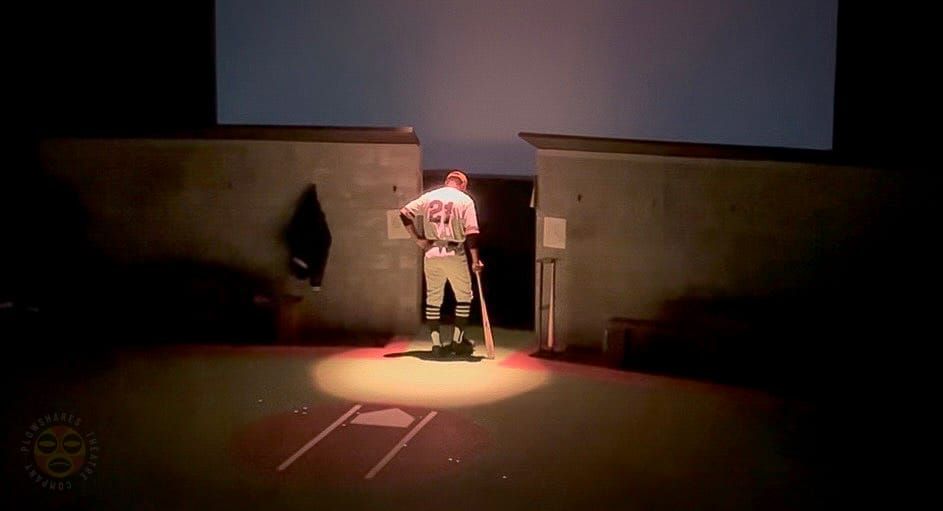
Roberto Clemente: A Diamond Within
Plowshares Theatre Company
Detroit
Through June 28
Everything is connected. If you’ve read enough of my writing, you may be tired of reading me say that, but Plowshares Theatre Company’s production of Roberto Clemente: A Diamond Within warrants a reminder.
The company presented the world premier of the play by Cándido Tirado at Detroit’s Marlene Boll Theatre on June 12. It follows the career of Afro-Puerto Rican baseball player Roberto Clemente, who faced racism from the moment he stepped onto the baseball diamond with a bat hand-carved by his father in his hometown of Carolina.
Clemente played for the Pittsburgh Pirates from 1955 until 1972 when he reached 3,000 career hits. But his run was rife with controversy. As a Puerto Rican man with African roots, he was treated the same as African American players in the segregated United States, who had to wait on the bus while white players ate at restaurants they were barred from entering. Reporters made fun of his accent, exaggerating his pronunciation, and called him hot headed when he got upset over his treatment.
The play centers around the moment Clemente is about to make his 3,000th hit, as he remembers all the tumultuous experiences of his career that brought him to that moment. Despite it all, Clemente never stopped fighting for the equality of Latin and African American players, calling for unity among the two. This brings me to the connection that was so beautifully weaved throughout the play.
When enslaved Africans were taken from, primarily, West Africa, they were transported throughout North America and the Caribbean, including Puerto Rico, Cuba, Brazil, and the Dominican Republic. These Africans largely influenced the culture of the lands they found themselves on. We see this in Puerto Rico especially with Bomba music, which was created by enslaved Africans on the island, and Santeria, a Yoruba-originating religion that was syncretized with Catholic saints. Both appear in the play.
At the theatre, Clemente goes to the ocean to offer prayers to Yemoja and Oshun, Yoruba deities of the ocean and sweet waters, for guidance. Infusing these spirits with Catholic saints was how our ancestors kept their traditions alive to pass down to future generations, since their spiritual ways were seen as “demonic” by white colonizers. The same happened in places like Cuba and Brazil. No matter where these enslaved Africans were taken, they took their traditions with them, and no matter how much the names or practices changed, the relationship to these spirits remains the same.
As (roughly) said by one of the other plays of color on the Pirates in the production, “What’s the difference between an African American, Afro-Puerto Rican, or Afro-Dominican other than where the boats carrying our ancestors dropped them off?”
Recently, I traced my genealogy through ancestry.com, and was surprised that no Indigenous Puerto Rican or Caribbean showed up, while high percentages of West African and European did. My great grandmother is from Puerto Rico, and her husband was from Barbados. The play helped remind me of not only my ancestors’ journey and how their culture changed depending on where they landed, but also how the African diaspora is connected through our collective experiences.
Actor Elvis Nolasco plays into all the nuances of Clemete’s personality and his experiences in major league baseball. We see his frustrations build over his interactions with reporters and his fellow players. We see his dedication to his wife. We see his love for his parents, and his charitable spirit given to those in need.
It’s also fascinating to see nearly all of the actors, except Nolasco, seamlessly play multiple characters. Zahirah Muhammad plays Clemente’s mother Dona, and later his wife Vera, for example.
In the end, Clemente never returns to the baseball diamond. Two months after making his 3,000th hit in October of 1972, he tragically died after his plane delivering emergency supplies to victims of an earthquake in Nicaragua crashed into the ocean off the Puerto Rico coast.
In the play, Clemente leaves his number 21 baseball jersey in the locker room and walks off, leaving his legacy and all of his memories for the audience to grapple with.
Performances of Roberto Clemente: A Diamond Within are held at the Marlene Boll Theatre until Sunday, June 28. For more information, see plowsharestheatre.org.


