
The Revolutionists
Tipping Point Theatre
Northville, Mich.
Through June 28, 2026
Liberté, Égalité and… Sororité? Tipping Point Theatre’s production of Lauren Gunderson’s “The Revolutionists” reimagines key female figures during the French Revolution. Directed by Michael Lluberes, it’s an exploration of women’s rights and hypocrisy during an era that fought for liberty and equality – something eerily relevant in 2026 America.
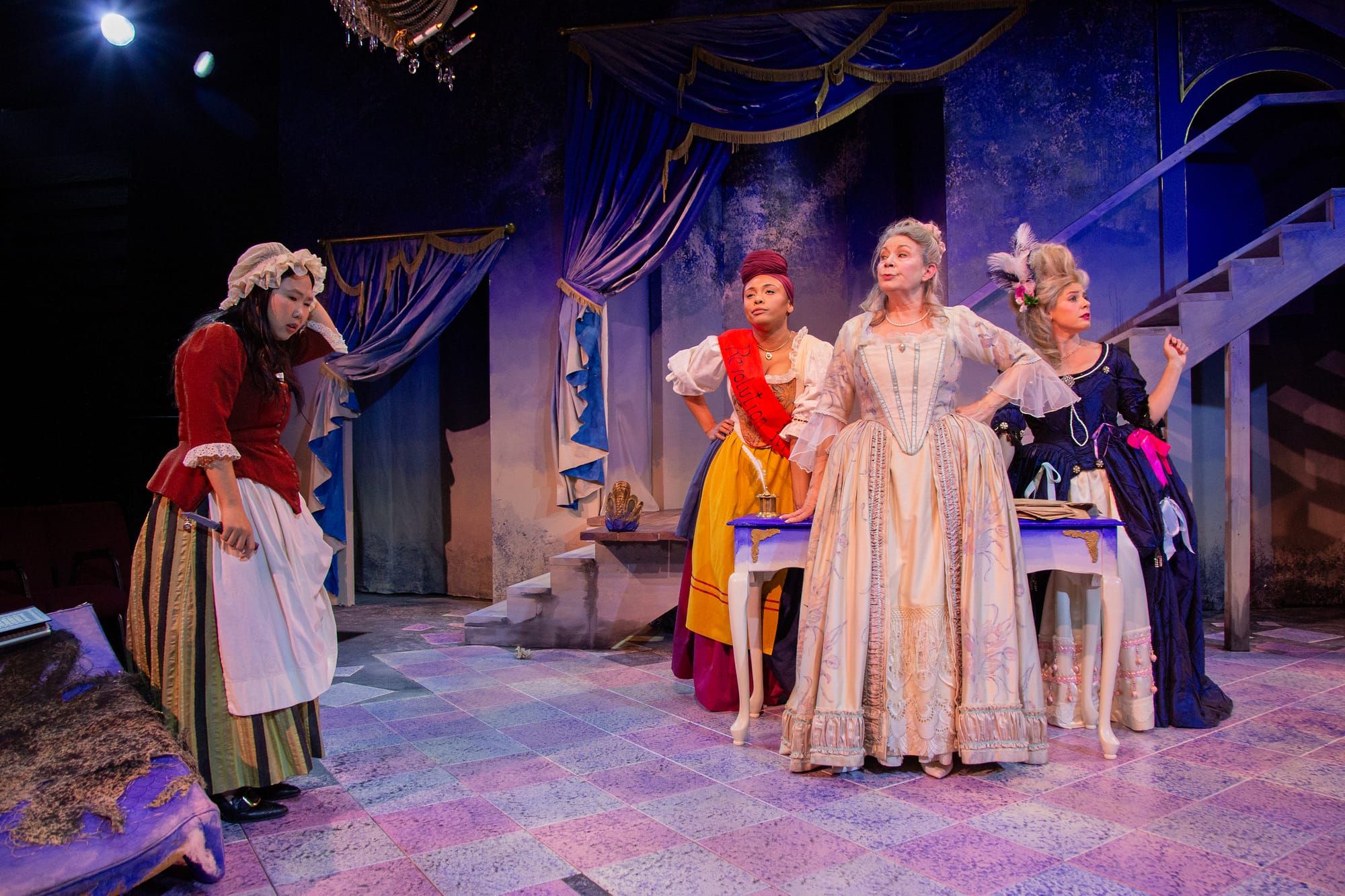
Set in 1793 Paris under the Reign of Terror, four women bond to support each other in a mutual struggle against persecution – under the constant threat of the guillotine. Feminist playwright and political activist Olympe de Gouges (Julia Glander) struggles to write her next play but begins to use her new friends for inspiration as each comes to her – and her power of the pen – for help.
French Queen Marie-Antoinette (Jamie Elvey) wants a more sympathetic portrayal in history. Charlotte Corday (Josie Mi) is searching for the right last words for her successful assassination plot against Jacobin leader Jean-Paul Marat, influential in the political purge of Girondins. Marianne Angelle (Rebecca Rose Mims) – the only fictional character – is a Caribbean freedom fighter and spy based on an amalgamation of historical figures. She asks Olympe to assist her in writing pamphlets for her cause.
The play is also metatheatrical, with frequent references to the role of arts and culture within society. Gunderson herself makes an appearance, identifying as her historic French predecessor, struggling between telling the truth or what she wants the truth to be.
Despite the dire nature of the subject matter, “The Revolutionists,” which premiered in 2016, is a comedy. With modern language – and plenty of swear words (“Pardon my American”) – the characters constantly bicker with one another, each with her own exaggerated personality traits. Elvey gives a standout performance as Marie-Antoinette. With a distinct social class difference from the other characters, she gives a charming, caricatured portrayal of a kind-hearted woman clueless of the struggles of her subjects but who ultimately means well.
Two-hundred-and-thirty-three-year spoiler alert: none of the historical figures survive the guillotine, artfully conveyed by lighting designer Harley Miah. As each character takes to the scaffolding – a symbolic stage – a guillotine-shaped shadow falls upon her before cutting to black, then a bright white spotlight to signify her returning presence as a ghost.
Sarah Pearline’s set is also impressive. Its slanted chandeliers, tattered, overturned wingback chair and half-opened stage curtains are beautifully feminine yet off-kilter with a modern touch. It signifies the sanctity but precariousness of the female space, still relevant today.
“The Revolutionists” examines not only what freedom is but who it is for, and the fight for freedom is not limited to women’s rights. Olympe represents the freedom of speech, Marianne is fighting to abolish slavery, Charlotte’s plot is against a revolutionary extremist who claims to support the Republic. Hundreds of years later, we find ourselves in a less extreme, yet parallel situation in the United States, as we continue to fight for the same freedoms upon which we were supposedly founded. It’s a reminder that these rights are not guaranteed, and we must continue to defend them if we want to preserve them.


