
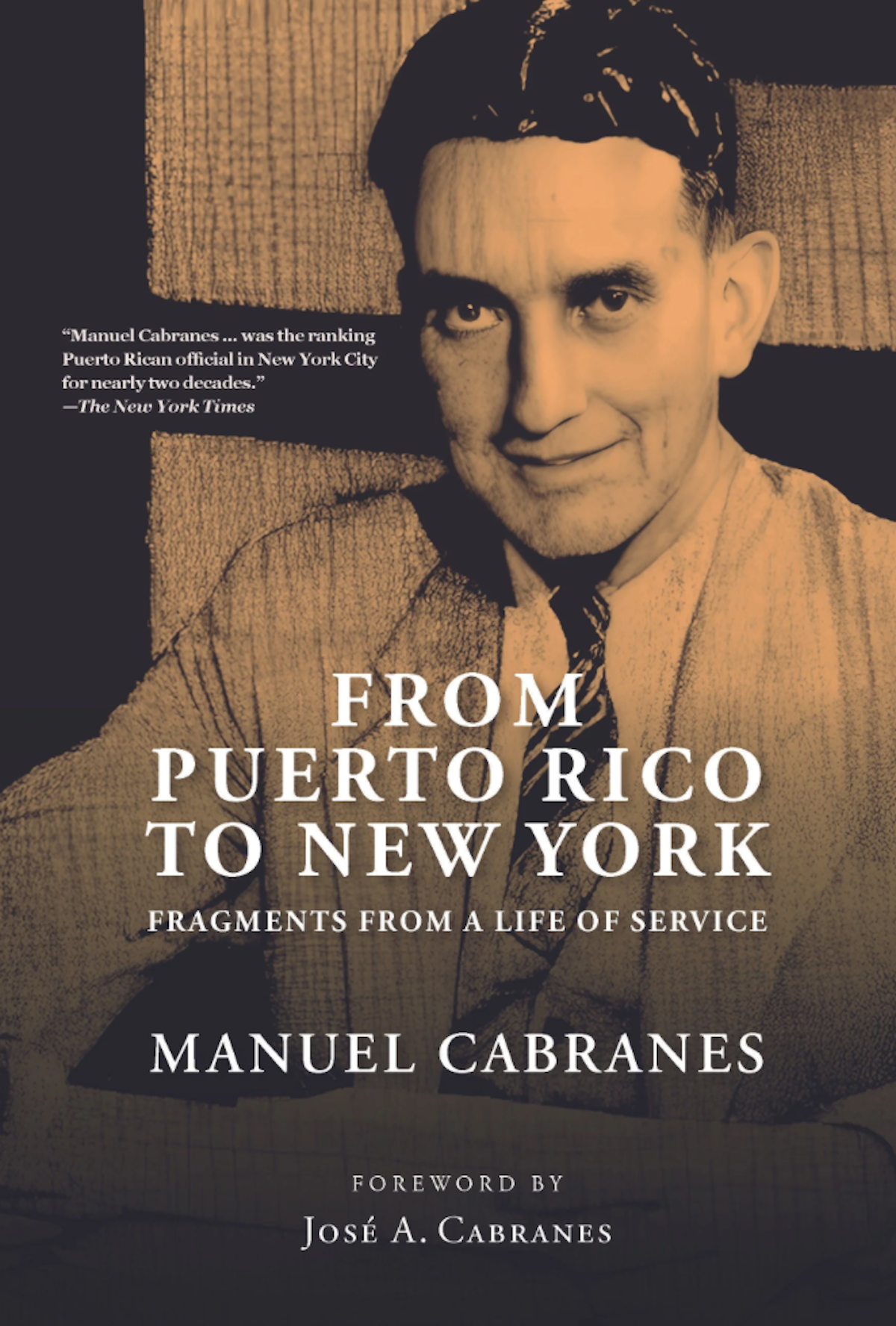
From Puerto Rico to New York
By Manual Cabranes
OctoberWorks
From Puerto Rico to New York, by lifelong Puerto Rican public servant and advocate Manual Cabranes, can be understood as the kind of book that happens when a man who lived an extraordinary life is too busy living it to write about it. It's a memoir told as a series of vignettes that, as his son José—a judge for the U.S. Second Circuit—explains in his preface to the book, "began in 1983 at the behest of his granddaughters (my daughters, Jennifer Ann and Amy Alexandra Cabranes)." But Cabranes "died in early 1984, less than a year after he embarked on this project. He had completed a first draft, in Spanish, which he did not intend to be the finished product. Alas, the first draft became the final draft."
José goes on to explain that he's now himself in his 80s, and "I am prompted to share these fragments of the story of Manuel Cabranes, not only for our family's personal history, but for the benefit of the Puerto Rican community writ large. To this end I have had his memoir translated into English and published in both English and Spanish in the volume you now hold in your hands."
From Puerto Rico to New York can thus be described as an act of love from a son to a father who has passed. But it's more than that. It's a glimpse of a life spent in service, with lots of meaning but no easy answers. There are flashbacks to a history that at times can feel distant, at times close. In its subtle way, it's also a rumination on the impossibility of ever using language, just squiggly lines on paper or a screen after all, to sum up a life.
In the preface, which is key to understanding the book, the son relates that his father was "the ranking Puerto Rican official for two decades," as The New York Times described him, when he died. He was 12 in 1917 when Puerto Ricans became U.S. citizens. He rose from junior high school principal to social worker to administrator, to become consultant to the commissioner of welfare in New York City. He held that position until 1965, when he retired to Puerto Rico and taught sociology. Just as important, he served on boards of various social service organizations and was a trustee. He was even the target of an assassination attempt in 1950 by Puerto Rican extremists.
Very little of the sense of Cabranes's importance comes across in the vignettes he writes about himself; one could argue that the father was rather self-effacing. Instead, there are flashes of insight into the times he experienced and the people he met. His childhood memories are especially sharp. "As a child I had a vivid fondness for roosters," he writes. "I learned from my father how to make paper roosters of different sizes, which I would take to compete with others made by my contemporaries. The stakes were the numbered sheets from the calendar. I delighted in hearing real roosters crow—especially early in the morning when I would wake from my sleep—watching them dominate the henhouse, and even more, seeing them fight." We learn that cockfighting in Puerto Rico was pretty popular, and it was the Americans who banned it when they took over.
Cabranes gives us a sense of Puerto Rico as a place in flux. Different Christian denominations move in, along with their non-Puerto Rican clergy. A sports complex gets built. But there are also stories of gangs in the forest on the road from his town to San Juan, and an uncle who almost dies of tuberculosis. In San Juan, an Italian restaurant puts rice and beans on the side next to the pasta.
"Memories of past experiences surface in my mind like a film reel, mingling with the excitement of my present reality," Cabranes writes. He sees Halley's Comet in 1910, before dawn. He recalls a boxing match narrated over the radio, a town resident who blew a conch shell to warn neighbors of rising floodwaters.
We learn only in passing that he was only 23 when he became a middle-school principal in 1928. He appears to have excelled and tells us he had excellent teachers to work with. He was there when the infamous 1928 San Felipe hurricane ravaged the island and didn't spare his school. Not having the money for repairs, they lived with broken windows for months.
Cabranes is no political firebrand. But the tension in what feels like a dual nationality winds all the way through his story and the way he tells it. He's awarded a scholarship in 1931 to study social work at Fordham University, and he goes. As he relates the journey to New York from San Juan, "during the day, I would gather on deck with a group of Puerto Ricans who had boarded in San Juan and were headed to various destinations in the United States, as well as with some Americans." The sense of distance creeps in around the edges, as when he's dazzled by New York City and sees the inauguration of the George Washington Bridge. "I still remember that clear, hot morning and how strange I felt among the crowd, being the only spectator wearing a white suit and a Panama hat," he writes. He sees snow fall for the first time that winter. He also connects enough with Puerto Rican politicos in New York to be among the entourage attending Franklin D. Roosevelt's inauguration.
He finds plenty of time to enjoy himself, and his prose quickens with the telling. "In those difficult times of depression and prohibition, Puerto Rican friends, longtime residents of the city, managed to have fun for little money. Walking with one or more of them on a Saturday night was like accompanying Alice in Wonderland," he writes. "Here, the speakeasy where those who wanted to drink would buy gin or rum; over there, the Hispanic family that to help themselves, offered a dance and dinner in their home, and finally—if there was still energy and room in the stomach—a visit to Father Divine's heaven in Harlem. This colorful character had his base in Philadelphia, where he lived surrounded by adulation and pretty girls. On one occasion, my friends took me to a large basement in Harlem where, according to them, Father Divine would preach around midnight and then serve a buffet, a gift from him to his followers and other attendees. This time, however, the event was canceled, apparently due to Father Divine's indisposition, so I did not get to meet him in person. And I never again thought of sticking my nose into that place."
Cabranes' sense of dual loyalty to island and mainland shapes his professional as well as his personal life. When he is evaluated at the end of his social work training, it's remarked that "I always wanted to make a good impression, and the people with whom I came into contact accepted and appreciated me ('like me much'). However, 'probably due to my loyalty to Puerto Rico and its people' .... I 'occasionally acted to the detriment of those relationships.'" In a harbinger of his later advocacy, he defends Puerto Ricans in class against professors who denigrate them. But "I was not, nor had I ever been, a nationalist," he adds. Walking the middle path sometimes feels like a tightrope.
After his training, Cabranes returned to Puerto Rico, started a family, and moved back to the Bronx to become executive director of Melrose House, a settlement house for newly arrived Puerto Ricans. His career rode the wave of The Great Migration. "In the Bronx and throughout New York, there was increasing emotion and anger about the growing presence of Puerto Ricans," he writes. His view of the migration isn't blind to its complications. He sees more established Puerto Ricans taking advantage of new arrivals. He advocates for Puerto Ricans to the media and to social service agencies at the same time he butts up against mores in his own culture. "From an Argentine Jew, a hardware store owner, I heard an observation that seemed accurate to me," he writes: "The attitude that limits the opportunity for Puerto Ricans is their lack of perseverance. Puerto Ricans get discouraged very quickly. They do not insist on achieving what they intend. If they do not get what they want the first time, they do not go back and try again."
In 1947 he became head of the Puerto Rican government's Employment and Migration Office in New York. His experience there was "vast, useful, and thankless"—the third adjective there offering a glimpse of the difficulties to come. He "came to understand even more the way of life and the despair of so many compatriots who moved to the New York metropolis with the intention of settling there, but lacking the necessary tools to integrate into that society," among those tools being English, job skills, education, and in his view, determination.
He continued to find himself a representative of Puerto Ricans to the media, explaining their difficulties, the obstacles they had to overcome. He got involved in the rights of farm workers, who were working for little to no pay. But he also made enemies within the Puerto Rican government. When he moved to the city government in 1951 as assistant secretary of Commission for the Foster Care of Children, Puerto Rican government officials sought to undermine him. Cabranes holds this up as an example of "the cruelty of Puerto Ricans to other Puerto Ricans," akin to the way he saw entrenched countrymen take advantage of new arrivals.
Perhaps most poignant, the era of his career meant that he also witnessed the decline of the Bronx, a neighborhood he had poured so much energy into. "It was once a splendid, large community, made up of citizens from different cultures and social strata—generally orderly, simple, and hardworking people," he writes. "Many people of goodwill, both individually and through their organizations, endeavored to avert the chaos that threatened to destroy it. They failed. After a generation, the Bronx had become rubble. I doubt it will ever be what it once was."
At no point in the vignettes does Cabranes attempt to tie it all together, to make sense of his life, to explain what lessons he learned. His son José perhaps knows better than to do that for him. As the son relates, as rich as his father's vignettes are, they offer "mere glimpses of the full picture of my father and his life, times, and views." He adds that "perhaps no amount of time or words would have sufficed to capture the richness and vitality of my father."
What's most telling, perhaps, are the omissions. It says something that the father tried to write something like a memoir very late, too late, in his life to finish. It means something, too, that the son in his own old age chose to flesh out his father's story rather than telling his own. At the same time that José seeks to preserve the past, he's all too aware of the way the family history is slipping from his grasp. It's a rooster that doesn't want to be caged. It runs around the yard, doing what it wants. We're left to reconstruct an image of the bird from the feathers it leaves behind.


