
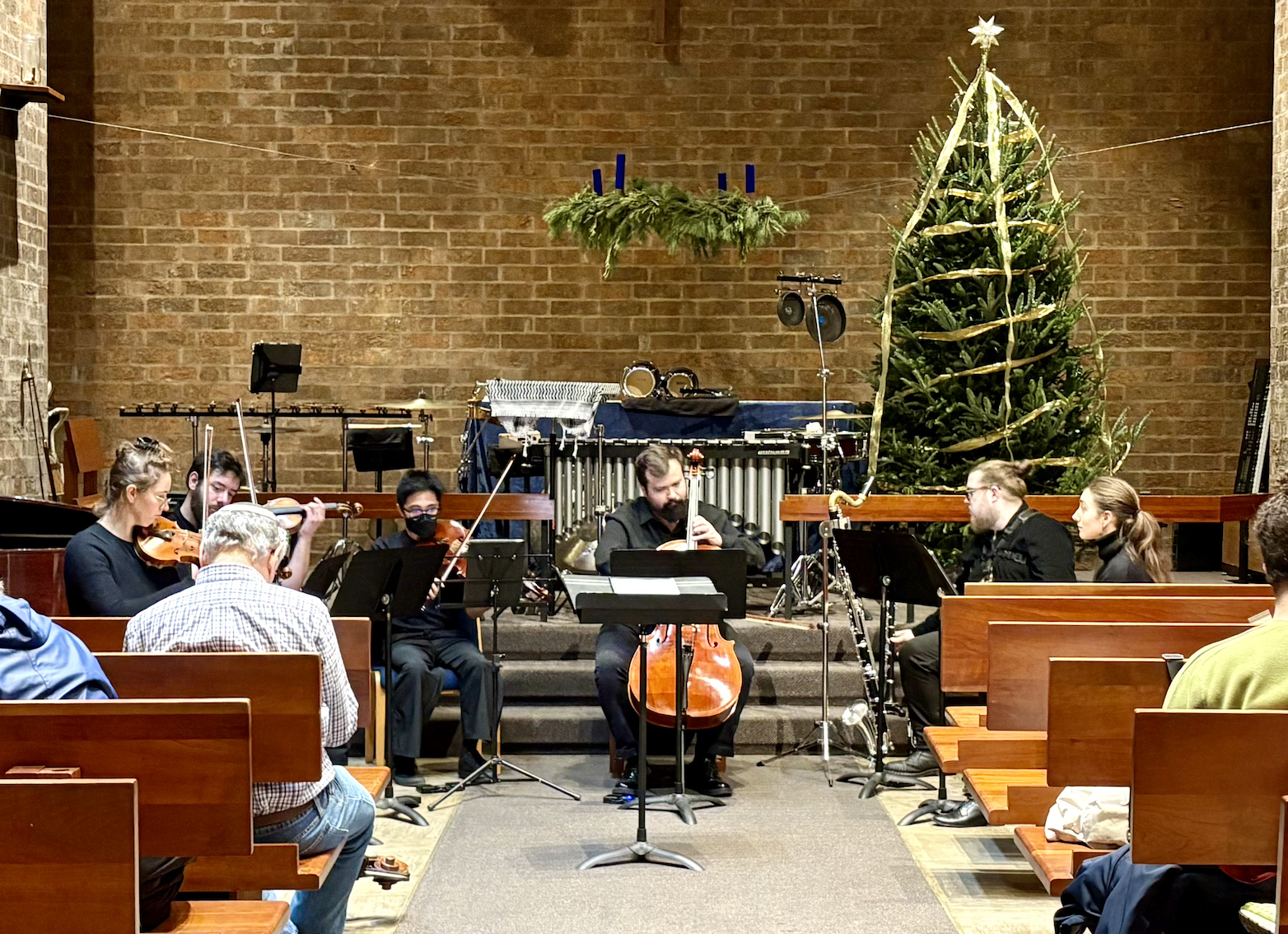
Bowerbird Presents: BlackBox Ensemble
University Lutheran Church
3637 Chestnut St.
Philadelphia
Dec. 6, 2025
Saturday night, Bowerbird presented The BlackBox Ensemble at University Lutheran in West Philly. The ensemble was a shifting group of ten musicians and one conductor, all dressed in black; over the course of the program, comprised of five contemporary compositions – most from the past three years, the oldest from 2019 – the ensemble expanded and contracted as needed, never utilizing the entire group at once. (You’ll forgive the use of the phrase “musical chairs,” but that’s literally what we got between pieces, generating authentic buzz as to who would be playing what next.)
The audience, somewhere between 35-45 people, included the composer of the third piece, Baldwin Giang, a Philadelphia native now based in Seattle. (Giang briefly took to the stage to give an improvised introduction to his piece, which included the mandatory “Go birds!” It was a possible classical-music first. Suck it, Seahawks!) His butterfly, posthumously (2022) was a vividly-drawn re-imagining of the denouement of Puccini’s famous Madame Butterfly, in four parts, delivered in the form of letters written by Cio-Cio-San, sung (and, very briefly, spoken) by the soprano Amber Evans. Evans was exceptional and breathtaking in her role, singing with a power that spiked at the outer limits of her register in the third section; the concluding fourth, with its plucked, creeping two-note cello pattern like cautious footsteps in the dark, landed with tense, unyielding finality. Giang’s writing was intensely evocative, with unsettling, complex harmonic language and a sometimes macabre approach to sound, the pianist Matt Schultheis running metal rods (including a tremolo bar nicked from an electric guitar) across the innards of the piano, clattering against the tuning pins.
The preceding piece, Nathalie Joachim’s I’m Right Here (2023), was my favorite. Opening with spectral bells, high, sustained piano and a three-note flute ostinato gliding trippingly over it all, like a dragonfly parsing flight paths, the music was vibrant and robust, a dynamic, tonal wonder of shifting landscape, with percussionist J Clancy summoning quaking rhythmic terrain at its peaks. Those three notes – short and stressed, a musical mirror image of the piece’s title – came and went, passing hands among the players – sometimes dramatic octaves on the piano, sometimes bold bowing, sometimes a quick, unexpected return, flickering like a sudsy hiccup interrupting a long-held breath. It was the through line and the emotional heart of the piece, a reassuring I’m-right-here, not-going-anywhere comfort, refusing to slip into memory.
The final piece – mil cuartos blancos en linea recta (2023), by James Díaz (a PENN grad), which translates to “a thousand white rooms in a straight line” – was introduced by conductor Leonard Bopp as a sort of process-based work, one where the ensemble would skate along in linear fashion from measure to measure, cell to cell, in “a maze-like journey through the piece." There was, indeed, an anxious, edge-of-your-seat feeling, which came and went. It had wonderful effects – I’m thinking particularly of the fierce, zap-y multiphonics and bent trills supplied, grippingly, by the bass-clarinetist Tyler Neidermayer – but I ultimately felt weirdly outside of the work, like I’d witnessed not a human performance but a mechanized demonstration or imitation of one. I felt something, sure, like when the final dying sound was the piano ringing out an E chord – just as The Beatles’ “A Day In The Life” ends, almost definitely a coincidence – a strange consonance that felt like freedom, like escape.
But for me, the piece itself had a lot less heart than everything that preceded it. Maybe it’s just that an explanation upfront dilutes something about the soul of the thing by tacitly encouraging me to think about the architecture throughout the performance, sort of like a magician explaining the trick first. Nobody wants that. I want to be taken somewhere where I forget there’s anything “tricky” about it at all; the thrills were tethered to a consideration of design that kept the edges from ever feeling properly dangerous. When it’s dark and you can’t find the light, you feel for the walls. This felt like the walls imposing themselves on me before I could reach out.


