
By Allan Appel
From fossilized footprints of a Dilophosaurus — our very own Connecticut State Dinosaur! — to mounted mallards in the splendid dioramas of the Connecticut shoreline, a visit any day of the week to the Yale Peabody Museum is always a tour through time.
In their newest special exhibition, “About Time: Measuring the Natural World” — which opened this week and runs through the summer of 2027 — the museum is inviting us to take a wider and perhaps even deeper dive.
In three easy-to-navigate rooms, created in consultation with New Haven Public Schools (NHPS) teachers, the ambitious special exhibition presents fossils and other messengers from the deep past that endure among us and. In the words of the curators’ invitation, the exhibition asks you to ponder how “human beings have wrestled with the most ephemeral thing we have — Time.”
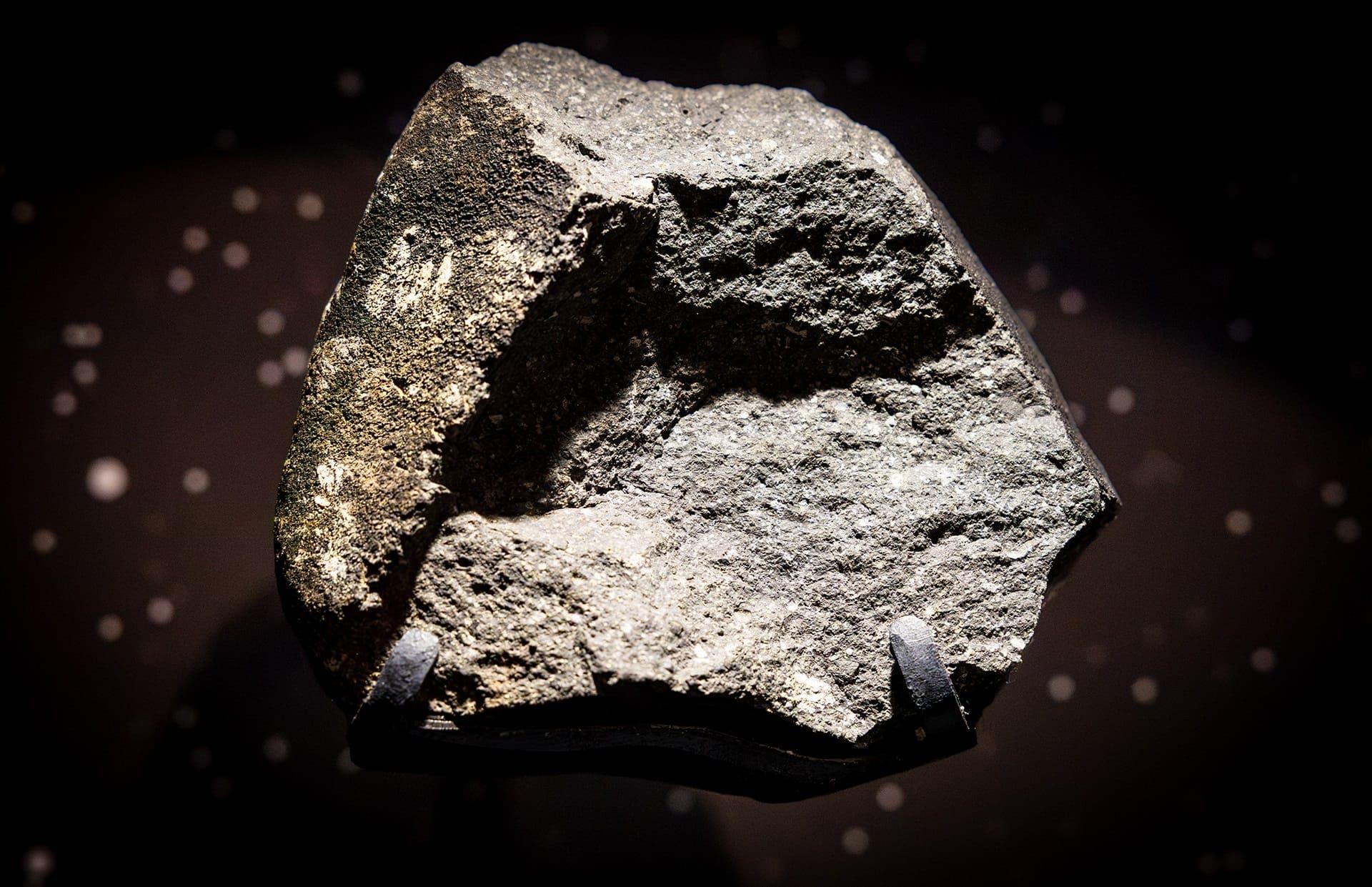
Although a jaundiced eye might say they look like bleach stains on a grey T-shirt, my favorite messengers in the exhibition are a truly awe-inspiring array of white specks that greet you, if you peer closely enough, on the inside face of a fragment of some of the 4,000 pounds of meteorites that fell at Pueblito de Allende in Chihuahua, Mexico, in 1969.
Scientists like the Peabody’s Jay Ague, professor of earth and planetary sciences at Yale, date those specks to 4.5 to 4.6 billion years ago.
The specks, he explained, are technically called CAIs, or calcium aluminum inclusions, and represent the first coming together of disparate minerals and elements from the flying specks and dust in the wild universe whose fusion began to create planets, a process that has resulted in the creation of nothing less than our solar system itself.
In short, you’re standing in front of the earliest evidence of the moment our world was born.
If you wear a hat, here’s a place you should probably take it off.
No wonder even someone who lives among these materials, like Ague, said, “It’s awe-inspiring.” Especially, he added, when he holds the objects in his hands.
While these Allende meteorites have been exhibited before, Ague said, this time it’s different. Placing them in this context — they represent billions of years of time travel from the past while what you view juxtaposed in adjoining rooms (fossilized sea urchins, botanical trout-lillies, bird and other fossil deposits) represent merely millions — all that cumulatively delivers a new and, if you’re open to it, even a spiritual perspective.
For example, the various ways our human ancestors have tried to keep track of all this time and measure its scale, which an introductory display gathers in the form of clocks, watches, hourglasses, and 19th century chronometers, seems, in perspective, extraordinarily humbling.
The Allende meteorites on display are carbonaceous chondrites, the oldest and “primitive” among them, Ague further enthused. What is further remarkable: “They also contain amino acids.”
As amino acids are the base of proteins, this reporter was eager to get Professor Ague on record as declaring this was evidence of extraterrestrial life!
A scientist, he wouldn’t go there, but he acknowledged the meteorites do contain the “potential building blocks of life.”
While the CAIs, from 4.56 billion years ago, grab the attention on the fragment, so does what’s known as the dark fusion crust on the outside of the rock.
It represents the “melting,” he said, “on the way to the earth.”
In other words, the specks are 4.6 billion years old and the crust is the infinitesimally smaller 57 years old. That they are part of the selfsame extraterrestrial visiting object captures the geological and scientific drama of it all.
That is, the radical change of scale the exhibition wants you to ponder as you move through galleries, and through Time.
Other highlights include a “living” fossil represented by specimens of ginko trees, that is, a species that has largely gone unchanged over millions of years.
And contrast that to the Peabody’s important collection of crabs collected from Long Island Sound since the 1850s. There a species is altering rapidly and you can look to environmental factors as potential accelerants of change.
Triggered by new thinking in the wake of the Peabody’s major renovations in 2024, all ten divisions of the museum contributed to the effort, said Associate Director of Exhibitions Kailen Rogers.
“It’s framed around Time, and its workings in our collections,” she said. “And how you think about the history of Earth.”
There are no human fossils in the exhibition — it is a Peabody policy not to display any — but an inescapable additional takeaway is also what a relatively small amount of all this Time humans have participated in on the Earth. And yet, for better and for worse, what an impact!
The exhibition runs through Aug. 9, 2027.
Click here for a full description of “About Time: Measuring the Natural World,” and for notices about the public programming to come, in time.


