
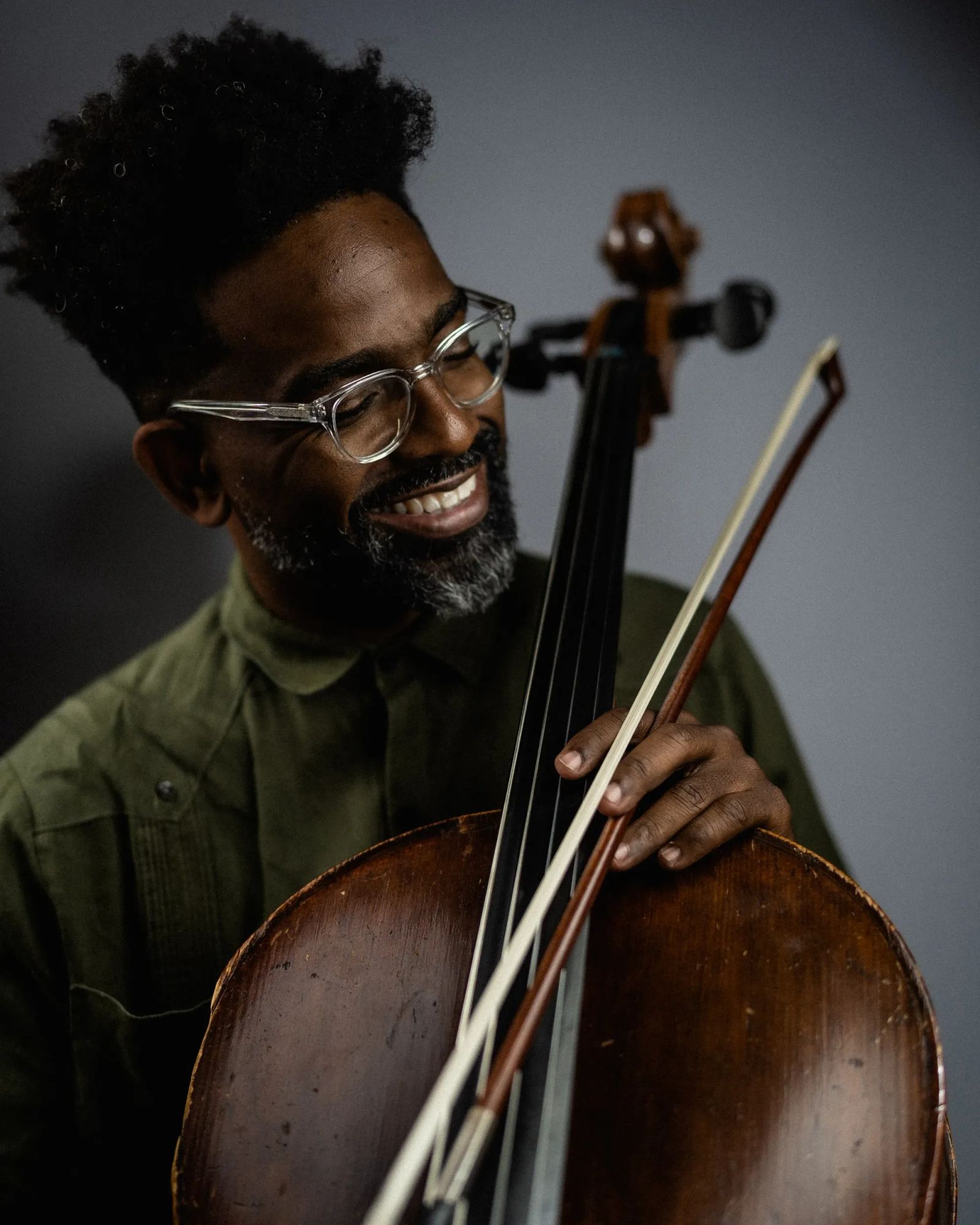
OK Cello
Shubert Theatre
New Haven
Jan. 8, 2025
At a sold-out show at the Shubert Theatre's cabaret space on College Street on Thursday night, almost everyone in the capacity crowd had their eyes closed. In the middle of the thick semicircle of chairs, Okorie Johnson, or OK Cello, improvised a melody over a waltzing chord progression he had played into his looper. The audience's eyes were closed at Johnson's request; he had asked them to conjure a movie in their minds that his music was the soundtrack to. At the end, he asked if anyone was willing to share what they imagined.
Hands shot up. One person talked about taking a walk with her grandchild. Another recalled an adolescent memory of borrowing her mother's shoes to go to a dance, and her mother finding out and punishing her by making her peel potatoes. Another person spun out a tale of animals eating other animals, the circle of life.
Johnson was thrilled. "This is the coolest thing about art and community," he said. Together in the room, "we're all having these personal experiences, but we usually don't get a chance to hear them."
In every moment of his performance — whether he was playing or speaking — Johnson displayed a winsome and uncanny gift for connecting with his audience, whether he was telling a self-deprecating joke, enthusiastically declaring his love of music, or making a substantive, empathetic comment about the fractured state of the country. His funny and heartfelt show perhaps found its ideal setting in the Shubert's cabaret, a small enough space to feel intimate, but large enough for a full house to feel like a community.
"It is an amazing way to start 2026 with a sold-out show," said Anthony McDonald, the Shubert's executive director at the beginning of the evening, noting that the theater's cabaret space is now officially a year old, hosting jazz shows, community events. "We have been trying things out, seeing what sticks, seeing what lands. Clearly this show connected with you all." The next events at the cabaret will be a trivia night on Jan. 27, a paint and sip on Feb. 7, a documentary screening on Feb. 18, and local singer-songwriters on Feb. 19.
"This is my first time in Connecticut ever," said Johnson, and the crowded cabaret was "a wonderful welcome." He then introduced himself: "I'm a cellist. I'm a looper. I'm a storyteller and composer," with his music being "largely informed by the African diaspora." He advised the audience that his would not be a classical concert and would involve some participation. "There are no safe seats in my audience," he said, getting a laugh.
He began with a composition called "Fire," for which, he said, "you should imagine a small flame growing into a towering inferno" and then diminishing again. He also added a small nod to current events, as if testing the waters. "This is a hard time," he said, and "I'm just going to play a small prayer to get us into the show."
He bowed a single note, then an octave above it, and a fifth, a simple musical declaration that he developed fast into a searching, urgent phrase. He then plucked an intricate pattern into the looper that he first used as the basis for floating musical ideas, then used to build a stack of harmonies that thickened and melted away again. A sharp break to return to pizzicato, and he was done.
"How many people saw the fire?" he asked, and got enthusiastic murmurs from the audience. "Did you at least hear the alarm?"
He explained to the audience how the looper worked, both to repeat a single phrase and to overlay phrases. "I can record over and over until I have a whole orchestra on stage," he said. "Can we give the looper some applause? It thinks it does all the work and I get all the love." But the truth, for Johnson, was that cellos and loopers were made for each other. "Whoever made the cello 500 years ago didn't know they were making it for the looper, and whoever made the looper in the 1970s didn't know they were making it for the cello, but they're a perfect match."
This was so because to Johnson the cello had "five instruments" in it. It could be a small bass, a set of drums, a guitar, a church organ, and a lead saxophone, he said, demonstrating as he went. "All this is right there in the cello," he said, and with the looper, "I get a chance to explore what the cello can do, not what the cello has done."
As evidence, his next composition started with a plucked bass line Curtis Mayfield may have appreciated. He added percussion and a plucked guitar part. Next, a simple melody. Improvising a verve, he returned to the chorus to suggest it needed words, eliciting them from the audience. Within a few seconds, the audience was singing "New Haven is a fun place to be." Johnson fed their voices into the looper as well. The audience was now with him, ready to go with him on whatever musical journey he laid out.
He decided, for the next piece, to go "heavy," he said. "We live in a complicated world right now, so I think we can hold heavy." He told a story of a Trinidadian couple that moved to the United Kingdom. "They thought the streets would be paved with gold," he said. "That found that it was not that. It was classist and racist. And it was cold." But they persevered and had a daughter, and that daughter went to college. The parents felt they had at last arrived in British society, and the mother bought a tea set. The daughter didn't like that, Johnson said; she associated it with colonialism, the powers that oppressed her parents in the first place. Which meant that one day, when the daughter accidentally broke one of the teacups on a visit home and faced her mother's wrath, she responded with a argument of her own.
"To be honest with you, there's nothing more to the story," Johnson said, to laughter. But it inspired him to write a composition that featured dueling voices, set to a texture inspired by the Police. "I love the Police," Johnson said, but couldn't help noticing early how much they had borrowed from Black music, and reggae in particular, and got bigger than any reggae act over it.
"I used to be an English teacher," he added, "if you were wondering why there's so much talking at a cello concert." The stories and the music kept coming.
At the end of his first set, Johnson offered his first cover, of U2's "With or Without You." He explained that he loved it as a teenager, with its lyrics about a painful relationship. As an adult, however, he had come to understand it as "a love song to our country," he said. "We are in a toxic relationship with each other," and "half of us would like to throw the other half out of the boat. But we can't." Why did we stay in it then? Maybe, he ventured, "we're also hoping for a sweetness we have never known." And "if there is optimism, there is perhaps a chance."
Johnson's second set opened with a piece he wrote for an aerialist duo to be performed at a festival. But, he explained, he cut his teeth as a performer by playing on the street, where he honed the craft of getting people's attention quickly and holding it. Setting up two baskets he got from the audience, he explained to the audience that he would play a game; if he could get anyone to laugh, they should put a dollar in one of the buckets — even if, he said graciously, the Shubert was already compensating him just fine for his time. The audience was game for his game, and he looked out over the crowd, seeing who he might hook with a song. "My Favorite Things" got a dollar, and "Heart and Soul" and "Jaws" got a few laughs, but the money started coming in for Corey Hart's "I Wear My Sunglasses at Night," the Diagable Planets' "Cool Like That," and music from Star Wars. He ended that segment by getting the entire crowd to sing the first verse of "Stand By Me."
His deft weaving of politics into his craft reached its apex with a composition of his that was a reworking of the theme song to the famous sitcom All in the Family. "I don't know why I do a song that requires me to embarrass myself," he said, to laughter. He loved the song, but "I can't be a Black man in 2026 going around singing, 'Those were the days,'" even as, he knew, the lyrics were ironic even when All in the Family was on the air a generation ago. The melody, meanwhile, partook of the Great American Songbook and jazz, a quintessential Black art form. He realized all he needed to do was tweak the lyrics — to "these are the days" and "we are the ones" — and while he was at it, he could decontextualize and reharmonize the melody to bring out its West African roots. The result was a revelation.
"Days like these make it harder to believe that these are the days we've been waiting for," he said at the end. "Days like these are not new. But we are."
He used his last piece, "Liminal," to explain how he had been between two worlds since he was a kid. He grew up in a Black middle-class neighborhood in Washington, DC but went to a posh high school in Bethesda. He loved Beethoven and Prince. So he grew to love the word liminal, which for him meant being "no longer what you once were, but yet to become what you are becoming." Existing in that between space, he said, in time came to feel like a superpower: "to see beauty in lots of places," he said, to "speak truth to power," and to "be comfortable in your skin." By the end of the night, he had made sure everyone felt comfortable being in theirs, too, together.


