
What a Glorious Clash They Made: Music from Connecticut During the Revolution
Windsor Public Library
Windsor
Aug. 24, 2026
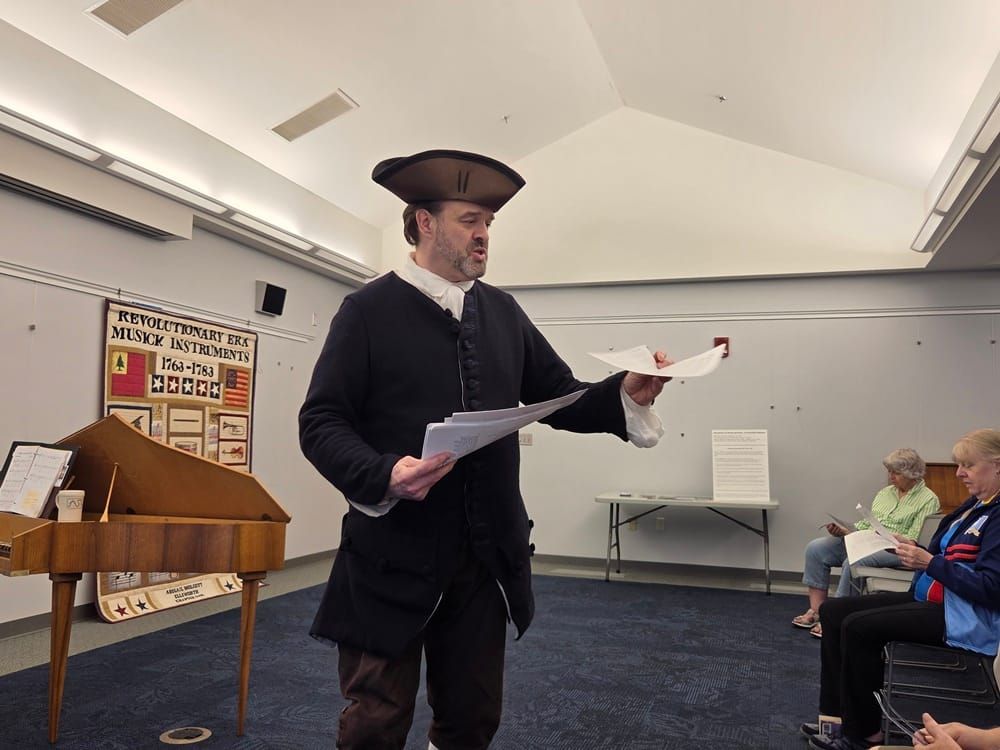
Richard Donahue was already at the harpsichord when I entered the meeting room at the Windsor Public Library, even though I was 15 minutes early. He was dutifully playing as the gathering audience milled about. Five minutes before the program began, he moved to the back of the room and gathered some papers.
Six-thirty came. Donahue put on his triangle hat, and became a revolutionary bard.
He burst into song immediately, walking through the aisles of the seating area and passing out broadsheets with the lyrics of his songs, a helpful touch. He had launched into a song appropriately titled “Liberty Song”:
Come join hand in hand, brave AMERICANS all
And rouse your bold hearts at fair LIBERTY’S call
No tyrannous acts, shall suppress your just claims
Or stain with dishonor America’s name
Donahue has a booming, but not overwhelming, voice that helped imbue the patriotic songs with the energy and force that must have been on display in taverns and meeting halls across the colonies.
He speaks energetically about the era when he’s not singing. The concert was also a history lesson about Connecticut’s place in the Revolution, and the songs Donahue performed reflected those that were sung in Connecticut during the era.
Donahue has done extensive research to preserve the accuracy of the songs as much as possible, linking lyrics with popular music of the era to provide an authentic experience. I liked the use of the harpsichord as his accompanying instrument, compared to similar programs that use era-accurate string instruments.
The history of the songs themselves was as fascinating as the colonial history. Americans had a habit of stealing British songs and repurposing them for our own uses. At the time, they were referred to as “new songs,” something we might today recognize as a remix. One such example is “A Song,” which demonstrates both the theft of British music– in this case, "God Save the King"– and the penchant to cram a bunch of words that don't fit into a song.
I enjoyed Donahue's expert use of the language of the era. For example, when he spoke about the Founding Fathers from the perspective of Americans, he called them “revolutionaries.” However, when he spoke about them from the British view, he referred to them as “rebels.” It’s a small touch that helps build the world of the performance for a pedant like me.
I asked him a question about the pronunciation of the “ei” sound in his singing. He lit up, saying that discussing the language of the Revolution was one of his favorite topics. He explained how words and sounds were in fact pronounced differently in the colonial era. For example, the name of our nation was said differently. Donahue shared that Benjamin Franklin and others went so far as to try inventing a unique American language that codified these quirks and got rid of the letter C (a crusade I sympathize with).
The writer and the music fan in me enjoyed Donahue’s presentation. The summer of our 250th birthday is coming to a close, but people like Donahue will continue to tell the story.
NEXT
Jamil returns to the Old State House for a jazz concert.


