
Open Studios
Wábi Gallery
Through April 17
New Haven
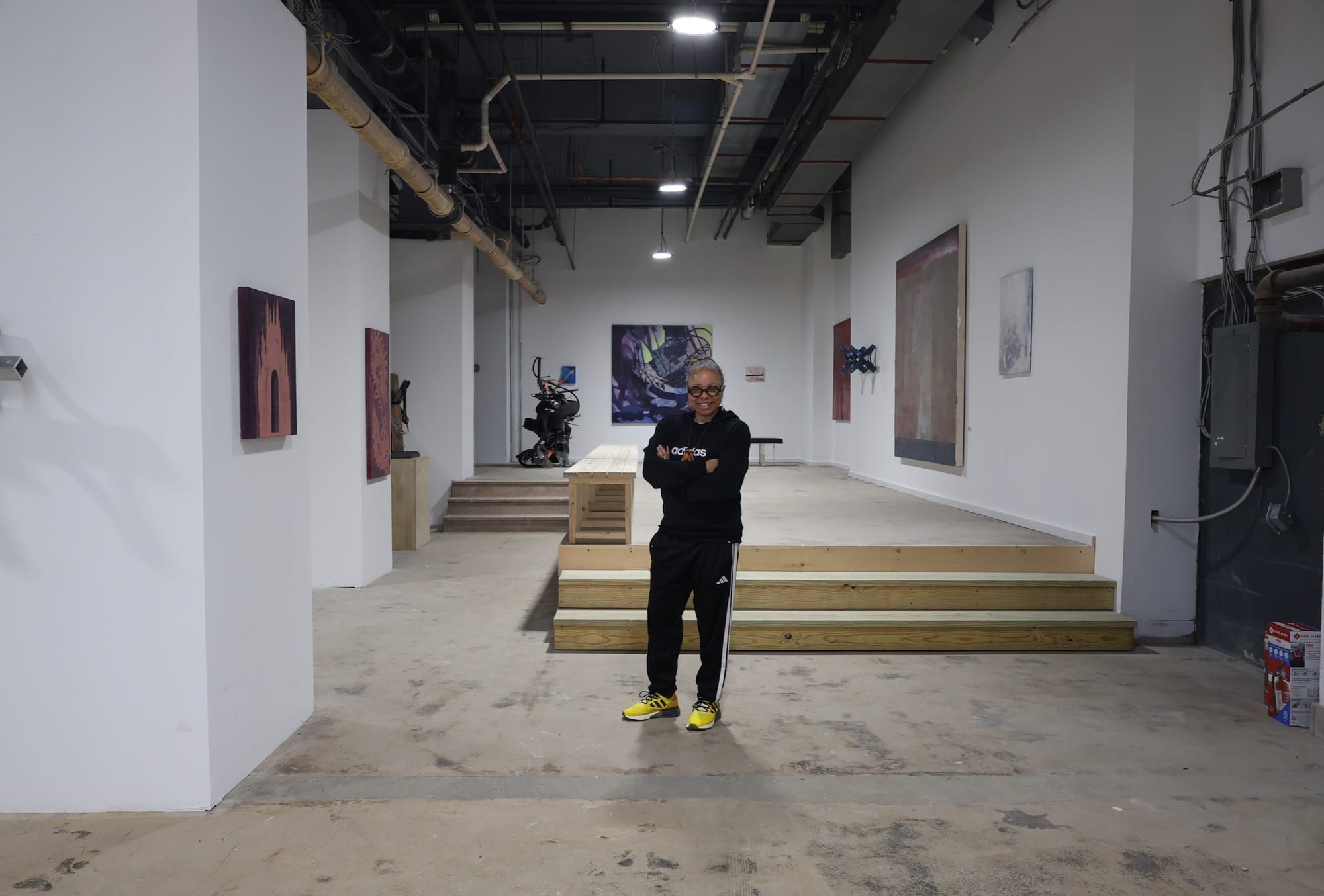
Artist and Wábi Gallery owner Kim Weston surveyed the art hanging on the fresh walls of her own gallery — for the first time, a physical space at 126 Court St. in downtown New Haven. The artists on display — Hazel Özgür, Moshopefoluwa Olagunju, Kika Serna, Lucía Reissig, Bryan Fernández, Inka Mani, César López, Shanique Emelife, and Mark Anthony Wilson, Jr. — were all associated with Yale's visual arts MFA program. The show was part of their open studios event, in connection with other open studios events at NXT HVN and the Ely Center of Contemporary Art. So, Weston said, "it's not my show, it's their show." But the fact of having a show in the Court Street space, she said, been "five years in the making."
When Weston bought the Court Street space five years ago with money her mother left her, it was raw and unfinished, requiring a near-complete rebuild, and "was packed with a bunch of stuff," Weston said. Weston didn't have any construction or repair money on hand. But "over the years, I kept doing it, a little bit" at a time, she said. She enlisted architect Eric Epstein to develop a vision for renovating the space. She put proceeds from her own art sales into the project. She assembled a network of small donors, and got money from the William Graustein to "start fixing it up and getting it to where I needed it to go." Another grant, from the Pincus Family Foundation, enabled her to keep her youth photography program going at the same time. Meanwhile, Weston was involved with mounting shows at other places in town, including Creative Arts Workshop, the former co-work space Known on Orange Street and the Ely Center of Contemporary Art, before it lost its own space on Trumbull Street.
Weston always intended Wábi Gallery to be a "space to showcase up and coming artists" who are "invested in their careers" to have a "professional presentations of what they can do." But the Court Street spot is also a response to New Haven losing downtown spaces to show visual art, including Artspace, Known, and the ECOCA, which has now moved to Fair Haven.
"I'm an artist," Weston said, and "I know how hard it is to create safe spaces for people." She credited her training at the International Center of Photography-Bard with teaching her how to not just build her own photography practice and career, but make opportunities for others. Originally from New York City, she has found New Haven to have "wonderful roots" and to be "a good place to ground ... to be who I am as an artist, an African, American, indigenous artist."
For her first show, Weston reached out to a group of artists a generation younger than she is. That connection began with New Haven-based artist Olagunju, who is also a student in Yale's MFA program. Olagunju, who runs Omola Studio, is a kindred spirit to Weston in making opportunities for other artists, having done shows at Artspace, Known, the Blake Hotel, 91 Shelton, the Ely Center of Contemporary Art, and other places, some in collaboration with Weston. He had heard Weston was building out her space. He and fellow Yale MFA artist César López were planning an exhibition of their work and came to visit Weston's Court Street space.
"This is good enough," Weston recalled them saying. "It's not done," Weston replied. "It's done enough for us," they said. And after a final flurry of activity in the spring, it was ready for the public. The open studies show serves as a soft opening for the space while Weston completes renovations, including revamping its HVAC system and improving its accessibility. But "right now, there's art on the walls."
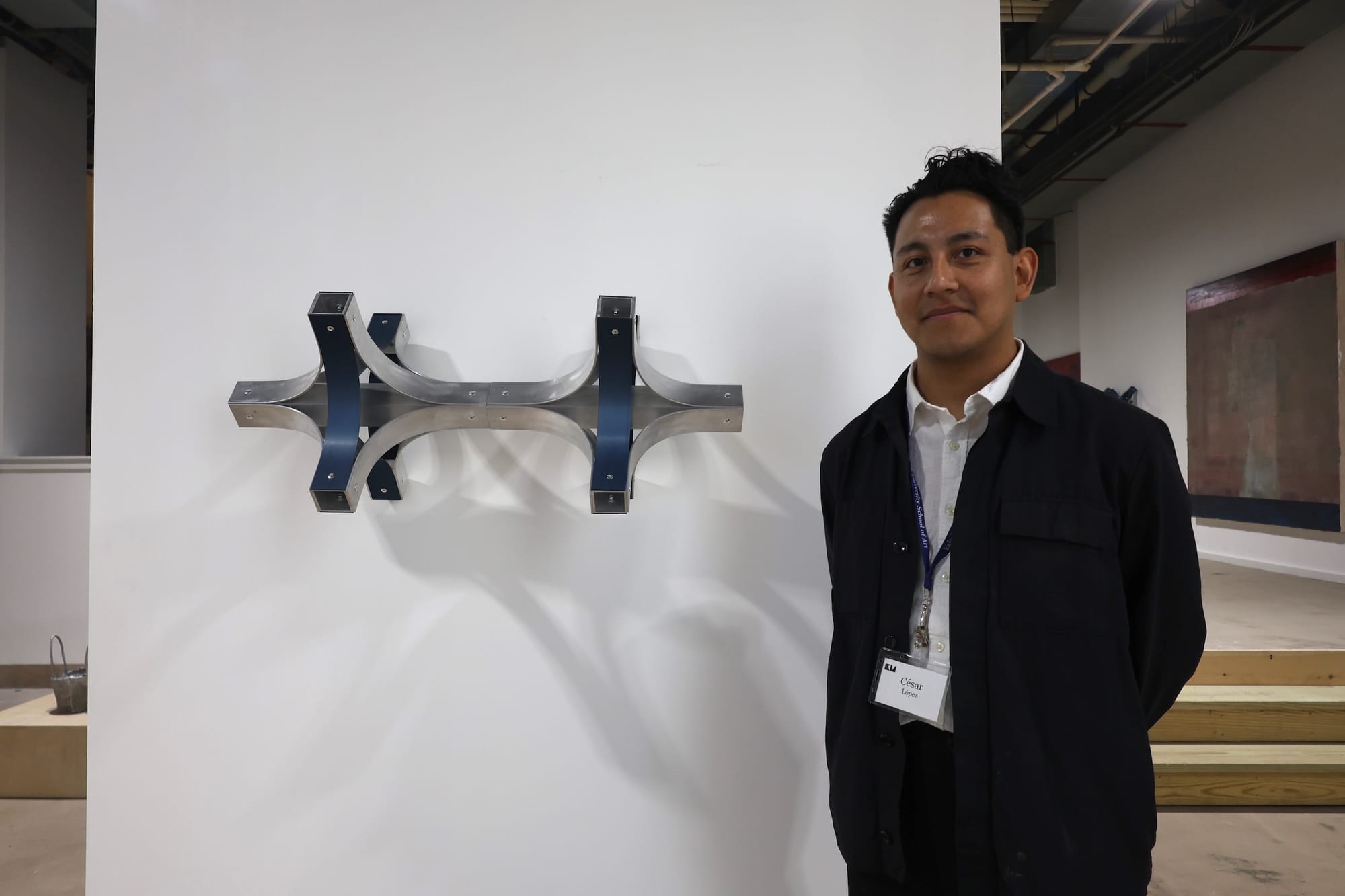
Among that art are metal sculptures by César López, who met Olagunju at Yale. "We've been working on how to get our work outside of the school," he said. "And really, I depended on him and his knowledge from someone who has lived in New Haven a little bit longer than me." They chose to work with Weston "to be connected with a place that has some presence in the community."
López makes art from anodized aluminum as a way to connect with his personal history and where he's from. In 2001, when he was 13, he migrated from Guatemala to Carthage, Missouri with his brother and his mother. Enrolled in Obama's DACA program, he went to Donnelly College in Kansas City, and from there applied to Yale. Looking back, he recognizes how his migration makes him part of a greater whole, a community of migrants facing the complex issues that arise when they leave their home country behind.
"Many people from Guatemala are dealing with this idea of a lost history and past," he said, particularly as many immigrated with little material culture—"only stories and recipes." The blue curve of the metal, for López, evokes the migratory pattern he took to get to the United States, a "combination of walking, being on the bus and train. It's a whole narrative, not just for myself, but for many people I know who have immigrated to this country."
"How can I consider representing the various paths" people took from Guatemala to the United States? he asked. "How can a system speak to a multitude rather than a singularity?"
López turns the aluminum blue through an anodizing—that is, an electrochemical—process. "You open the pores of aluminum and deposit color," he said, rather than painting it. In the future he plans to try the same process with natural dyes that figure heavily in traditional Guatemalan textiles. But "I have to learn the science," and, he added with a laugh, "I have to not blow myself up."
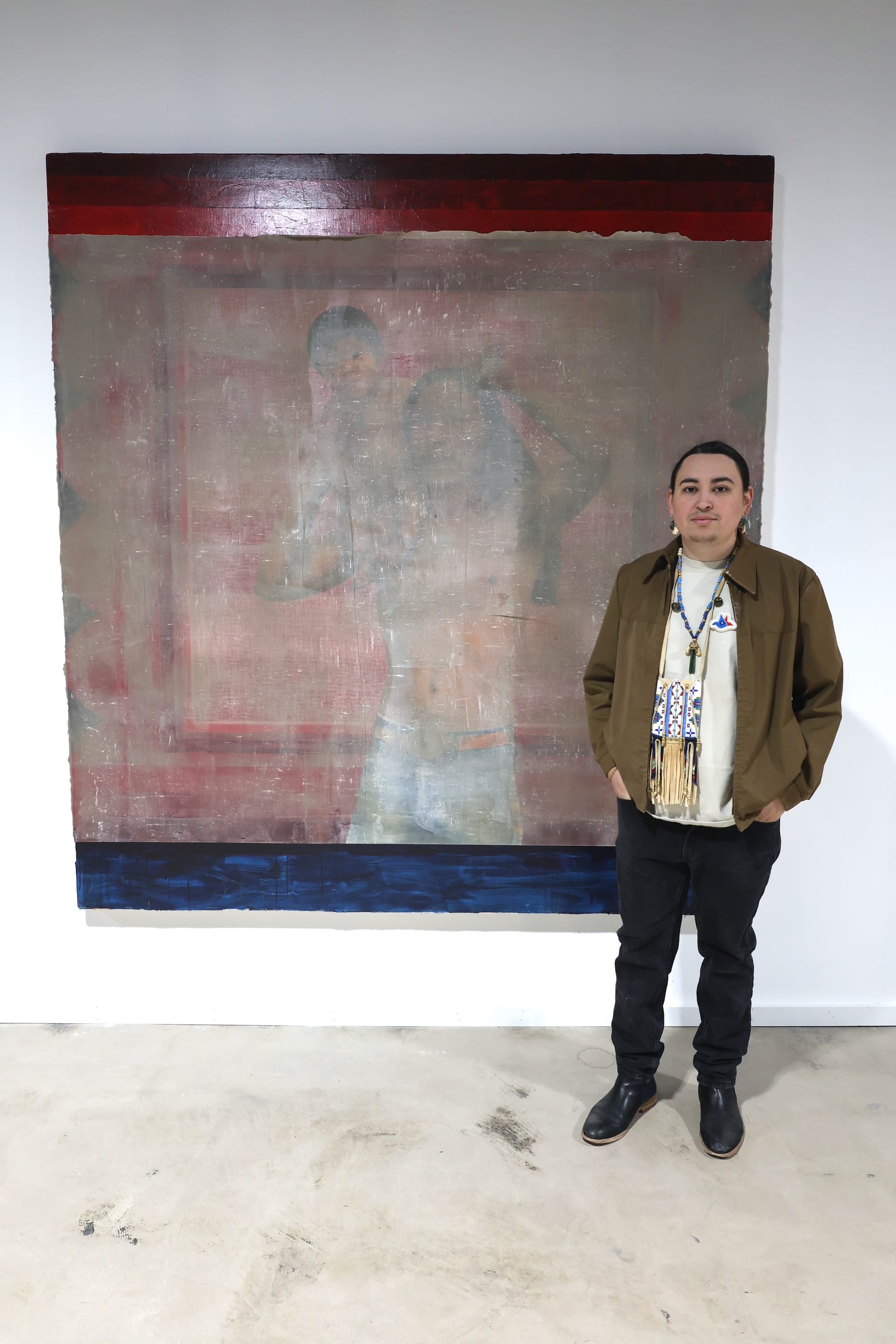
Inkpa Mani's painting and sculpture likewise interrogate some of the more complex issues in indigenous communities. He grew up in Chihuahua, Mexico and western Minnesota; his mother moved their family around to escape violence and for better economic opportunities. He went to the University of South Dakota and from there to Yale.
His sculpture addresses the heartbreaking connection between extractive industries and femicide. In Chihuahua in the 1980s, he explained, cartel activities created a demand for illegal logging, which led to the creation of logging camps in which women were killed. Poppy cultivation for opium, then heroin, led to more violence against women. A similar pattern emerged in the Bakken oil fields of North Dakota. "Illegal sex trafficking came in, and then we see a rise in missing and murdered women." For Mani, the connection traces back to the first trading posts between indigenous people and colonists.
His paintings, meanwhile, are made from "earthen materials." In one, he painted a portrait of one of his cousins who was murdered in South Dakota. He and Mani had kids about the same age, and "he was equally as excited to be a father." His cousin died, he said, in a context of violence and short lives across indigenous communities. "These are things that I wish were not common, but they've been part of the communities that I've grown up in," he said. "And since they're smaller communities, you know the people it's happening to."
After painting the portrait, he covered the figure with layers of stone dust and acrylic. The stone "can hold and protect the image, or the idea of the person," he said; "it's layered between geological time and the histories of this land." But over time, the oil beneath will seep out, degrading the surface. So "the figure will reveal itself," in a future Mani imagines when "these ideas, these things that I feel uncomfortable around, aren't a reality any more."
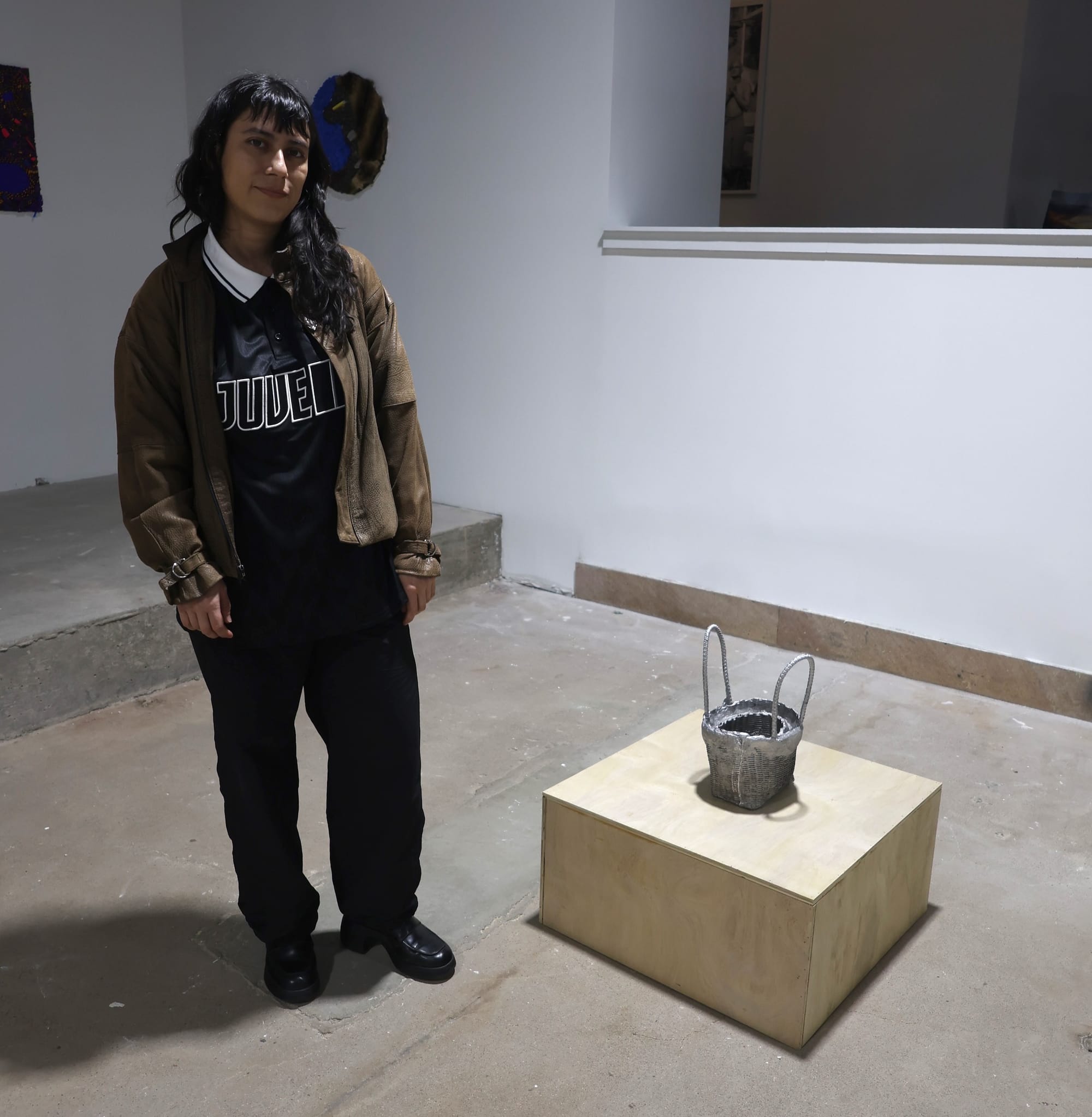
Lucía Reissig was invited by López to be part of the show after they met at an art event in Brooklyn. Reissig's piece — also aluminum — was made in the foundry she works for in New Jersey. The process of casting is "pretty intuitive, but also very physical," she said. The mold for it weighed about 200 pounds. It's a cast of three baskets of different sizes, made from woven plastic. Reissig is interested in containers, on the idea that bags may have been among "the first technologies that humans ever made, because we needed to carry things from place to place," she said. "So I see a lot of relationships between containers and immigration or care."
In Guatemala the plastic woven bags are ubiquitous, and people often store then one inside the other. Though made of a modern material, they employ techniques that weavers have been using in Guatemala for millennia. For Reissig, it's a potent "metaphor for family and intergenerational relationships — one inside the other." The patterns of weaving in Guatemala serve as small encyclopedias of culture: to those who can read them, they tell where the weaver is from and something of her personal history. But weaving is also a business, and this dovetails with Reissig's interest in informal economies, people making money under the table. Embedded in all of it is the idea of transformation. An informal market and appear and vanish as if no transactions had ever taken place. The income made there, however, can change a person's life.
Now that Wábi Gallery has a physical location, Weston's vision for it is to host art shows and other types of events, from music performances to community gatherings. "This is not just some solo adventure," she said. "Indigenous people, we don't believe in the 'I.' We believe in the 'we.' You work as an individual to get yourself where you can help other people." And "that philosophy," she added is "what keeps spaces open."


