
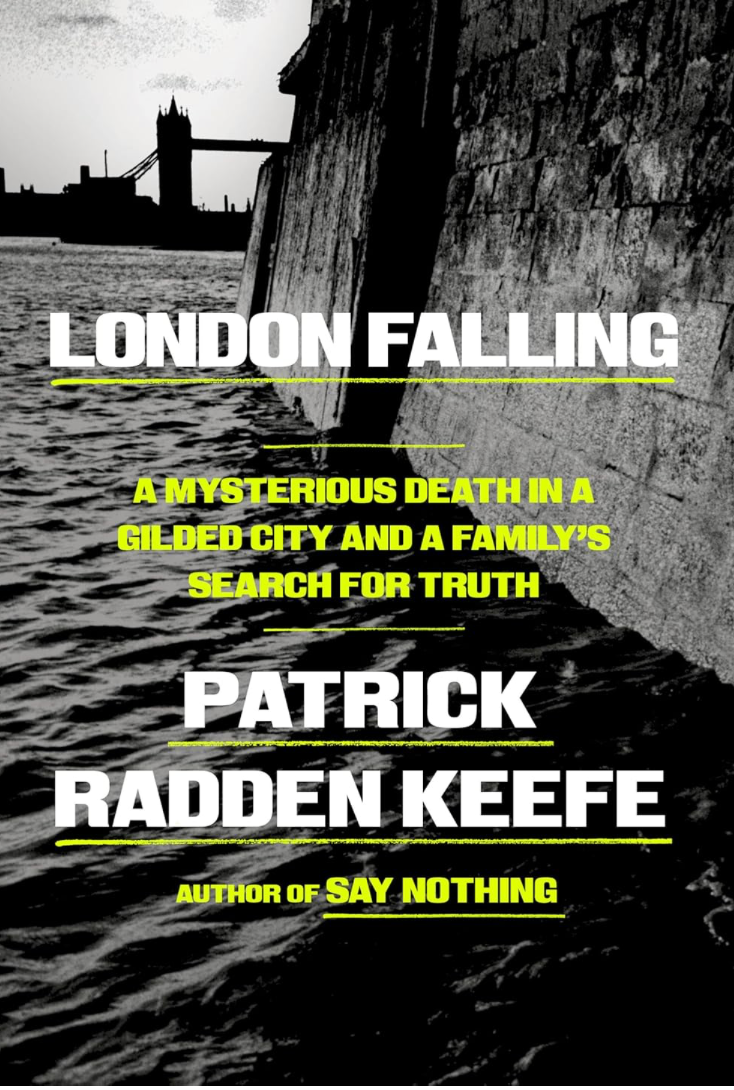
"London Falling"
by Patrick Redden Keefe
Doubleday
In graduate school, I studied with a professor (Julie Checkoway) who coined a “lingerie theory of narration,” about which she wrote: “Lingerie ads and storytelling balance the veiled and unveiled, the seen and unseen, the shown and the about-to-be-shown. In short, it is the art of the tease, the craft of selective ‘coverage,’ that, not just in lingerie but in storytelling, works to enthrall.”
This notion kept coming to mind as I tore through Patrick Radden Keefe’s gripping new book, “London Falling: A Mysterious Death in a Gilded City and a Family’s Search for Truth.” In basic terms, “London” chronicles The New Yorker staff writer’s investigation of a 19 year old’s fatal plunge from a fifth-story apartment balcony into the Thames in 2019. As you follow Keefe on his meticulous fact-finding mission, the book becomes a chilling meditation on parenting, capitalism, grief, and the city of London, all while somehow still working as a page-turning, real-life thriller.
This is largely because what initially seems to readers (and London’s Metropolitan Police) like a relatively straightforward case turns out to be anything but. As Keefe reveals more about the victim (Zac Brettler) and the shady figures he associated with shortly before his death, you find yourself staying up ’til all hours with “London Falling,” having quickly become addicted to Keefe’s chapter- and section-ending reveals. (See “lingerie theory” above.) The hunger to get more pieces of the puzzle grows increasingly intense, thanks to Keefe’s masterful material-wrangling and storytelling skills.
The account’s immediacy stems in part from Keefe having full access to Brettler’s family (who had done a lot of sleuthing on their own) over the course of two years. Brettler’s parents, Rachelle and Matthew, had recorded their various conversations, with officials and others, about Zac’s death well before Keefe entered the picture.
Indeed, at the book’s start, Keefe states: “What follows is a true story. The book contains lengthy stretches of verbatim dialogue. None of this language is invented or imagined. Longer conversations come directly from transcripts or recordings that were made available to the author. Some shorter snatches are drawn from the recollections of people who took part in a conversation or from their contemporaneous notes. The book also cites numerous texts and emails, which have been edited only to correct for typos.” Which is all to say, if it wasn’t already clear, “London” is a work of disciplined journalism, not gossipy speculation.
To set the scene, the prologue focuses on the city of London, and how it has changed throughout history: from being the busiest port in the world, to an industrial hub, to a cosmopolitan financial capital that draws some of the world’s wealthiest people. From this last point, Keefe zeros in on one set of luxury apartments called Riverwalk: “At 2:23 a.m., the M16 camera (across the Thames) captured a dark figure walking out of the apartment and onto the narrow balcony overlooking the Thames. It was a slender silhouette against the brightly lit windows: a young man. He made his way to one corner of the balcony and seemed to peer over the ledge, before crossing to the other corner and briefly pausing there. Then, returning to the center of the balcony, he jumped.”
From there, we get a brief backward glimpse of Zac as a mischievous, kindhearted, and charismatic kid with a nearly photographic memory and an uncanny talent for mimicry. When he’s rejected, as a preteen, from the highly selective school his older brother Joe attends, and must settle for one less academically prestigious, his demeanor starts to darken. At his posh-but-less-esteemed school, he finds himself surrounded by the children of foreign plutocrats – particularly those from Russia.
As the years pass, Zac’s god becomes showy demonstrations of wealth. He badgers his modest parents about getting a bigger house or fancier car. It’s as if Zac decided that if he couldn’t distinguish himself as a star in academics, he would do so in lucre.
Rather than attending business school, or starting a gradual ascent up the corporate ladder, Zac comes up with his own “starter” moneymaking schemes as a schoolboy. Later, as he pulls away from his family, he creates a false identity (and backstory) for himself, claiming to be the estranged son of a wealthy Russian family. The lie gets Zac entree into the rooms where men talk of big-time deals and investments. Of course, those rooms can be dangerous places, especially for a young man who doesn't realize he's in way over his head.
I don’t think it’s a spoiler to say that Keefe, in the end, can’t provide all the answers to the questions raised by Zac’s death. But he (with an assist from Zac’s parents) fills in an awful lot of the gaps with new information that the police never bothered to ask about or pursue. (The Met comes off looking pretty bad, generally.) It’s to Keefe’s credit that as he slowly reveals all he does discover, a story we know the ending to already becomes an edge-of-your-seat reading experience.
It's profoundly moving, too. You'll leave “London” with a sense of Zac’s parents' bottomless grief, which is palpable. While Rachelle is described as being “less self-conscious about surrendering to her feelings” than her husband, Matthew’s buttoned-up-ness makes his occasional breaks all the more wrenching. Once, when Keefe met up with him for lunch in New York, Keefe asked if Matthew’s love for cycling had been shared by Zac. “Matthew, just as casually, was starting to respond that, yes, biking had been a thing that he and Zac would sometimes do together when suddenly he was convulsed by a terrible sob. It was gone almost as soon as it started, and Matthew apologized – clearly embarrassed, and worried that I might be embarrassed. But in that moment, it was as if all the pain he normally kept locked away behind his controlled, cerebral facade had erupted in a spasm of anguish.”


