
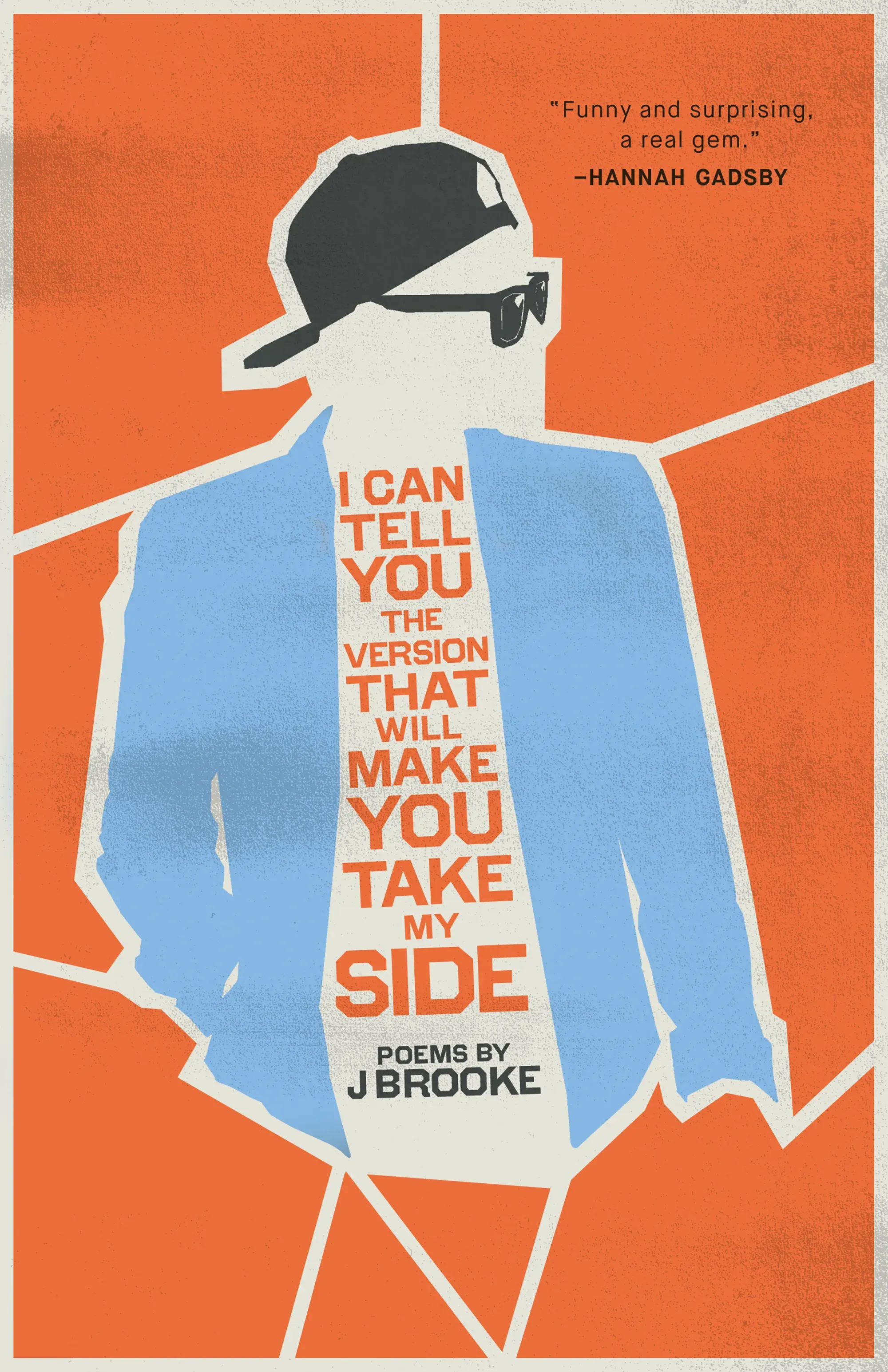
I Can Tell You the Version That Will Make You Take My Side
By J Brooke
Driftwood Press
Published June 2, 2026
Writer J Brooke insists that they are not a poet, even though their poems and essays have been widely published. They are a writer who just happened to write a poetry book.
“Poems were just the way [the story] wanted to be told,” Brooke said of their stunning debut, I Can Tell You the Version That Will Make You Take My Side, during a recent Zoom interview. The book details Brooke’s reckoning with gender and acceptance.
Poetry’s particular impact lies in its ability to convey a lot with a little. Words are employed sparingly and precisely. Through this fashion, Brooke renders the interior life of a nonbinary person with an aching specificity. Yet so much is painfully familiar, anyone could pick this book up and relate. Who hasn’t experienced the excoriating process of self-defining?
The book is separated into two parts: “Why I Am” and “Not Getting Top Surgery.” The poems in “Why I Am” are about Brooke’s early life. We are taken on a journey where secrets and hidden desires abound. Brooke brings us into their head, baring their humanity as they make sense of who they are.
The poems “Demoralizer” and “Weaponizer” open with the book’s incredible title as a line: “I can tell you the version/that will make you take/my side…” But there’s a twist. The line ends with “but I’m not/going to tell you that version.” Right from the start, Brooke is telling us that they have a story to share that could be interpreted in a multiplicity of ways or even cause misconceptions. But they are asserting that they do not care; they will not pander. They simply present their truth. We, the readers, can take it or leave it.
“Demoralizer” presents Brooke as a person who pretended to be a beast, amongst other unpleasantries, to slay their captors. Here, their gender discovery is depicted as a noble conquest. In “Weaponizer,” the conquest changes tack and the goal now is to seduce men. As Brooke writes, “I pretended/a girl then a young/woman using all/hair toss lip lick brazen/swagger wresting desire…” Brooke’s poems understand gender as a series of battles and negotiations through which Brooke’s real self tries to claw through.
“Mistaken Identity” is a poem in Part I that burrowed under my skin through its effortless power. Here, Brooke apologizes to an orangutan at the zoo for mistaking it for a baboon. Though they are two different species — on different hierarchies according to the world — Brooke is willing to identify with the orangutan and emotionally connect. The grace of their apology almost screams, “See how easy it is?” It should only be this easy to show respect for a living being who is altogether different from you. Why can’t the rest of the world see this?
Delivering their story in the form of poetry gave Brooke room to play with structure in a way that hones their message. In “Exit Strategy,” the words “bounce/like a/tennis/ball” are spaced apart to look like they are bouncing on the page. It’s a playful touch that makes the heartbreaking theme of the poem even darker. In the full line, Brooke is pondering jumping to their death, at the age of four, with a childish innocence.
About that real-life moment, Brooke said, “For the first time it crossed my mind that I could get away from this. Kids think of ways out. Kids have no power. And that’s a way out.”
“Rules to Age 11” is written like prose in a manner that makes you feel like you’re peeking at a diary entry. You can picture Brooke hunched over their notebook in their tense household, where everything is monitored, frustratedly jotting down their thoughts about their mom’s stupid rules about breakfast and how they should present as a lady. The last line — “Stop wondering/why you can’t be who you are” — carries the feeling of grave finality. It feels like Brooke is resolving to squeeze their life into a box. Thankfully, by the end of the book, we witness Brooke destroying that box; however, we feel every private moment of this reckoning.

In Part II of the book, “Not Getting Top Surgery,” the poem “LGB No Longer My 4-Le er Word” omits the letter “t” throughout the entire poem, to devastating effect. The poem directly mentions “rump” (hehe) and his abhorrent inauguration speech: “here are/only wo genders and hey are dic a ed by your body/a bir h.” It’s a poetic visualization of the attempted erasure of trans people in current society. The poem triumphantly ends with: “bu he can’/ge rid of me no ma er wha he akes away/or how he spells ha e.” The poem’s seemingly haphazard presentation perfectly spells out the inanity of the world’s hatred for gender-nonconforming people.
Part II widens the collection’s lens, moving from Brooke’s private progression of becoming to the broader politicization of trans life. The poems weave together current events, history, and intimate revelation, showing how public scrutiny presses against the body’s most personal questions. A friend interrogates Brooke about them not taking testosterone; Brooke can’t stop obsessing over another friend who is getting top surgery; and they grapple with pressing health concerns.
Yet “Out Late” arrives as a radiant counterpoint: a triumphant tale of Brooke raising their trans kid, K. In the final stanza, they write, “Wild joy like that night needs to be/protected, so I tuck it tight. Bind it/close to my heart – never risking it/being diluted by a big gender stew.” Joy is a sacred act that they vow to protect. It’s a heartening sentiment that speaks to a beautiful will to live defiantly.
Finally, the book concludes with “Not for Everyone,” an exquisite ode to Brooke’s relationship. The third to last stanza reads: “I choose, surprisingly, my own/mistaken form instead.” Such a tender acceptance of self.
By the end, how could you not take Brooke’s side?
For more on J Brooke, and to read their other writing, visit their website: jbrookewrites.com.


