
Trust the Universe: The Philosophy of Alan Watts
Chabot Space & Science Center
10000 Skyline Boulevard, Oakland, California
June 26th, 2026
Yes, more and more metaphorical movement, as my life goes longer. And more alliteration with the accounting of it. That’s the way of the writer, here charting a sinuous route up into the outskirts of Oakland in the final foggy hours of a Friday, a meandering mystery leading to a set of more mysteries, anticipated and unanticipated.
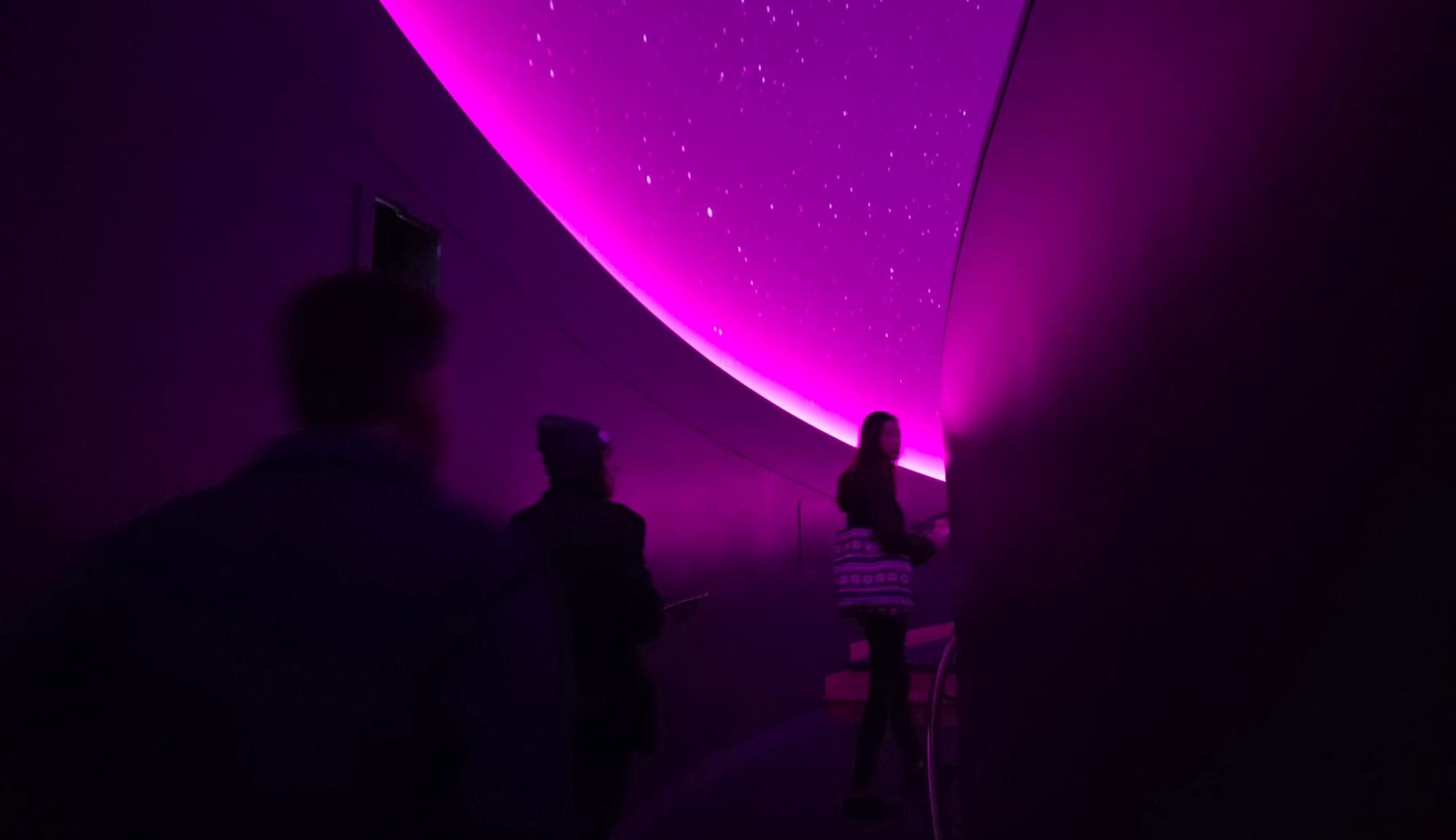
My event partner was longtime fellow journalist and adventurer Ken Bullock. It was a challenge finding where to park, and once parked, how to locate the Chabot Space & Science Center itself, as there was no signage about how to get there from the garage. After some wrong turns and furtive interrogations of terrestrials wandering across the gloomy grounds, we located the entrance to the Center and then the passage into the planetarium, where we settled onto inclined seats which had us gazing upwards at a hemisphere projected with small white celestial bodies drifting across a magenta-hued void.
Eventually there were messages about the upcoming show, which turned out not to be Circle of Light: The Love of Rumi & Shams, which is what I thought I’d be reviewing, based on my online research and emailed queries. Instead, it would be Trust the Universe: The Philosophy of Alan Watts, a different “immersive 360° experience” presented at Chabot during the month of June and elsewhere across the US and Canada by British Columbia-based Spherical Pictures (whose shows, technically speaking, are of necessity hemispherical). Buddy Ken had been providing me a batch of background material on Rumi, a deeply influential and inspiring 13th Century Sufi poet. But Ken and I, much as we adore Rumi, were willing to share a shrug, because we’d both also been fond of Watts, an English scholar who’d settled in the Bay Area in the latter part of the 20th Century. Watts recorded a set of lectures, broadcast over Berkeley’s KPFA-FM, promulgating his infectious personal, sometimes humorous fusion of Christianity, Hinduism, and Zen Buddhism, which he also put into a batch of popular books. Whether Ken and I would be able to trust the universe to always get us where we wanted to be with what we expected to find (more metaphorical material) would remain open to question.
Both the Watts and Rumi shows were produced and directed, and the projected visualizations created, by Amir Aziz, an Iranian-Canadian graduate of Simon Fraser University’s School of Interactive Art and Technology. The ecstatic projections we saw accompanied and visually conveyed recordings of Watts’s familiar soothing baritone-tenor speaking voice, enhanced by a meditative musical soundtrack, composed by Iranian-Canadian Alvand Jalali and presented in 5.1 Surround Sound, matching the immersiveness of the visuals.
Illuminating the wise words of Alan Watts. Video by Jeff Kaliss
“Which star is in the best position?”, Watts posited. Then, answering his own rhetorical question, “Well, it’s all equal. They’re all in the middle. Any point on the sphere is the center of the surface of the sphere.” He might have been talking about what we happened to notice at any point at any moment there in the planeatarium: luminous undulating circles spreading outwards and downwards from the apex, encompassing latices, and kaledioscopic or mandalic fractal images in an array of colors.
“A real feeling understanding of the polar relationship between the individual and the world is something that operates, as we say, in your bones,” Watts pointed out, “and isn’t just a view that you hold or a belief that you hold.” Resting my bones and opening my eyes and ears and mind to the sights and sounds of the show, it was easy to sense the thrill of the experience in my viscera. I wondered, though, how that might compare to listening to Watts in the flesh, with his skinny, sardonically smiling bearded British self right in front of me.
"Seeing through your game" with laughter and a light show. Video by Jeff Kaliss
Towards the conclusion of the 42-minute spirit-lifting session, Watts offered something we could take away on the drive home, on our way to a holiday. “Life, as one looks at it, is in fact a celebration of itself,” he assured us. “When you look at night at the stars and you really wonder, ‘Good God, what is all that about’, well, it’s fireworks, it’s a kind of exuberance!” Mixed with the music, there was the delightful sound of children at play…
I effected the additional delight of chatting by phone with the show’s creator, Amir Aziz, whose mission “to bring contemplative and transformative art to audiences using cutting-edge immersive technology and emerging digital and industrial arts” has evolved over fifteen years. He came to favor the theatrical openness of the dome over head-mounted virtual reality devices, and the benefits of his choice, he says, are being enjoyed by over 100,000 people in nine cities across North America. And some good news: the Rumi show, which as an artist of Persian origin he holds close to his heart, will be returning to Oakland on July 25th and 26th.


