
Tulsa Ballet: Sleeping Beauty
Tulsa Performing Arts Center
February 15, 2026
If I’m being honest, few things sound more romantic these days than going to sleep for a hundred years and waking up in a forest bower alongside all my friends and family, none of us having acquired a single new wrinkle. The prospect of powering this whole thing down and relaunching in another era—like Aurora in last weekend’s Tulsa Ballet production of Sleeping Beauty, which set me off on this daydream in the first place—is yearn-worthy.
You know the story: Sleeping Beauty’s birthday girl, Aurora, is cursed by a fairy who’s mad about being left off the party guest list; the curse, delivered via knitting spindle, is softened from “death” to “sleep” by the Lilac Fairy; Aurora is awakened by a kiss from a prince; they get married; happy ever after. But there’s a whole archetypal interpretation that makes this more than just a fluffy romantic fantasy tale. What the story’s really about, say the likes of Carl Jung and Marie-Louise von Franz, is a personal or cultural awakening of consciousness; a maturation of passive fragility into active, enduring power; a movement from rose-colored innocence to integration. And you’ve got to go through that liminal, dormant state—chrysalis mode, you might say—to get there.
The ballet Sleeping Beauty itself has time-traveled through a century to arrive here and now, in an age when it’s still being performed by companies around the world. In addition to telling an ancient, deeper-than-it-looks story, it’s also the big kahuna of classical ballet, the apotheosis of the art form’s evolution in the late 19th century. The original production, which premiered in St. Petersburg in 1890, packed in the complete Charles Perrault/Brothers Grimm story as well as characters like Puss in Boots, Tom Thumb, and Little Red Riding Hood—basically a three-act live-action encyclopedia of Europe’s fairy tale lore and ballet’s own triumphs. All of this is threaded together in the warp and weft of Tchaikovsky’s score, festooned with audience-pleasing folk rhythms, character-specific motifs, and stately slow builds that erupt into ecstatic releases.
Weighted with history and folklore and archetypes and Russian music as it is, Sleeping Beauty might sound like it’s ready-made to put you to sleep. But in a rendering as good as Tulsa Ballet’s, it’s both an enchanting spell and an invigorating wake-up call.
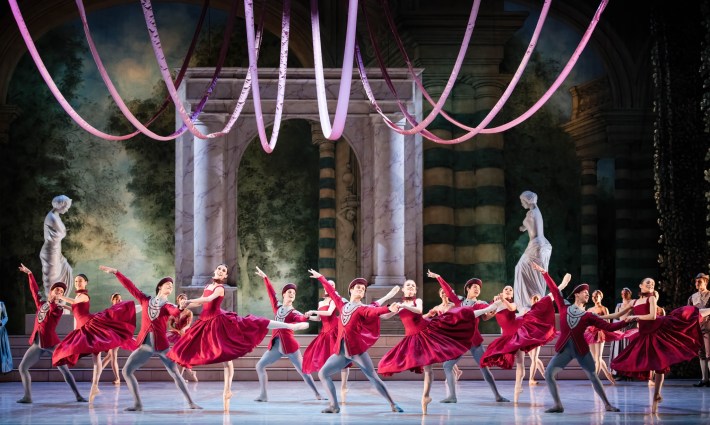
Tchaikovsky's prologue starts the journey with what sounds like a lightning storm, which softens into a woodwind breeze and ends with a wall of horns and strings, urgently mounting toward resolution. Tulsa Symphony Orchestra—playing for nearly three hours with unity, clarity, and vigor under conductor Peter Stafford Wilson—was key to the success of this production. Light, dark, boisterous, menacing: they found every color in this glorious score, including the glimmer of “are we really doing this?” anticipation that makes the wedding pas de deux music so special.
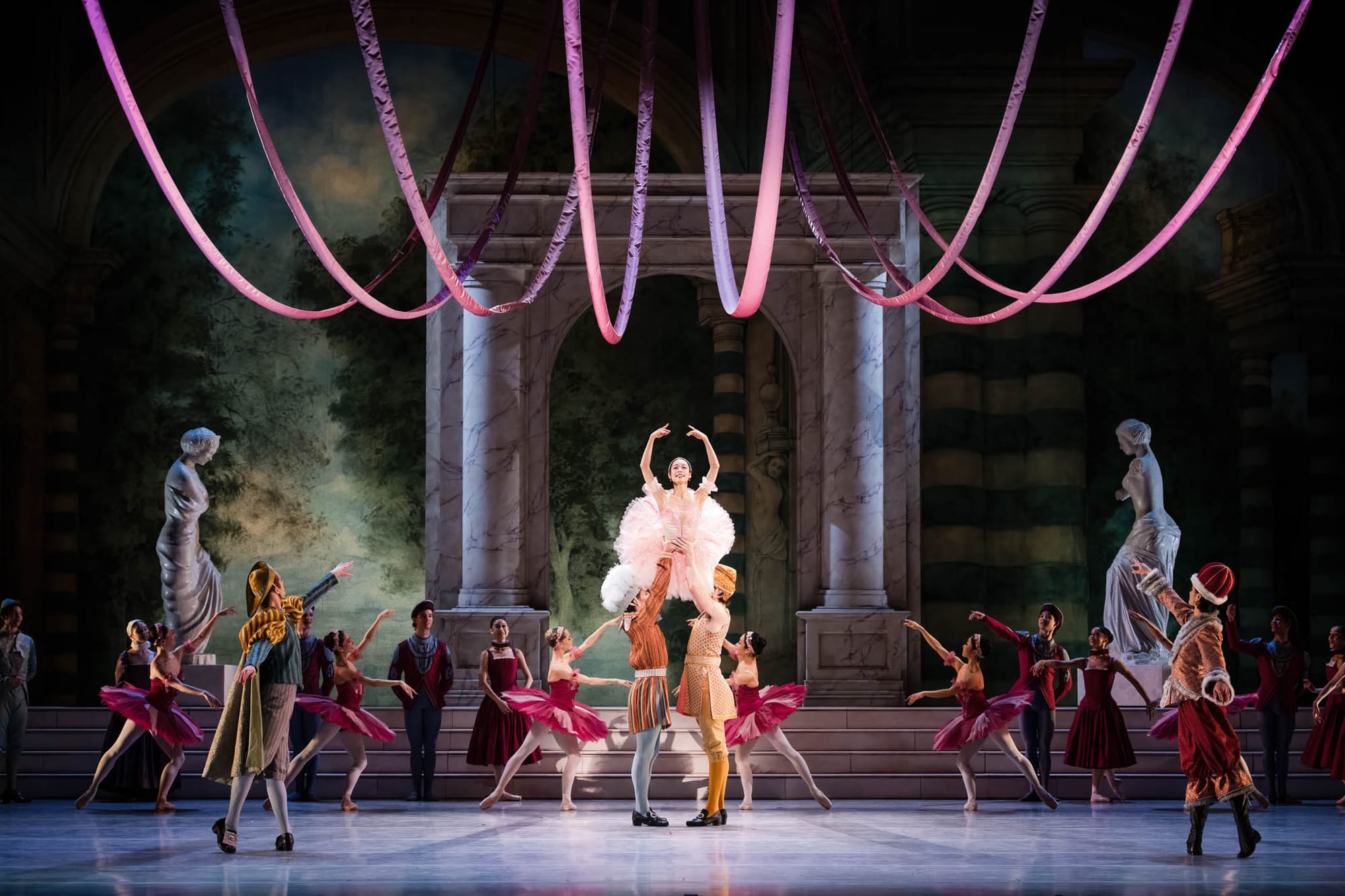
The possibility of transformation ran like a subtle thread throughout Emma Kingsbury’s intelligent designs (custom made for this production), starting with the pastel sketch of a sleeping woman in a rumpled bed that adorned the curtain; Aurora, it suggested, could be any of us. Some Sleeping Beauty productions build out a pastel-heavy candy floss world or coast on familiar 19th-century forms. But this was a realm of folk magic, feathers and shadows, tulle skirts encrusted with gems like gifts from the sea, wide ribbons at the neck, giant draped marble nudes, and colors that met somewhere between Piero della Francesca, Bruegel, and Magritte.
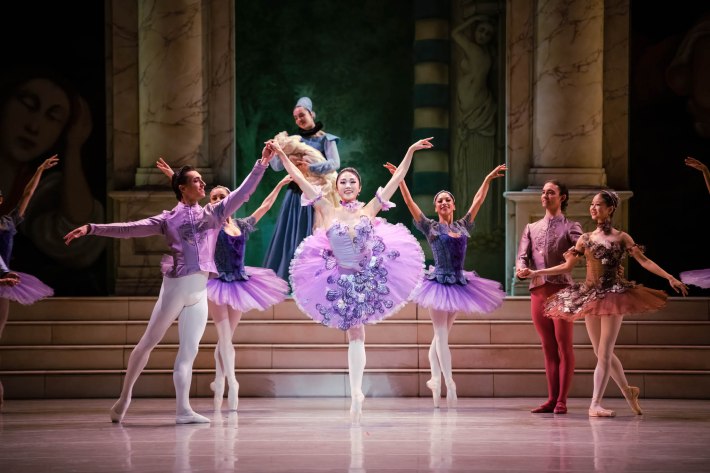
The world Kingsbury made held its own liminal space between the antique and the modern—like the time-traveling fairy tale that spins its archetypal magic across the ages. While Aurora sleeps, the world changes around her; Kingsbury updates the fashions when we arrive at Act II so that we land clearly in another age, with top hats and velvet capes and stripes and pleated skirts rather than soft caps, puffy sleeves, and buckled shoes. One of my favorite costume shifts was the simplest: in Act I, Aurora's tutu is the palest pink; when she arrives in the fullness of Act III, she’s wearing a wash of spun gold.
The detail in the dancing was just as intentional, creative, and thought-provoking. These dancers, so capable in the sinuous business of contemporary movement, delivered flawless clear lines, rigorous musicality, and the biggest gift of all in Sleeping Beauty: a restraint that allows for revelation. As the dark fairy Carabosse, Jaimi Cullen gave Black Swan vibes with her wide-spread fingers, jutting jaw, and a pack of panther-ish attendants who at one point cast a terrifying shadow on the back wall of the set. Her dark force came through with so much power because of its contrast with the steadiness of every other member of Aurora’s royal court; even its vivacious fairies, in a series of famous variations in Act I, moved with precision and care. JooYoung Kwon pushed into every lush curve in the Lilac Fairy’s movement, visually signalling that even the clearest of curses isn’t necessarily fated to move straight to its target.

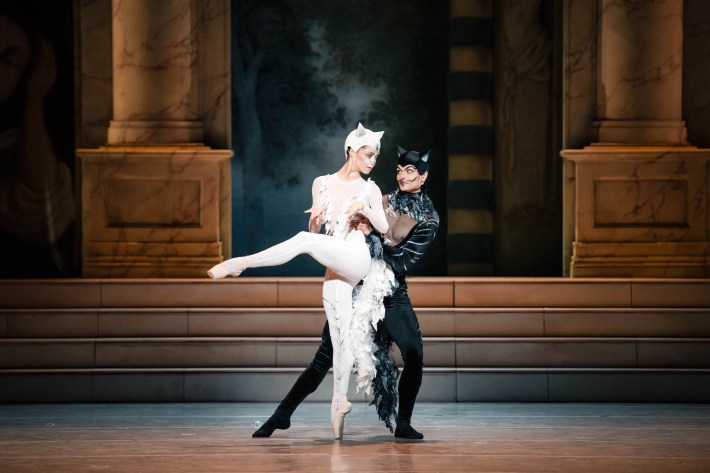
Coherence doesn’t mean sameness; it’s in constant dialogue with change, diversity, and difference. In a production this stunningly unified, it was satisfying to see each individual involved bringing their own unique qualities. I won’t forget Regina Montgomery’s attack as one of the Act I fairies, Alfonso Martin and Alexandra Bergman’s compelling pantomime as the King and Queen, Giulia Canavese and Ian Stocker’s feral serve as the Cats in Act III (which provoked a cascade of laughter from the kids in the audience), and Jun Masuda’s gaze into the Romantic distance as the Prince.
But it was Nao Ota’s Aurora that epitomized the changeable, enduring magic of this ballet. Ota has been a delight to watch since she joined Tulsa Ballet II in 2017; this season, she’s grown into an authority that made her Aurora like none I’ve seen before. In Act I, she was quick as a needle prick, darting and dashing with 16-year-old glee—which made her Rose Adagio (one of the most difficult in all of ballet, full of long balances on one leg as she encounters the six princes there to court her) an unusually thrilling moment of suspense and victory.
With the orchestra’s delicate triangle working overtime, Ota sliced the solo that followed down to its purest dimensions, allowing it to be so slim and simple that we felt the meaning of the smallest embellishment, the merest shift in weight. In Act III’s flawless wedding pas de deux, she seemed to be moving inside the edges of the music itself, illuminating it from within, discovering a time-space continuum that her character, and Aurora’s whole world, had never experienced before.
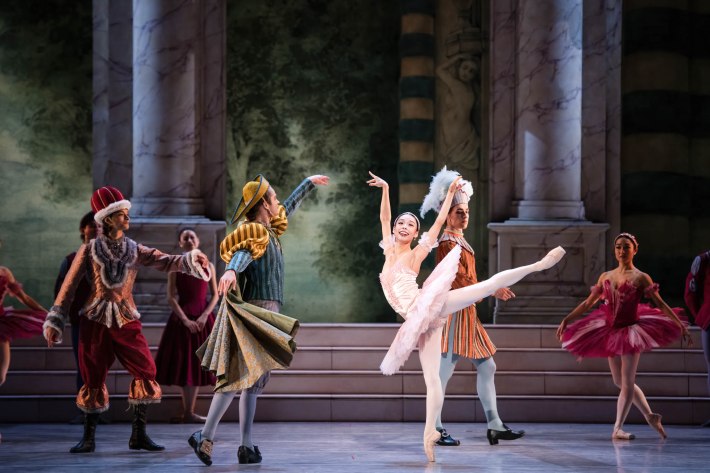
I left the theater feeling like I’d just seen the birth of a star. The genius of Ota’s performance was like a distillation of everything surrounding it: this ancient story, these new designs, this choreography that unites historic lineage with contemporary freshness, this company that continues to surpass itself by deepening into, not surrendering, its values. We may be in a new timeline by Sleeping Beauty’s end, but the world we came from never fully disappears; it’s up to us to integrate it in a way that carries us forward. Like Aurora, Tulsa Ballet emerges from this production with two feet firmly rooted in a new era.


