
Chaos with a Side of Spaghetti
Ely Center of Contemporary Art
New Haven
Through May 24
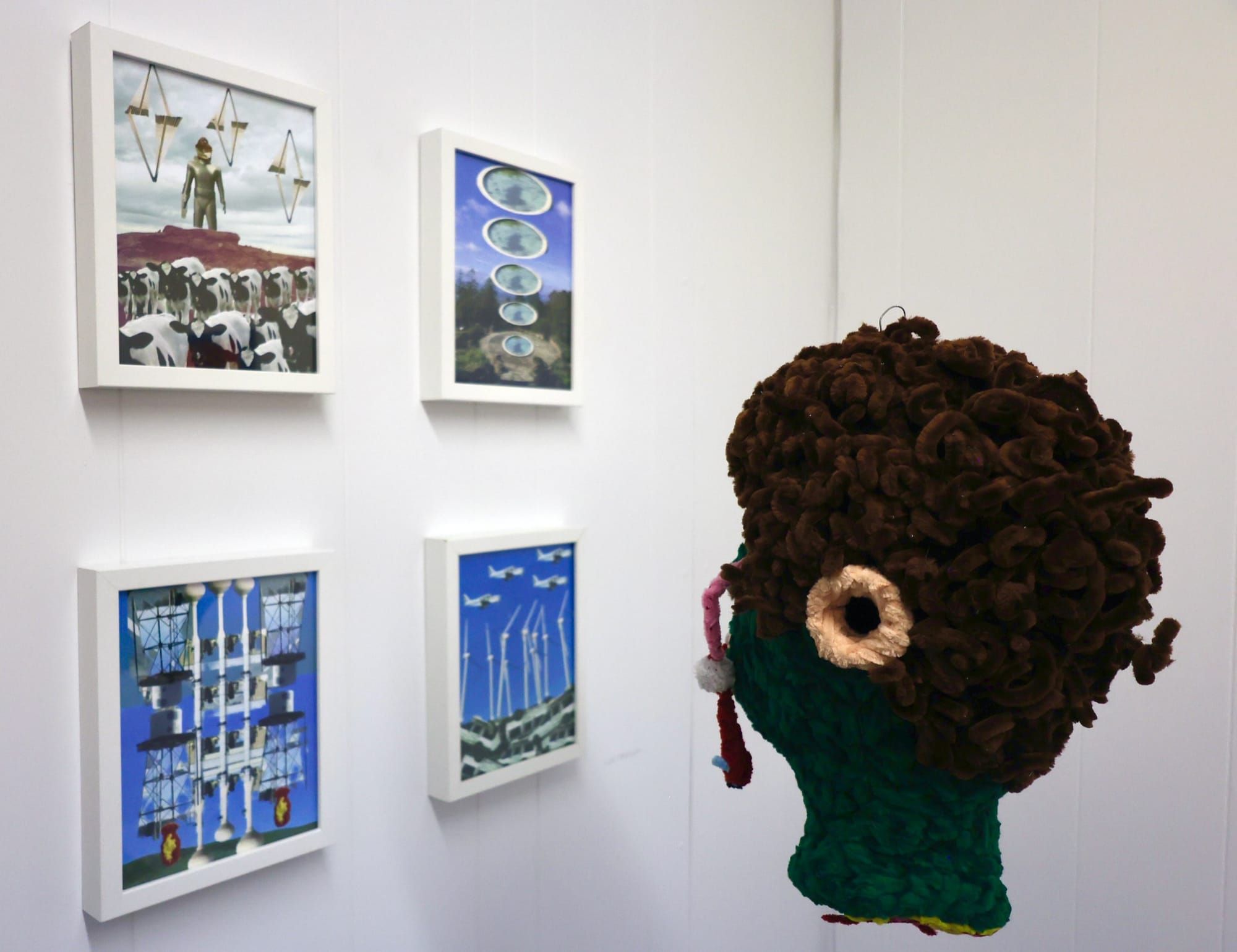
Don Porcella's You Are What You Eat is a smorgasbord of visual stimulation, with four collages featuring giant robots and wind turbines, cows and saucers, other objects pulled far enough out of their context that it's unclear what we're seeing. A head made out of pipe cleaners, suspended from the ceiling, floats in front of the collages, taking them all in.
But some damage is being done. Get close enough, and you can see the expression on the head's face suggests discomfort, or rage, or stupefaction. Something pink and jarring flows from the face's eyeballs. The piece hearkens back to the scene near the end of Stanley Kubrick's A Clockwork Orange, in which the protagonist's eyeballs are pinned open to be forced to watch violent imagery projected on a movie screen. But it has much more current associations too, of the way we take in torrents of images on our phones, all the time. What is that doing to us? At the same time, Porcella's piece is a lark, from its kitschy imagery to some of its material choices (pipe cleaners?).
It's an escape. It's a confrontation. It's a bit of both. And it's an emblematic part of Chaos with a Side of Spaghetti, running now at the Ely Center of Contemporary Art in Fair Haven through May 24, featuring art from Porcella and fellow artists John Dickinson, Kat Ghent-Cababallo, Hannah Hanski, Yi Hsuan Lai, Lucas Moran, Liz Rodda, Jenna Rothstein, Ryan Scails, Emily Silver, Paul Theirault, Mark Van Wagner, and Lexa Walsh.
"We are hurtling toward the unknown," writes curator Emily Weiskopf in an accompanying note. "The unrelatable. The bizarre and disorienting shape of this moment. The endless news cycle feeds instability at every turn, every click. Comfort slips from under our feet, our eyes look for the sun. What once felt real, what once felt safe, is gone. Poof. In the wind. Chaos with a Side of Spaghetti is response and survival. The artists laugh in the face of impossible odds. You take our healthcare, we pick up the brush. You wage wars, we build worlds. For every right stripped away, there is a video, a painting, an assemblage. We meet the absurd with humor, comfort, vices, and despair, still searching for beauty, for joy. Like spaghetti thrown at the wall. We'll see what sticks. Today, if only to take your mind off things for a moment."
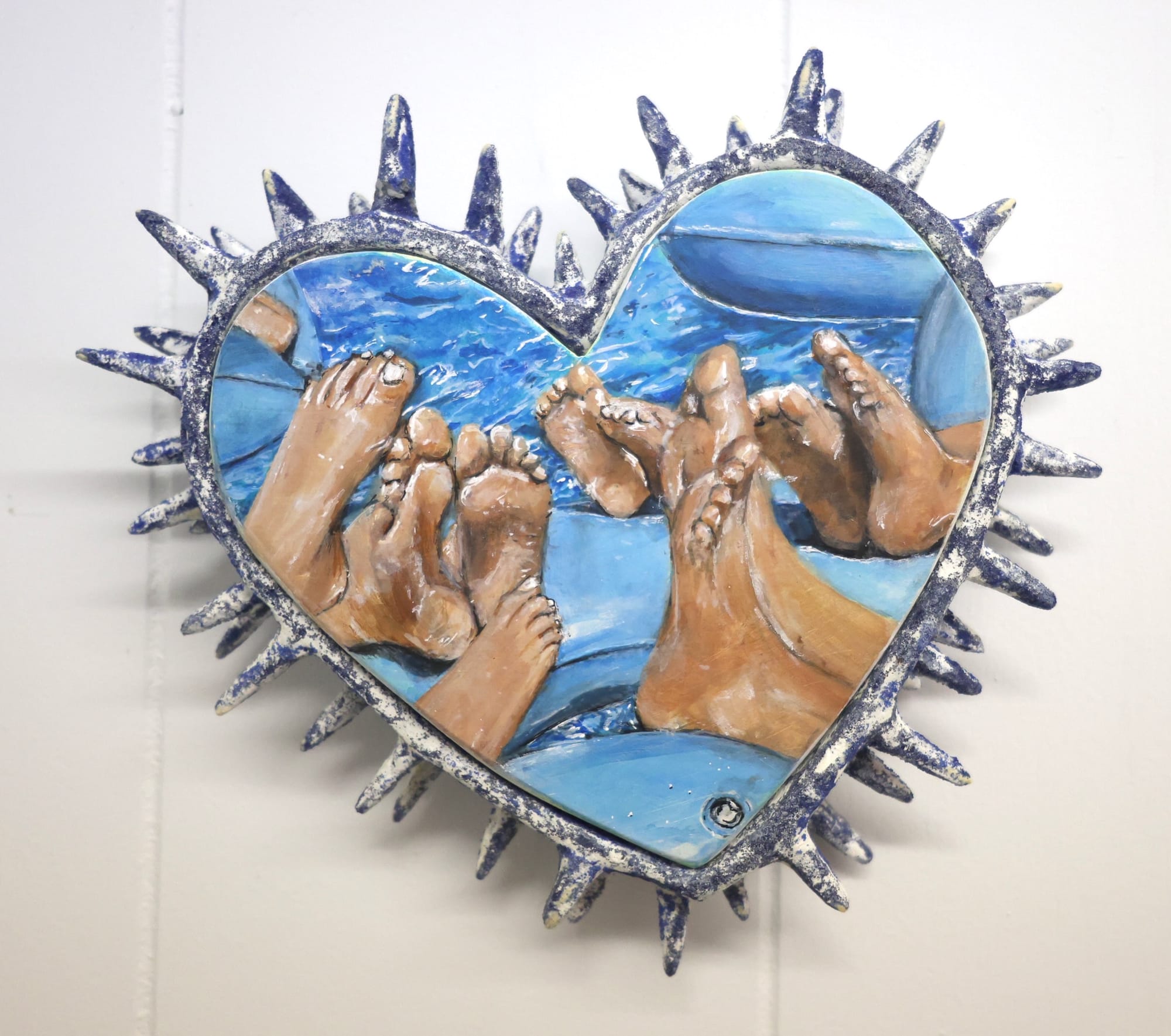
A sense of play unifies the art in the show. Jenna Rothstein has two paintings in the exhibition, one of two toilets sitting side by side in a way that, on second glance, one realizes could never occur in reality without creating an awkward social encounter if two people tried to use them at once. Another, of a series of jumbled feet, is pleasantly disorienting until one grasps more of the concept with the help of the title; it's a portrait of people's feet on rafts floating down a river, but Rothstein's painting reminds us how rare it is that people's feet are so close together.
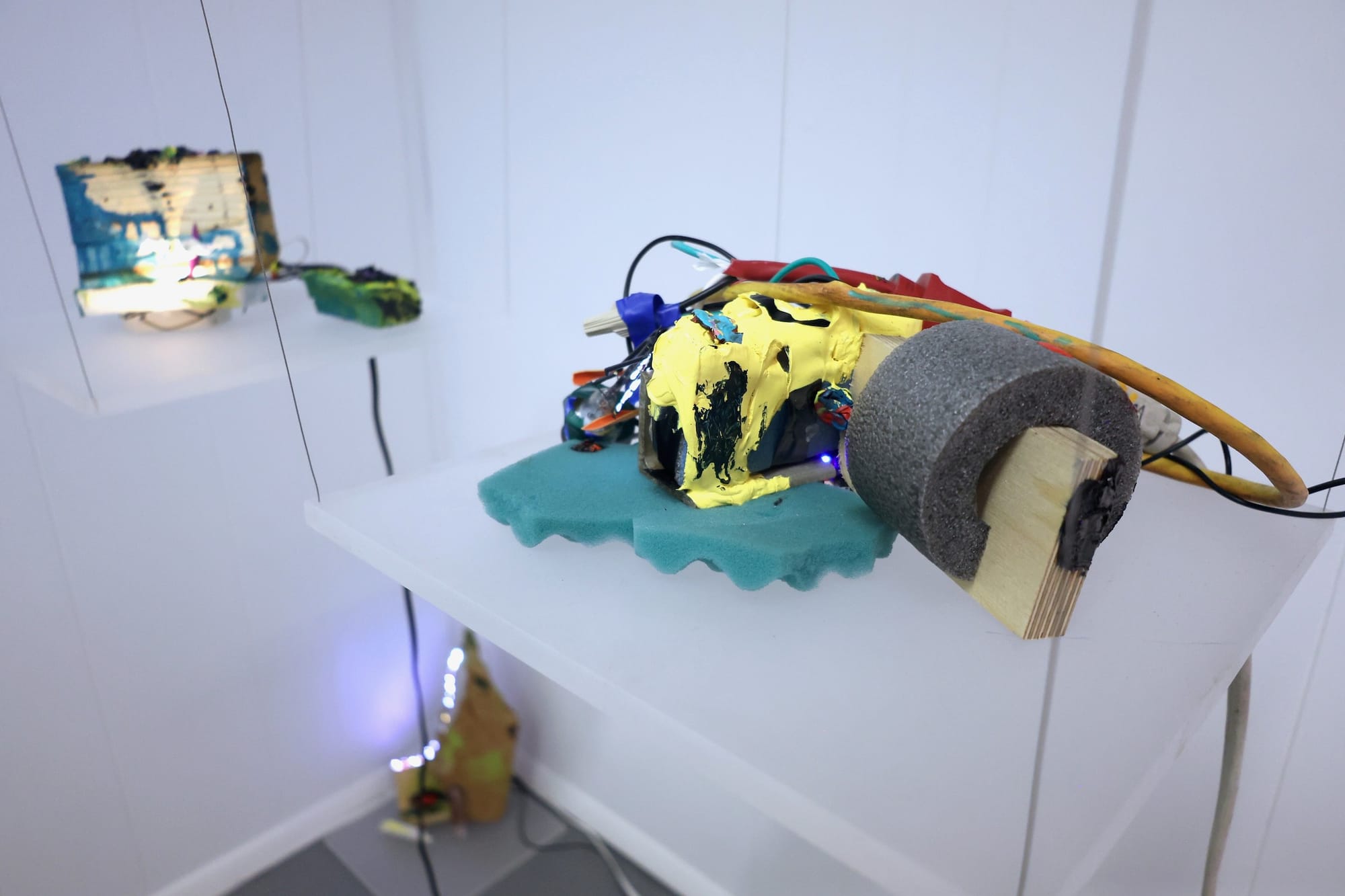
Paul Theriault's Revival Machines hover somewhere between tool and toy. Their machinations have no observable function, but they look busy. The bright colors suggest playthings. The wear and tear suggests they've been hard-used, or perhaps well-loved. Or perhaps they were left in the sun. Whatever happened to them, it's clear they're not brand new. If they could talk, what would they tell us?
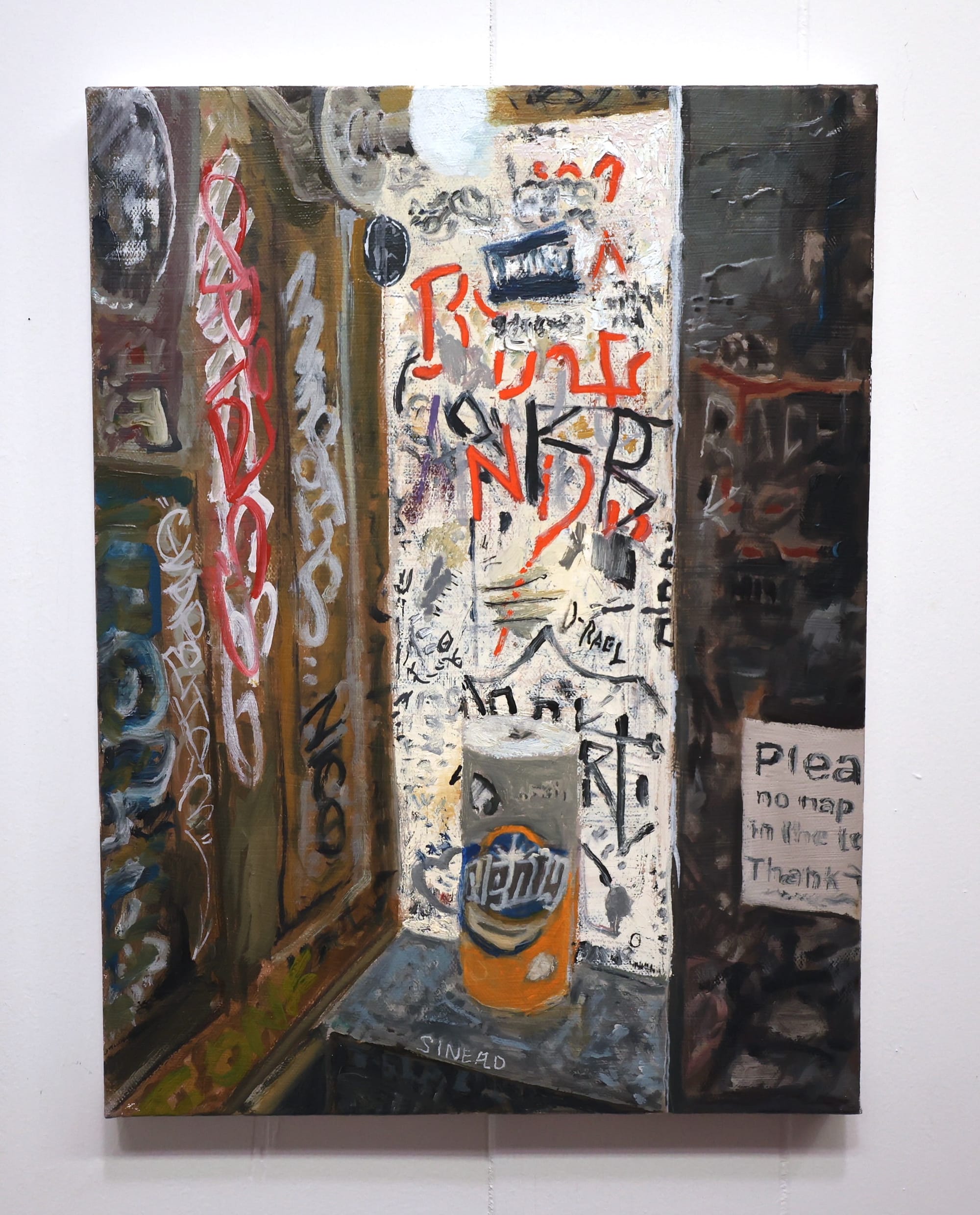
Many of the artworks in the exhibition have a deliberate messiness to them, in keeping with the embrace of the show's themes. In painting, this comes to a head in Lucas Moran's Nancy Whiskey, which is the name of a song but is possibly a depiction of a real scene in the Tribeca bar that bears the same name. Established in 1967, that bar belongs to an older era of watering holes, which is in keeping with the way Moran makes art.
"My aim is to make paintings that feel historical in their approach. Using traditional techniques — wet-on-wet painting, linseed oil over a grayscale ground, and stand oil to avoid a slick varnished finish — the works can initially appear as if they belong to another era. On closer inspection, however, they reveal themselves as contemporary," Moran writes. "Their compositions draw from photography and street scenes, and their framing carries the deliberateness of cinema. At the same time, the paintings remain close to the feeling of a study, preserving a sense of immediacy and vitality within an otherwise historical register."
Moran's style, like that of many of the other pieces in the show, also conveys a hurriedness on the part of the artists; the show is, after all, commenting on the frenzy of our present situation, in which one dramatic headline seems to follow another far too closely. Weiskopf remarks that the artists "meet the absurd with humor, comfort, vices, and despair, still searching for beauty, for joy." They also offer a chance to step off the whirling, out-of-control treadmill of current events and view it from a different place, one that understands where we are from a longer perspective — in which, after we cry, it's okay to laugh, and play.


