
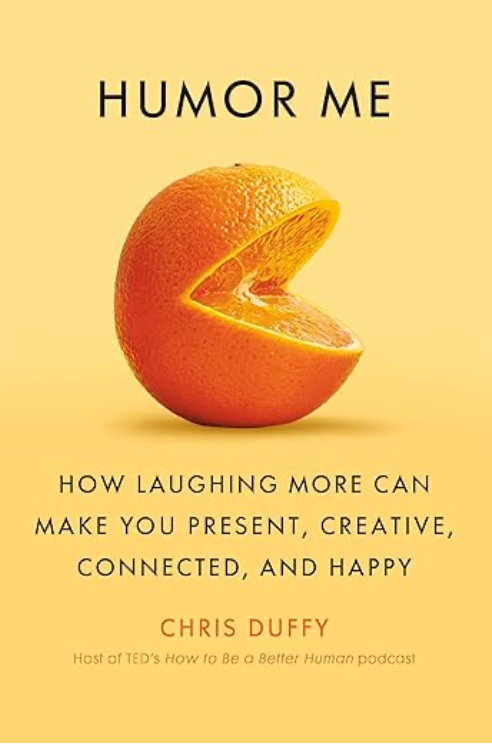
"Humor Me"
By Chris Duffy
Doubleday
I’m a sucker for pop psychology and comedy books, so when I spotted Chris Duffy’s “Humor Me: How Laughing More Can Make You Present, Creative, Connected, and Happy,” I was first in line at the library to nab it.
Duffy – currently host of the TED podcast “How to Be a Better Human” – is a stand-up comic as well as a former teacher and television writer. His goal for “Humor Me” isn’t to make us all comedians (thank God) but rather to give us ways to spot more small opportunities for humor and joy in our daily lives.
In lighthearted, clear prose, Duffy provides different approaches, using both pop culture references and personal anecdotes. He cites the scientifically proven health benefits of laughter and humor-based bonding; and explores thorny questions like, “When does teasing become bullying?”
As a starting point, Duffy talks about how both he and one of his fifth grade students (Chris) in Boston felt isolated and miserable. Duffy offhandedly suggested, after hearing the student complain again about the quality of the public school’s lunches, that Chris become the school newspaper’s food critic.
“I could barely believe it,” Duffy writes. “Not only would Gary be voluntarily practicing his writing skills, but I would get a much-needed infusion of comedy into my stressful teaching days. That first day of helping Gary write his food column, I laughed more than I had in the previous five months combined.”
Admittedly, Duffy gets a bigger laugh out of these candid kid critiques than I did. (I’m known to be a tough crowd.) But the point remains: When we get out of our own heads and pay closer attention to what’s happening and being said around us, more opportunities for joy inevitably present themselves.
Indeed, this variation on mindfulness is the first of three “pillars” of humor Duffy discusses. The others: being able to laugh at yourself and taking more social risks.
In regard to the second pillar, Duffy introduces the challenging topic of how you determine what’s harmless self-deprecation and what’s esteem-damaging – an issue he explores in greater depth near the book’s end: “If you make a joke about being a piece of garbage once, it’s probably fine. If you’re making that joke every day and repeatedly sending the message to the people around you that that’s how you see yourself (and how they should see you), it starts to feel less than okay even if it’s still getting laughs. … Another test to think about is whether you’re poking fun at an element of yourself that you’re comfortable with or one you’re insecure about. … You have to pay attention to how you feel in the moment and afterward. If you get that queasy feeling of shame or embarrassment, it might be worth rethinking where you’re getting your laughs.”
Predictably, Duffy discusses comedy’s rule of three, “punching up, not down,” and improv’s central tenet of “yes, and … “ It’s astonishing how these humor principles are now so mainstream that we all know them – but they do feed into his broader argument about being more present, attentive, and bravely open to life’s absurdities.
A lot of this will ring familiar to readers tuned into our present mindfulness movement – which is to say, there’s not a lot particularly new or earth-shaking contained in “Humor Me.” However, it did make me reflect on (and appreciate) how laughter bonds us to others, whether it be via inside jokes with a family member or spontaneous, random moments of silly solidarity with a stranger.
Duffy never gets too technical or academic in "Humor Me." He does, early on, touch on his belief in encryption theory, which suggests that “on a fundamental level, humor is a type of social test. It’s a riddle, a puzzle, intended to see if the listener can figure it out. As (cognitive psychologist Greg) Bryant explained it to me, when someone says something funny to you, that’s essentially a secret code. ‘The only way you can decrypt it is if you have a corresponding piece of information – you have the key. And if you have that key, then you get the joke, and then you signal back to me that you get the joke by spontaneously laughing.’ … Knowing whether someone gets your joke, whether they can crack the code on your encrypted message, instantly tells you whether they’re part of your group.”
Which is why cracking a joke and getting silence in response is so terrifying and awful.
But when laughter is shared, it can help us process and get through some of life’s hardest moments.
For part I’ll most remember reading in “Humor Me” concerns Duffy’s story about Michael Cruz Kayne, a writer for “The Late Show with Stephen Colbert,” who wondered if he’d ever find anything funny again after the death of his infant son, Fisher.
Then this happened: “On the day of his son’s cremation, the funeral home handed him a receipt that said, ‘Thanks you, come again’ at the bottom. He and his wife couldn’t help but laugh. There was no place in the entire universe that they would less want to come back to.”
Yes, even in our worst moments, the world remains utterly ridiculous; and when we can take that in, Duffy argues, it can help us all find our way through the dark.


