
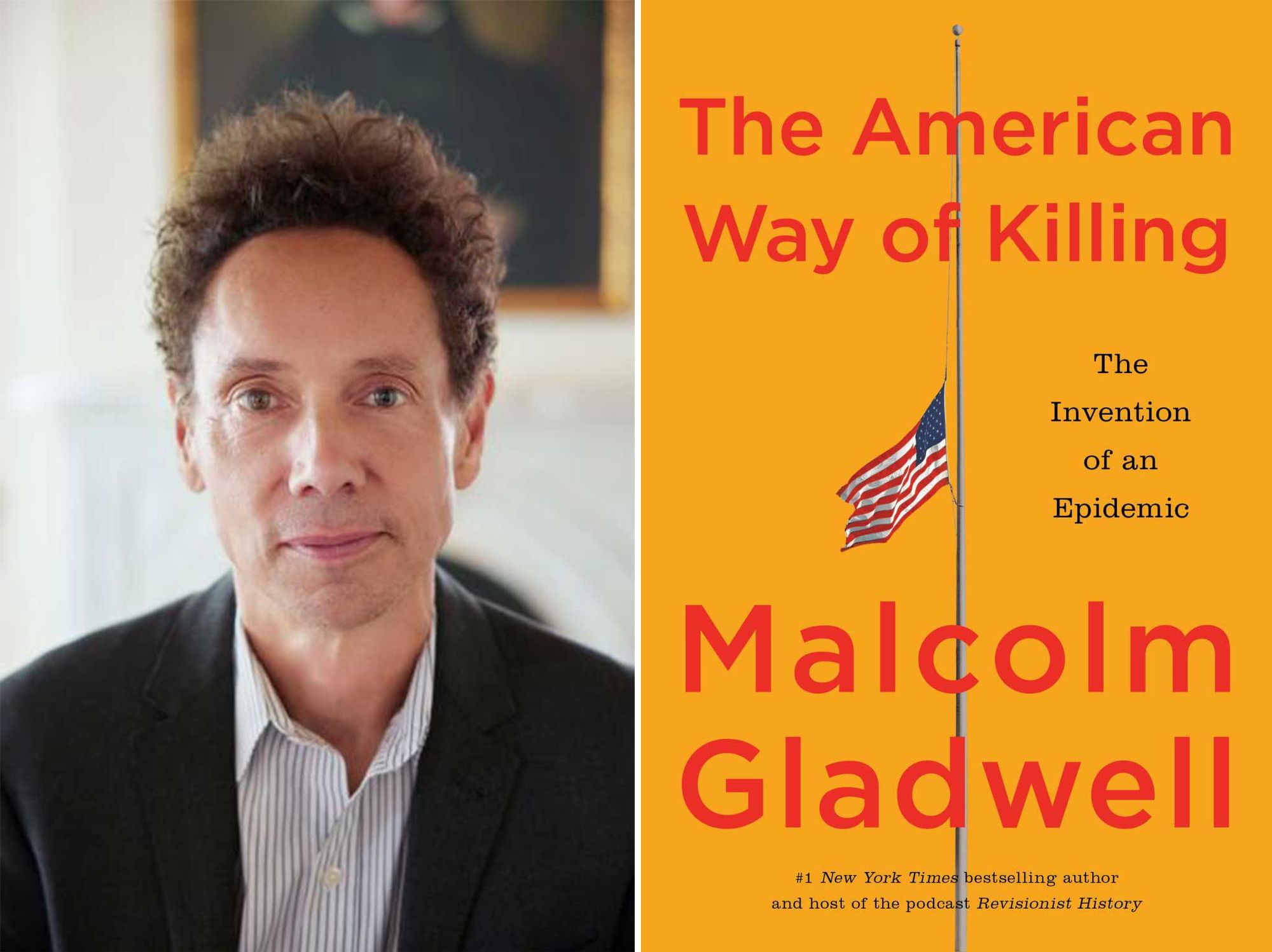
“The American Way of Killing: The Invention of an Epidemic”
By Malcolm Gladwell
Little, Brown & Company
The morning after I’d stayed up late finishing Malcolm Gladwell’s newest book, The American Way of Killing, I woke to news of a 16 year old male in Oregon having forced his way into an elementary school with a shotgun. He killed three children and a teacher before a parent with a pistol entered the fray and fatally shot the teenager.
In the past, I might have said the timing of these two events was uncanny; but now, there are so many mass and school shootings in this country that frankly, the chances are depressingly high that another may happen when you read AWOK, too.
And you should. We all should if we’re ever going to have what Gladwell calls an “honest conversation” about gun violence in the U.S. Despite the Goodreads critiques already leveled against the book (surprise!), AWOK doesn’t pretend to offer solutions or answers; instead, Gladwell unpacks his thoughts on how we got here, historically speaking; discusses what we get wrong or misunderstand about gun violence in the U.S.; and analyzes our potentially backward (in Gladwell’s opinion) approach to crime and punishment.
One of the book’s starting points, for obvious reasons, is the Second Amendment. The sentence’s seemingly clunky construction has given us endless potential for debate and argument: does the “the people” refer to those in militias, thereby connecting the clauses by retaining the same subject, or is the Amendment aiming to protect the right to bear arms for both militias and all citizens?
Gladwell argues that James Madison, the Amendment’s author, was anything but careless in his prose, so this is decidedly not a case of “sloppy writing.” It’s instead an archaic grammatical construction that was common in Madison’s day, but has been out of use for more than a century.
Admittedly, as a word-nerd writer, I found this discussion utterly fascinating. Gladwell interviewed Australian linguist Kari Sullivan, who’s done “the most extensive empirical analysis of Madison’s prose,” and after talking with her, he concludes, “Here’s how Madison liked to use being clauses: … Observation and explanation, separated by a comma. Now the Second Amendment makes perfect sense: Why should the right of the people to keep and bear arms not be infringed? Because we don’t want anything to threaten the existence of militias.” (And as Gladwell then argues, concern for militias in this historical moment seems most deeply rooted in slave owners’ anxiety about potential revolts.)
Other ways in which Gladwell insists that we’re not having an honest debate about gun violence concern our fixation on rifles and automatic weapons, when handguns are responsible for the vast majority of murders; our obsession with cities’ murder rates, when a city’s number of attempted murders can often reveal a very different picture about our country’s most dangerous areas; our tradition of investing resources far more heavily in punishment and prisons instead of police and prevention, when countries in Europe do the exact opposite (and have statistically more positive outcomes); and our mistaken assumption that most violent crimes have a motive, when in reality, the vast majority of them happen simply because someone lost control.
Gladwell loves nothing more than to subvert readers’ assumptions and expectations — it’s often his work’s raison d’etre (and it’s no accident that his podcast is called Revisionist History). Though critics argue that he relies too heavily on anecdotes, and that his voice can seem smug and condescending, Gladwell is a truly gifted storyteller, and I, for one, adore reading his books. (Yes, I would rank AWOK among his best.) He’s a writer who follows his curiosity and goes down rabbit holes, coming back up to report on what he’s found. And I appreciate that while conveying this information, Gladwell employs his dry wit and personality. It gives his work an added sense of fun and humanity.
And let’s face it: when it comes to tackling intractable, polarizing, hot button topics like gun violence in the U.S., we need all the hand-holding and intel we can get.
Follow Midbrow Detroit on social media:
Bluesky, Facebook, Instagram, Threads, TikTok, X.


