
Tulsa Ballet: Creations in Studio K
Tulsa Ballet Studio K
September 13, 2026
“We’re a restless organization,” Marcello Angelini said in an introductory video before Creations in Studio K, which runs through this weekend to launch Tulsa Ballet’s 70th season, his last after more than three decades as artistic director. It’s fitting that this company’s headquarters—the home of the 295-seat Studio K—sits right on Tulsa’s Restless Ribbon, between the gleam of downtown and the sprawl of the suburbs, just as Tulsa rumbles in the middle of America’s great dance hubs.
The Shawnee-Peoria ballerina Moscelyne Larkin and the Polish premier danseur Roman Jasinski traveled the world as dancers before doing the most incongruous thing imaginable: starting a ballet company in Oklahoma in 1956. This year’s Creations in Studio K program, showcasing three contemporary works newly created for Tulsa Ballet, gives a nod to the full range of what the company is bringing with it into the future. These are all new pieces, but that restless history shines through them in a way that gives them depth and dimension.
I’m temperamentally disinclined to like a Route 66-themed ballet, but Ma Cong’s Route 66 won me over, in part because of the real-life story of its creator. Cong arrived in Tulsa from China in 1999 and spent 21 years with Tulsa Ballet, where he was beloved as a dancer and choreographer and is still remembered with affection, as signaled by the audience’s happy murmurs of recognition as he appeared onscreen in a pre-performance video. He’s gone on to become an American citizen and artistic director of Richmond Ballet, living in Virginia with the man he married here and their two sons. Sometimes dreams really do come true on the Mother Road.
Route 66 feels like a love letter to the dance of life that passes through Tulsa, ranging from sassy kicks from a passel of fellas (“King of the Road”) to deep-welling emotion (“At Last”) to a loose-limbed line-dance shuffle set to the wind-it-when-we-feel-like-it watch of “Tulsa Time.” Signature elements of Cong’s choreographic voice bloom like roadside primroses across this ballet: a main couple up front as other couples drift in and out behind them; formations that merge and blow apart with ease; limbs that fling out from a warm-hearted center. In jeans and gingham skirts, the dancers have believable fun with this work, whose Oklahoma-sky-inspired lighting by Julie Duro starts with a full-spectrum sunrise and ends with the company in silhouette, still dancing under a violet dusk.
The history of American ballet is studded with reflections on American life, from Billy the Kid and Filling Station and Rodeo (all of which Tulsa Ballet used to perform) to Paul Taylor’s Company B and Justin Peck’s millennial-coded The Times Are Racing. Route 66 fits comfortably into that lineage: it’s a crowd-pleasing romp, but it’s also a vibrant and emotional bit of storytelling by someone whose life was actually changed in this place.

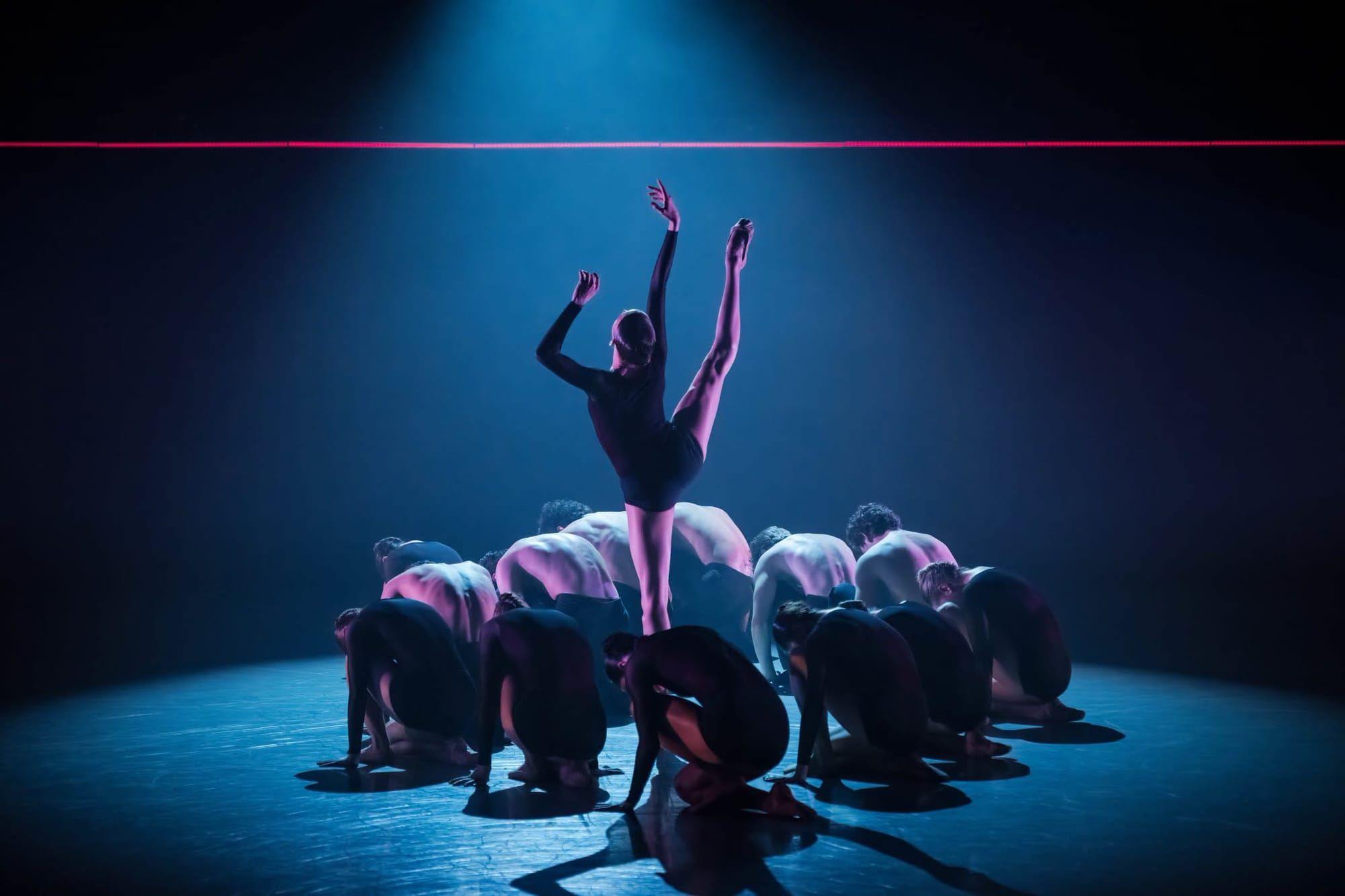
In the middle of this year’s Creations program sits Yury Yanowsky’s (in-TER-stiss): industrial, architectural, equal parts night sky and concrete alley. The dance lineage here tracks back to William Forsythe and Wayne McGregor, with atmospheric notes of Blade Runner and a score full of whooshing whip cracks, synthy techno beats, and hints of thunderstorms and voices by Cologne-based artist Senking.
An interstice is a gap between things—objects, people, events—and the word makes an apt title for a piece made for Tulsa Ballet II, a transitional hub between young adult dancers’ intensive training and their full-fledged arrival as professionals. The second company’s emerging artists get to start each season with something delicious: a short contemporary piece created just for them to premiere at Creations. I love this annual introduction to the literal future of ballet, and the pieces made for TBII each year tend to carry a special charge of dynamic energy, as if the choreographers themselves are dipping into their own youthful spirit of risk and ambition.
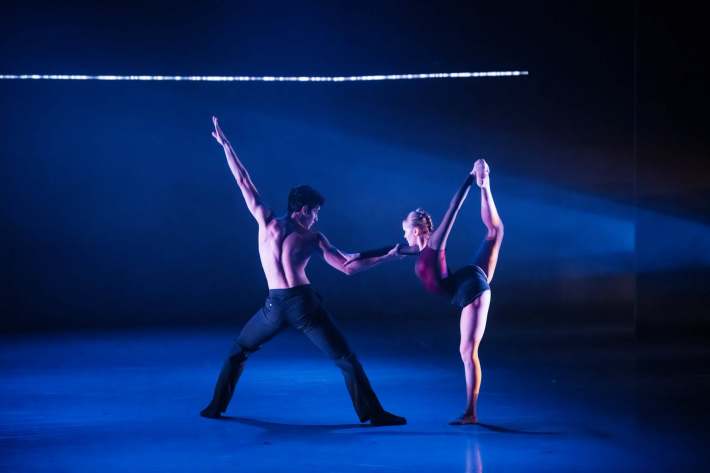
Yanowsky starts the dancers off in an upstage-left pack under a head-height strip of LEDs and, in near darkness, shoots them through invisible narrow passages in ones and twos as if moving between panes of glass. As he fills the stage with dancers exquisitely attuned to the timing of the music, the interstice itself becomes another figure in the room, appearing and disappearing with every interaction. By the end, there are two packs of people back by those lights, both separated and linked by the space between them.
It’s a satisfying stroke of choreographic development: as the piece moves along, it trains our eye to find that shape—that gap—with simple elements delivered unexpectedly. Two dancers, at first moving in opposition, reach a second of harmony on the same diagonal; a woman slips through a hole made by her partner’s arms; a mid-stage single-file line (ubiquitous in contemporary ballet) pulls apart and collapses into a sort of honeycomb through which the lone standing dancer runway-stalks toward the audience. Little details—fingers moving as if on piano keys, a light tap of foot against floor—feel fresh and beguiling.
Do objects define the gap between them, or does the gap define the objects? It’s a fun question for a mobile, 3D visual medium. The same gesture starts and ends this piece: a long balance on one bent leg, with the other foot closely wrapped behind it like an arm around a friend. There’s no melody here—just a metallic slice and rumble, shards of geometry and physics in which a quiet, persistent human shape can make a home.
I saw another glint of Tulsa Ballet lineage in Natasha Adorlee’s Salt Wives, which opens the show—namely that of Spanish choreographer Nacho Duato, whose works defined this company’s voyage into contemporary dance. Angelini noted that Adorlee’s piece last year for Tulsa Ballet II, Horas de Hamra, was so loved by the main company’s dancers that they asked him to bring her back to make something for them. Her new piece is less spirited than that earlier work, but it strikes a deeper note and wrestles with loss and belonging in ways that stay with me just as strongly.
Adorlee, an Emmy-winning musician and filmmaker as well as a choreographer, crafted a whole world for Salt Wives, with design details that help tell a loose story of young women learning, through love and grief, to be part of a community. Duro’s lighting, especially the wide hazy panels of side light in the opening scene, created a breathtaking effect that seemed to erase the edges and double the size of the stage. Costumes by Alysia Chang gave finely rendered suggestions of a fishing village: vests, pleats, a duster, pearlescent skirts, and a haunting garment of shredded white fabric like bleached kelp.
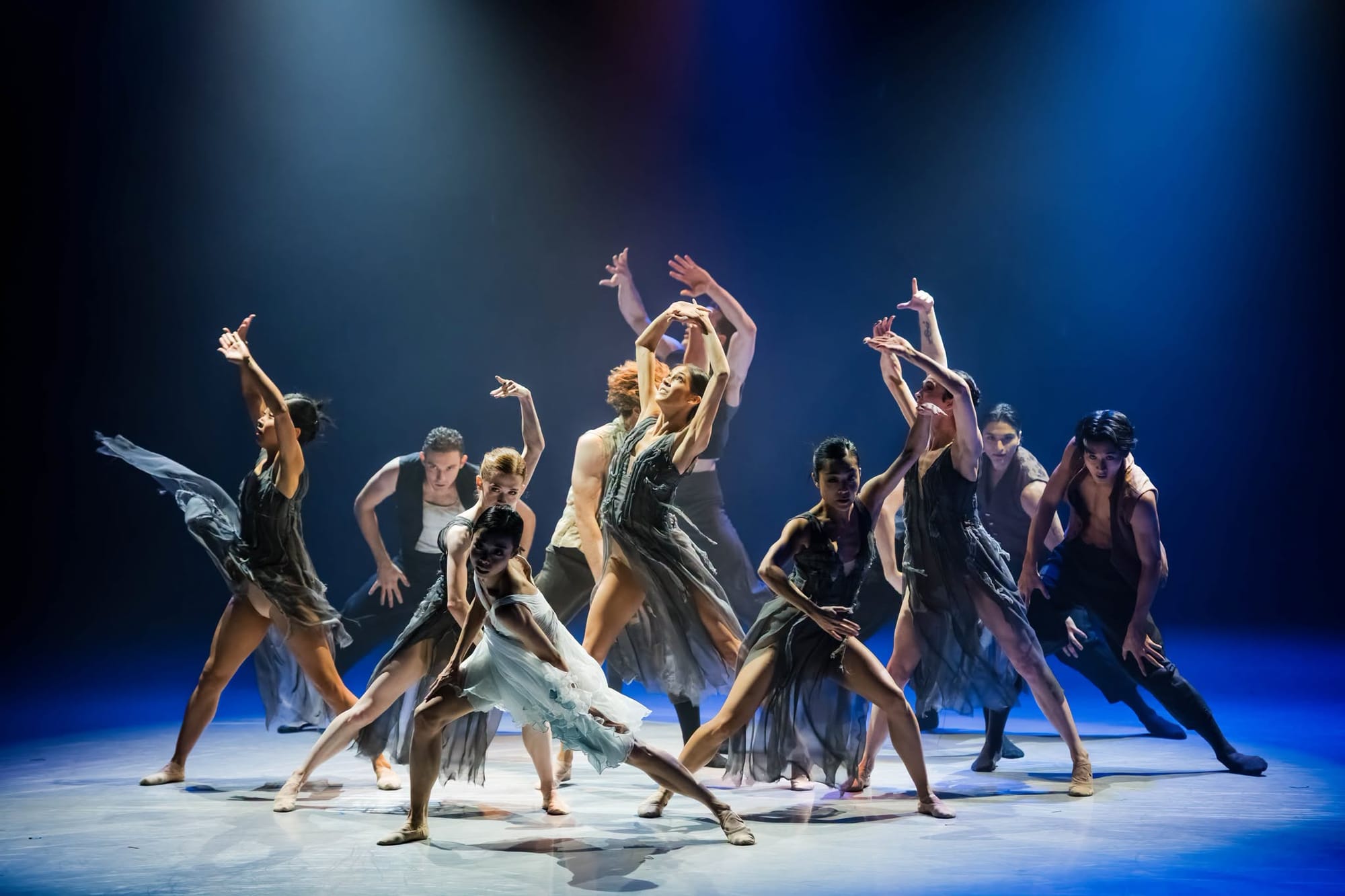
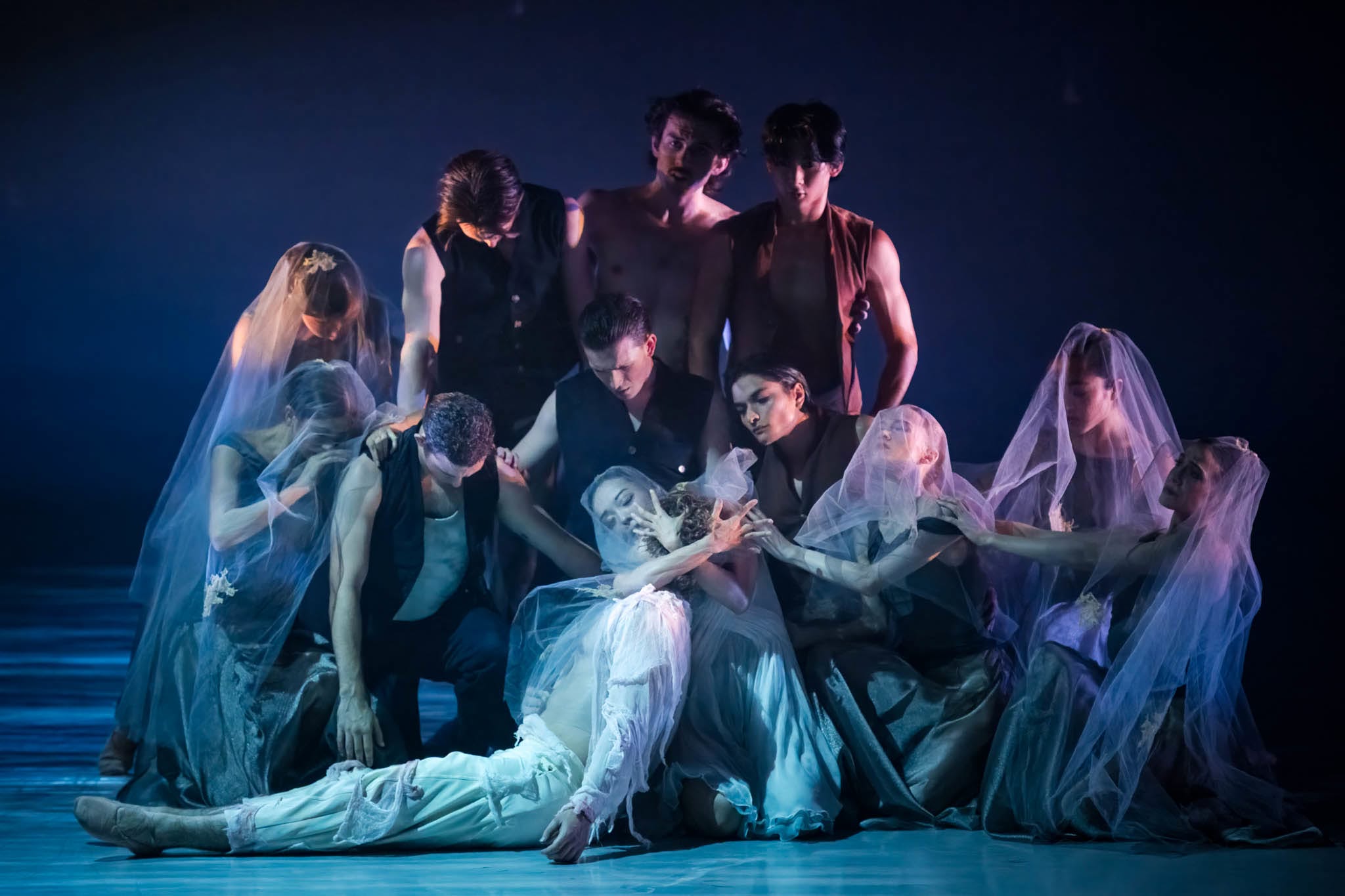
Natasha Adorlee's "Salt Wives" | photos by Kate Luber, courtesy of Tulsa Ballet
Salt Wives moves in tides and flashes to sounds that flow from Gambia, Iran, Lebanon, Albania, Andalusi classical song, and traditional Palestinian music. Adorlee’s movement language is lyrical and lush and legible: full of undercurves and overcurves, contractions and releases, and sharply beveled moments that the dancers seized upon with passion. A pas de deux for Aina Oki and David Sloan was a particular marvel of gravity and grace; he lifted her as naturally as hoisting a rope, then she reached one long leg across the back of his bent neck, sinking both of them softly to the floor.
Part of why Adorlee’s art resonates for Tulsa Ballet, I think, is that she’s working with subjects that matter in an increasingly artificial world: ritual, lineage, grief, joy, memory, connection, all of which have been the purview of dance around the globe since before recorded history. Humans, like this company, are restless. The most fundamental thing about us is that we move; we process life through our bodies; we carry our ancestors forward; we change reality through creative action. Spaces in which to do or witness that are the direct opposite of the algorithm’s endless void. Go see some dance.


