
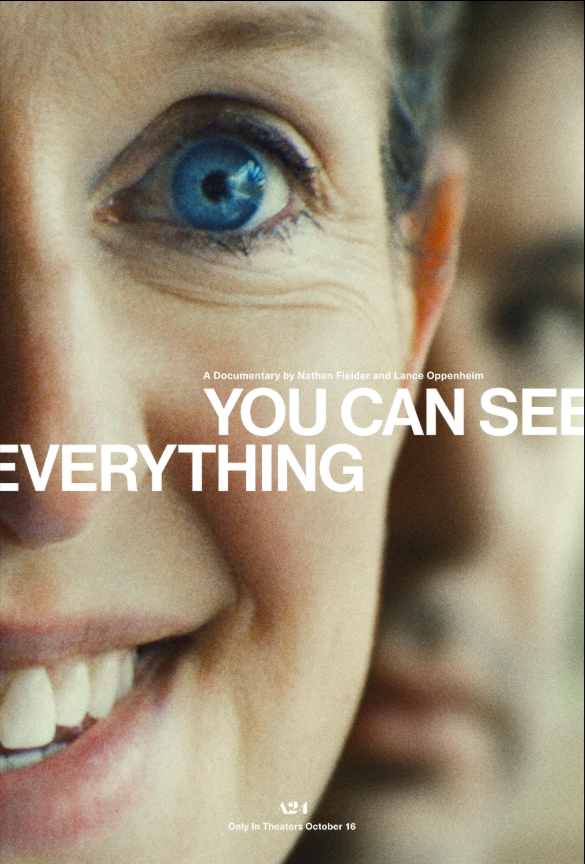
You Can See Everything
Cinemark Buckland Hills 18 XD
Manchester
Oct. 16, 2026
Contains Spoilers
At one point in his new documentary You Can See Everything, Nathan Fielder jokes to Theranos founder Elizabeth Holmes about her choice of him as the person to film her last month of freedom before reporting to prison for defrauding investors. He references his most popular project, Nathan for You and says (paraphrasing from memory): It’s funny, because I give fraudulent business advice, and you ran a fraudulent business.
Fielder actually isn’t that odd of a choice for a project like this, given the faux-documentary nature of his other work. But he approaches Everything with sincere empathy, not just for Holmes, but for the people she lied to. That broad-based empathy allows him to let Holmes tell her story, but he never lets her off the hook. He constantly challenges her. There’s no schtick here, at least from Fielder.
A large portion of the documentary is Holmes trying to prove to Fielder that she wasn’t committing fraud, that her machine actually did what she said it could. She called her persecution the result of malicious people weaponizing a terrible misunderstanding.
If that was all it was, You Can See Everything would be a fascinating look into the mind of Holmes, who claimed she could revolutionize blood testing with a machine that could perform hundreds of tests on a single drop of blood. She and her-then boyfriend Ramesh "Sunny" Balwani proceeded to defraud investors of hundreds of millions of dollars with a machine that did not live up to its lofty promises, which led to their eventual convictions.
None of that has deterred Holmes, who agreed to give Fielder total access to her home for 34 days. He moves in for the last two weeks, watching the relationship between Holmes and partner Billy Evans unfold in real time. The two are cooking up a new business based on using light to read blood chemistry or something.
Holmes is not defiant, but she’s unapologetic. She earnestly does not believe she did anything wrong. At first, even Fielder can’t read whether she’s being sincere or not. He and co-director Lance Oppenheim play up that doubt with masterful camerawork and a moody, eerie score that highlights the eerie qualities of Holmes herself.
One of those qualities is she barely blinks. It may look like that fact was played up for effect in the trailer for the movie, but she truly rarely blinks throughout the film. There are multiple moments when the two are simply staring at each other; Fielder is trying to figure out if Holmes is lying, telling the truth, or telling the truth as she believes it. When Holmes tells Fielder that she’s never told a lie before, he aggressively questions her on that assertion; she never backs down. Just as he can’t tell if she’s being serious, neither can we, although it feels like she’s practicing the closest thing to sincerity she’s capable of.
But Everything is much more than a case study of Holmes, as she enters federal prison about halfway through the three hour documentary’s runtime. The film then shifts to Evans as he attempts to keep using Holmes’ name to get the new business off the ground. Evans is a genuinely dislikable man, a caricature of white male ego and fragility, wrapped up in intense fear masquerading as rage. He carries a gun with him everywhere in case someone tries to “silence him.” A guy making medical equipment.
Evans is literally using Holmes’ name, tweeting as her, making an AI avatar of her, even going so far as to secure her power of attorney while she’s in prison. All of which begins to shed a new light on Holmes: Is she, as her father suggested at one point, simply at the whim of powerful men around her like Balwani and Evans?
By this point in the film, Amanda Seyfried, who portrayed Holmes in the Hulu miniseries The Dropout, has joined Fielder in his search for the truth of the relationship between Holmes and Evans. Fielder initially contacted her to play Holmes to reenact certain scenes he didn’t have footage or audio for, but she becomes as wrapped up in the question of who Holmes really is as Fielder does. She accompanies Fielder to meet Evans, where an explosive conversation between Seyfried and Evans reveals just how awful Evans truly is.
The two decide that the only way to find out if Holmes is being manipulated is to ask her. Fielder travels to Texas to visit her in federal prison. She essentially admits to allowing Evans to do his own thing; while she may not have exact information on all his dealings, she trusts him to act in their best interests. When Evans shows up with the rest of the family for visitation, it becomes clear what’s going on: a love story between two sociopaths. As complex as the film makes Holmes, it never casts any doubt on who she is morally. She is a practiced, habitual liar who manipulates the people around her to her own benefit. Evans is the same. The two unironically seem like a great match for each other.
In the end, as Seyfried and Fielder talk about the experience, she says that Fielder has become protective of Holmes, even if he doesn’t completely trust her. It’s understandable; no matter how clear the wrongdoing, it’s impossible to live with someone and not be sympathetic at least a little bit. To Fielder’s credit, he never falls completely for Holmes' charm offensive, but he certainly becomes aware of what Nietzsche meant when he said the abyss stares back.
NEXT
Jamil goes to Hartford Stage for the US premiere of Morgan Lloyd Malcolm’s Dracula.


