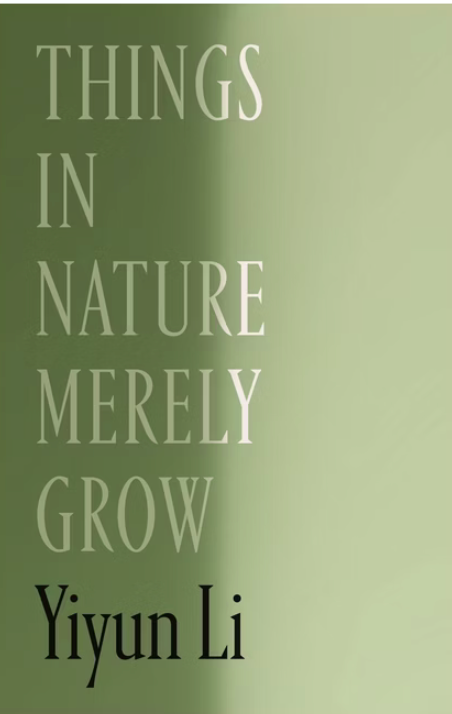
"Things in Nature Merely Grow"
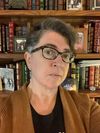
Yiyun Li
Farrar, Straus & Giroux
When I was young, my number one goal was to be smart. If I could rationally, unemotionally “Sherlock Holmes” my problems, I thought, I would be happy and respected. Add thinking-via-writing to that equation – if I could, as the musical “Hamilton” suggests, also “write my way out” of challenges – and you get a true believer in the church of intellect.
But when something like the heartbreaking loss of a child to suicide hits a parent not once, but twice, what possible consolation or answer can intellect offer?
Princeton University professor Yiyun Li’s memoir, “Things in Nature Merely Grow,” addresses this painful, seemingly impossible question: “My husband and I had two children and lost them both: Vincent in 2017, at sixteen, James in 2024, at nineteen. Both chose suicide, and both died not far from home.”
A prolific author and scholar, Li previously wrote a novel inspired by Vincent’s death (“Where Reasons End”), wherein a mother continues to talk with her son following his suicide; and a memoir (“Dear Friend, From My Life I Write to You in Your Life”) that chronicles her own struggles with suicidal depression after immigrating from China to the U.S.
Li tells us up front in "Things" that writing a book for James is likely to be her toughest challenge yet: “In life, James resisted metaphor and evaded attention. If Bartleby and Hamlet could merge into a singular being, James might have occupied that space with some comfort. … It’s an impossible task to write a book for James. It will have to be done through thinking, rather than feeling.”
She is not kidding about this, folks. The book is a sustained, literary-quote-filled effort to grapple with life and death when both your children chose suicide – an awfully tough thing for an involved, loving parent to confront. As Yi explains, after inviting readers to stop reading the book if they’re looking for a conventional grief narrative, “This book is about life’s extremities, about facts and logic, written from a particularly abysmal place where no parent would want to be. This book will neither ask the questions you may want me to ask nor provide the closure you may expect the book to offer. … This is not a book about grieving or mourning. This book will not provide a neat narrative arc, which some readers may hanker for: from hardship to triumph, from incomprehension to newly gained perception and wisdom, from suffering to transcendence. This book will not provide the easy satisfaction of fulfillment, inspiration, and transformation.”
This passage arrives in an early chapter. It caused me to pause and ask myself: Well, why did I seek this book out? I’m a parent. The book is about living through my worst nightmare, twice. What exactly am I looking to get from this memoir? Yes, it’s highly acclaimed and made several “best books of 2025” lists, but each year, I skim through several titles on those and think, “Nope, not for me.” What made me say “yes” to this one?
The only answer I came up with was: to hear how a parent – who suffered from depression herself before losing both sons to suicide – keeps putting one foot in front of the other.
Although I’d read and understood Li’s warnings about what the book wasn’t, I was surprised at my own resistance to the book’s cold logic. I found myself frustrated by Li’s many literary quotes and allusions, and her family’s dogged devotion to free will. She writes, “despite our not knowing enough of James’ thinking, what we could be certain of was this: he knew that we would respect his decision to take his own life, and he trusted that we would endure his death, as we had done it once before.”
To me, this sounds enlightened and detached to the point of incredulity. As if a scientist (which Li was earlier in her life) were simply looking through a microscope – which is precisely what Li seems to be aiming for.
But as a non-academic who isn’t likely going to process personal pain via Camus’ “The Myth of Sisyphus” or Shakespeare’s “Richard II,” I struggled to solely engage my intellect, and not my heart, in regard to her experience.
Yet as she takes pains to point out, Li does not aim to speak for anyone but herself. And her particular filter seems, to some degree, to be the result of childhood abuse (mental and physical). She describes a game her mother invented about Li, at age 3 or 4, having an identical twin in the house “who was obedient and sweet-tempered, and she was neither selfish nor lazy. … Sometimes my mother recruited my sister into the game, saying that there was no point in loving me anymore because that perfect twin was in the next room. And then they would go away together, my mother laughing and talking vividly about the other girl.”
With glimpses like this at her past life – up to and including a description of her 2012 stay at a psychiatric hospital following her own suicide attempt – you see why and how Li came to center intellect over emotion in her life. But what’s perhaps hardest to square is how she and her partner were the opposite of her mother, in terms of being loving and supportive parents, and still had children who not only also tried to end their lives, but succeeded.
Li writes, “I did not feel any anger when Vincent died – not at him, not at life, either. But I did feel baffled and wounded by life. That a mother could do all things humanly possible and sensible for a child but still could not keep him alive – this was the fact I would have to live with, I thought, every single day, for the rest of my life.”
How one lives with this awful contradiction is the question that drew me to read “Nature.” Li’s response, in the end, wasn’t wholly satisfying to me; but speaking as a former acolyte in the church of the intellect, I have to admit that in this particular circumstance, it’s pretty hard to imagine otherwise.


