
Winter Solstice
Group exhibition
Kehler Liddell Gallery
New Haven
Through Dec. 21
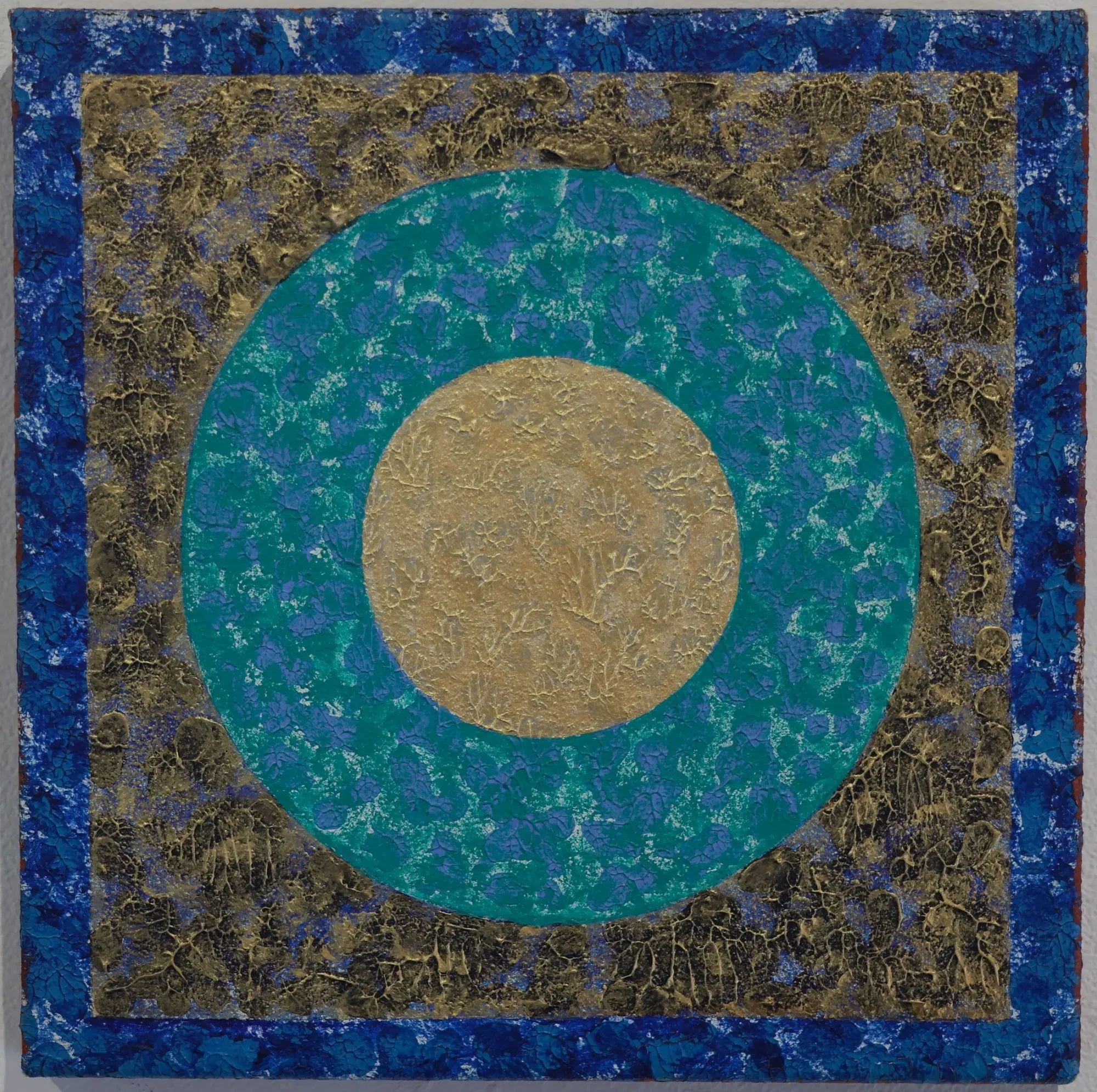
Sheldon Krevit’s Portal to Now — part of “Winter Solstice,” the show running at Kehler Liddell Gallery — has the soothing, variegated colors of a shady, tropical oasis: warm sand, mottled turquoise waves, submerged rocks and deeper water beyond. The title gives it all a sense of possibility. Diving into the portal’s center promises a sense of calm presence and hope.
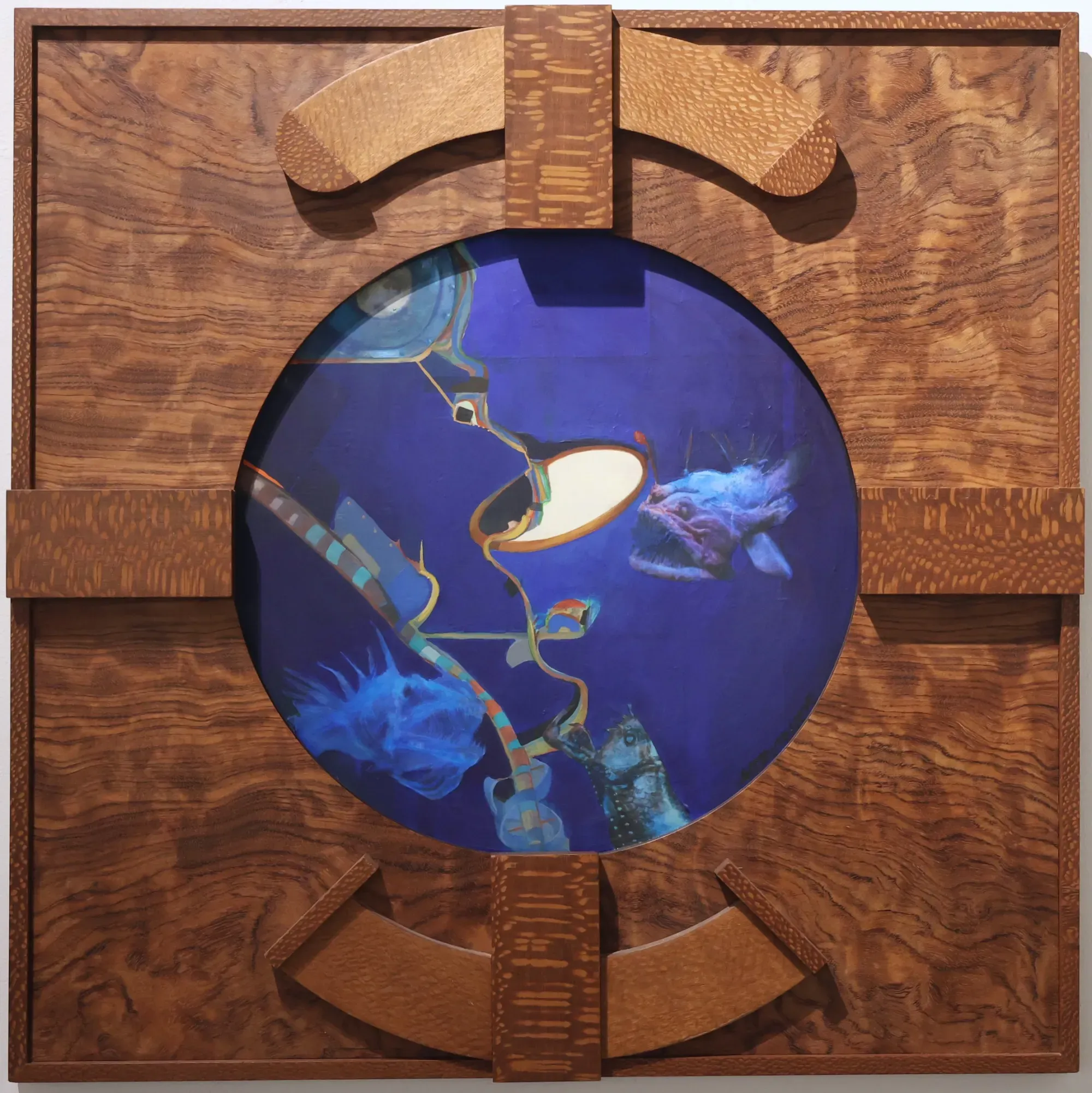
Elsewhere in the gallery is a piece by William Butcher — Portal to the Abyss — that feels as though it could be a response to Krevit’s piece, or even that Krevit and Butcher collaborated in making them. The similarities extend beyond the title; they share formal elements (circles within squares) and color schemes as well. Their shared proclivities have a way of informing one another. The cheerfulness in Krevit’s piece makes it easier to see that the title of Butcher’s piece isn’t just portentous, but also descriptive. It’s possible even to see a little humor in it, an awkward deep-sea exploration device encountering some of the most alien life forms that live in those depths. They will never really get along.
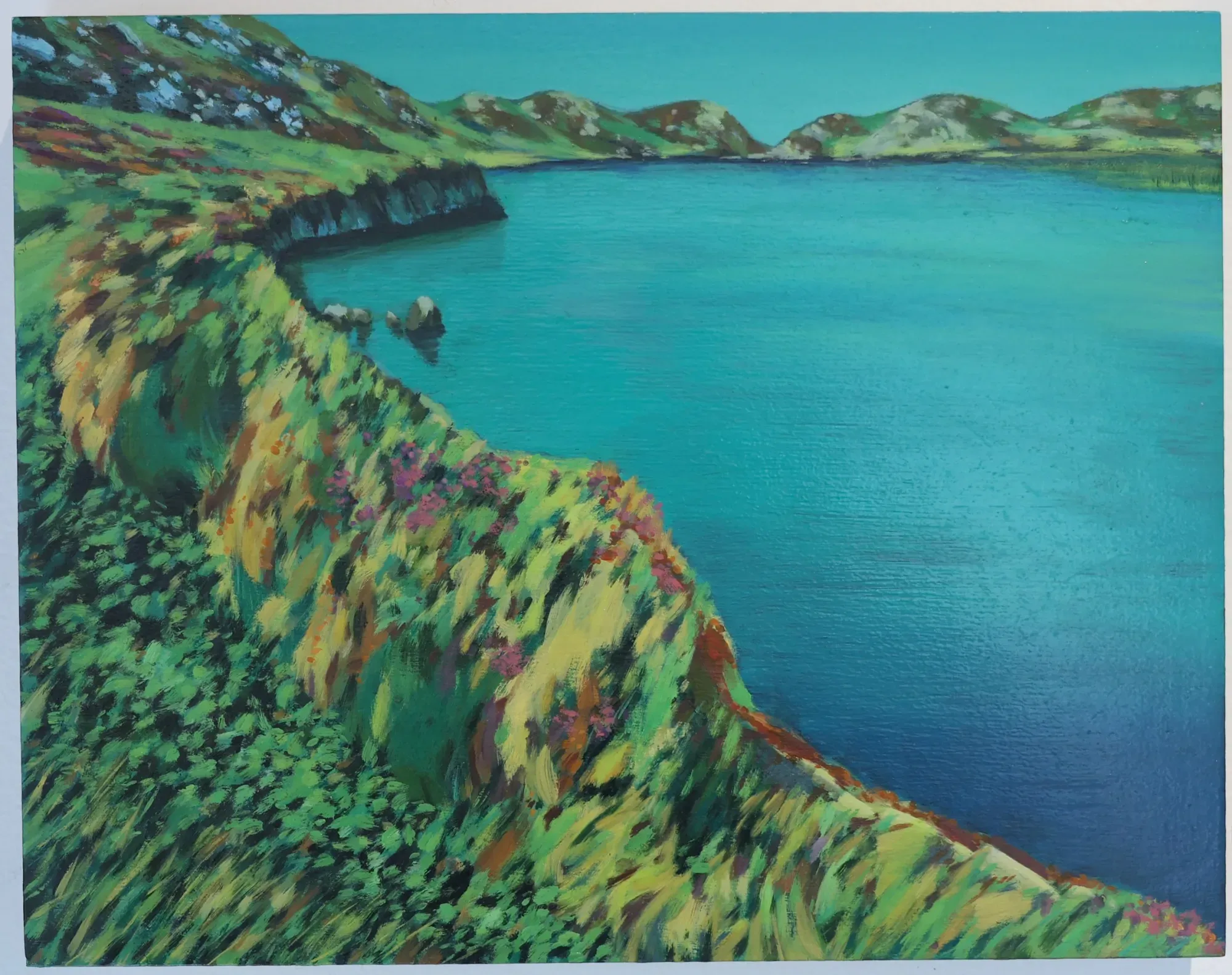
Krevit’s and Butcher’s pieces are emblematic of the affinity among the pieces on the walls in “Winter Solstice,” which doesn’t aspire to a theme but revels in the parallels. Sculptors Craig Frederick and Gar Waterman, for example, contribute tall, thin works that use sweeping lines to make their pieces feel kinetic, almost more like mobiles than static sculpture. Both artists also take their inspirations from the natural world. Frederick titles his piece Crustacean Dreams I, while Waterman names his piece Cotelydon, the term for the first leaf to sprout from a germinating seed. Painters Sean Patrick Gallagher and Dganit Zauberman both create landscapes that seem serene at first, though the textures point to more complex emotions that the titles bear out. Gallagher’s What She Left, and What She Kept suggests a view fraught with personal meaning for the original viewer. We don’t necessarily know what that meaning is, but that doesn’t stop us from feeling the emotions that it evokes. Zauberman’s Once Was, meanwhile, confirms a viewer’s suspicion that the painting is of a large glacier in a mountainous valley — and that, if we were to travel to that spot now, the glacier would be gone.
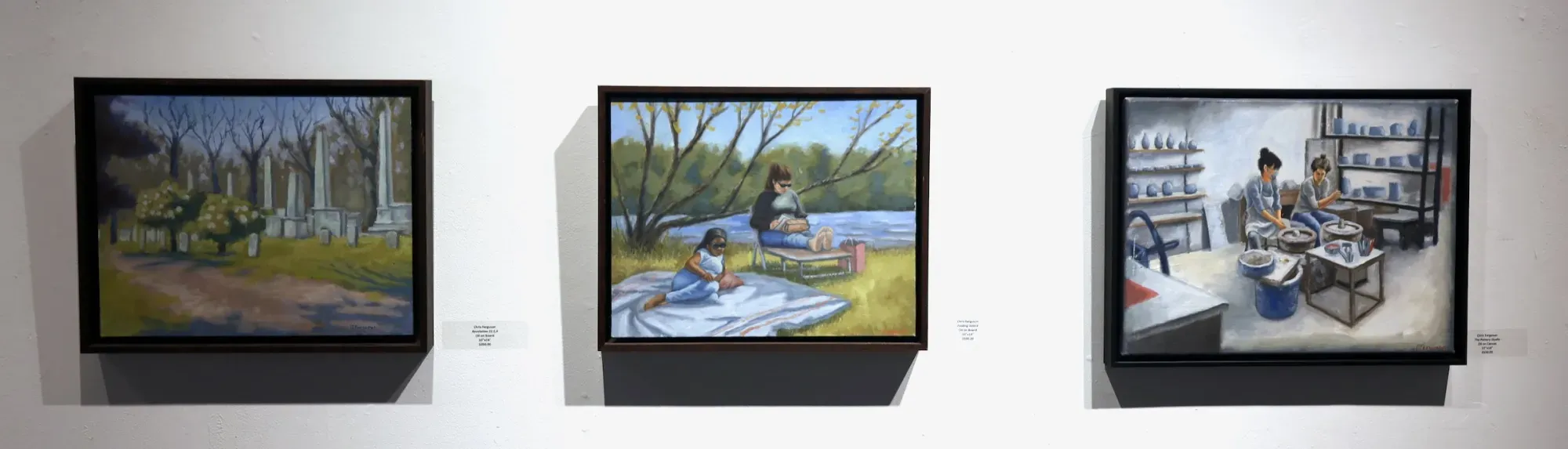
Two other painters — Frank Bruckmann and Chris Ferguson — have three paintings each in the show. Bruckmann’s paintings are an obvious series, a still life of what appears to be the same vase of dahlias on a table, viewed, as the titles suggest, from the left, center, and right. Bruckmann’s warm touch and careful eye let us see that the same flowers from different angles can feel new all over again. Meanwhile, Ferguson’s paintings may not be intended as a series, but their grouping invites a reading that encompasses them all. The center and right paintings have much in common: a breezy atmosphere, a sense of leisure, two people sharing an activity, whether it’s relaxing in the sun or making pottery.
The painting on the left, of a graveyard on a sunny day, complicates any story you might want to tell, however. The scripture quoted in its title — Revelation 21:3,4 — reads: “and I heard a loud voice from the throne saying, ‘Look! God’s dwelling place is now among the people, and he will dwell with them. They will be his people, and God himself will be with them and be their God. He will wipe every tear from their eyes. There will be no more death or mourning or crying or pain, for the old order of things has passed away.” It’s a hopeful passage given a spin by the subject matter. A first reading allows that it’s the sentiment of a faithful person, drawing strength from religion when faced with loss. But the pairing of meaning and subject also acknowledges the difficulty. Even if the title and the subject don’t undermine each other, they suggest that, even for the faithful, the faith can sometimes be hard to muster. The practice lies in working through it, even in the face of difficult things.


