
Videoheaven
Yale Film Archive
New Haven
Jan. 23, 2026
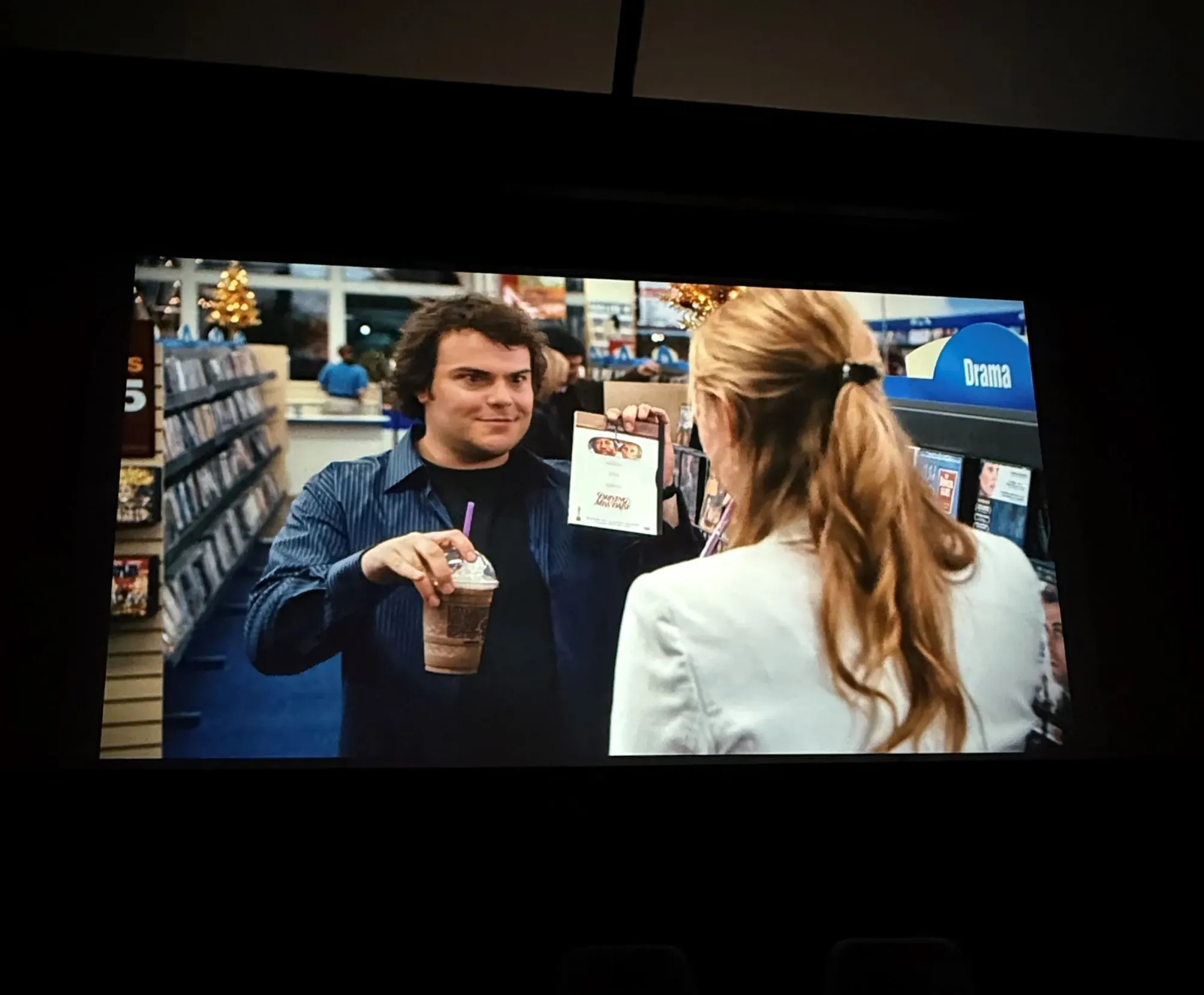
In a clip from the 2000 film Hamlet, Ethan Hawke wanders through the action section of a video store as the titular character, his “to be or not to be” soliloquy an apt form of pondering about life and death in such a place. This clip is the first of many in the spectacular journey that is the film Videoheaven. This 2025 documentary – Friday night’s offering at Yale Film Archive — traces the lifespan of the video store via clips from a seemingly endless number of movies, television shows, commercials, and news reports. The film is narrated by none other than Maya Hawke, daughter of Ethan and an actress herself who has also appeared as a video store clerk in a famous series (Netflix’s Stranger Things for those not in the know).
Writer and director Alex Ross Perry was on hand after the film along with YFA’s Brian Meacham and Best Video’s Rob Harmon to discuss his film and participate in a Q&A. Meacham called Perry “a leading light in independent film” and called the documentary “a sprawling encyclopedic look at video stores.”
By the end of the film, it was apparent that Meacham was correct on both accounts. The nearly three-hour film is a testament to the indelible mark the video store has left on American culture and the love with which it is remembered and revered by so many. But it is also a detailed examination as to how the media’s representation of it affected its growth, persistence, and eventually its demise.
The film is separated into six chapters and an epilogue: What Was the Video Store, The 1980s and the Rise of the Video Store, Hey Day of the Video Store, Adults Only, Concerning Clerks, The Decline and Death of the Video Store, and The Afterlife of the Video Store. These chapters include not only detailed background information but also contemplation as to how and why the video store’s lifespan played out as it did.
And if you are a cinephile and/or fan of television shows, especially of the ’80s and ’90s, this is the next must-see documentary for you. Nearly 200 clips are shown, from the famous films — such as The Fisher King – and the not so famous films — such as Watching the Detectives. They are also discussed and dissected for their roles in portraying the video store, its employees, and its patrons in all of their glorious and often not so glorious ways.
According to Perry during the discussion afterwards, the thesis of the film “is not that video stores are gone” but instead “three hours of proof that they were so culturally ubiquitous that you would see them on TV, in movies, everywhere.” He also mentioned that it is “not a definitive eulogy” but it is “a eulogy of their depictions.”
If you really think about it, you can most likely recall a scene in a show or film that occurs in a video store. Examples include Seinfeld (where it happened famously more than once), Serial Mom, I Am Legend, and The Simpsons. One might even recall a film or show where one of the characters famously played an obstinate or judgmental video store clerk (such as in the film Clerks). You may also recall your own experiences renting movies back in the day, whether it was at your local small video store or in the once ubiquitous Blockbuster superstore. Either way, its 172-minute run time flies by, especially for those of us whose lives can be revisited by these cultural landmarks including buying their first VCR or watching their first videotape. (Mine was Nightmare on Elm Street on a sweltering Fourth of July with my boyfriend who is now my husband and a bunch of other teenagers.)
Of course, there are most likely readers here as there were viewers of this film on Friday night who were not even born during the bulk of these cultural shifts. All the more reason why Perry’s film is such an vital and necessary piece of work. It becomes a visual document of not only the video store lifespan and experience and its depictions in film and television, but of the time period during which it all occurred. Think about it: in the future one may not see a video store depicted in a tv show or film unless it is set in that time period (as Stranger Things is).
One can consider physical media such as the videotape in a similar way. Perry spoke of having visited Best Video earlier that evening and being impressed with their section of documentaries and music films. He noted that for some of these films from the 1980s through the 2000s this would be the only way to see them due to many of the distributors no longer being around and them not being able to create updated versions of them on, say, Blu-ray or 4K.
“It’s not rare, but it’s not accessible,” he added.
The collective experience was, as often is at YFA, one of joy and connection, especially the gasps and laughter heard when certain familiar scenes were shown (one of the loudest being when cartoons such as Beavis and Butthead and The Simpsons were on screen). A decent number of lesser-known films are also examined, and, if you are the type of film fan like this reporter who likes to make note of new discoveries, your to-be-watched list will grow exponentially by the time this film is done. For example, did you know Toxic Avenger III: The Last Temptation of Toxie was so prescient? I had no idea, but I plan on watching it to find out more.
With this film Perry has created a fun and fascinating visual document, something that can be watched to learn, to be entertained, and to remember that, once upon a time, we all had something really special.
Those of us in the New Haven area still have a piece of that something really special: Best Video. So go check them out if you haven’t already, look for Videoheaven on streaming services in March. Check out the rest of YFA’s massive spring schedule of films – all free and open to the public – which includes, among others, an epic series of Stanley Kubrick’s work in 35 mm.


