
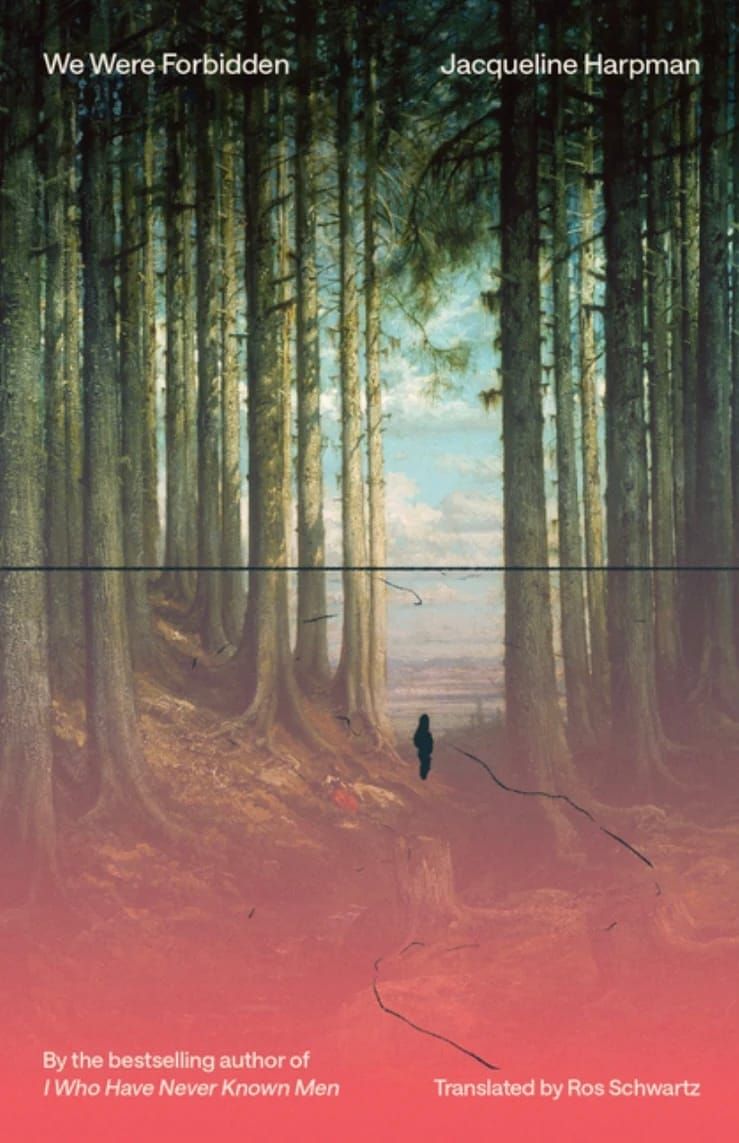
We Were Forbidden
Jacqueline Harpman
Translated from the French by Ros Schwartz
Transit Books
I like bleak. The via negativa in literature is good stuff to me. Apophatic approaches toward the mysteries and experiences of life is my jam. So, intrigued by the back cover précis of the first of three novellas that comprise Jacqueline Harpman’s newly published We Were Forbidden, I was eager to dig into what promised to be a dark read. There’s darkness all right, but not a lot happens in this trio of tales, one that’s terribly interior. While the writing is surprising at times, it’s so cerebral, philosophical, and oblique that I found it to be rather frustrating. Perhaps this might have something to do with the fact that these stories are translated from the French (by Ros Schwartz). But despite a story’s original language, a good yarn should shine.
The first novella, “The Ardennes Forest,” is the strongest and the one I found to be the most compelling. The feeling of disconnection and dread that pervades the tale is insidiously brilliant. It’s dreary, but in the best kind of Twilight Zone way. Although written flat as a pancake in an expository, matter-of-fact fashion, it’s unshakably creepy. A group of people—both men and women—are tasked with patrolling the Ardennes Forest, but what their mission is, exactly, isn’t specified, nor it is revealed by whom the mission is given.
There’s a war going on, or perhaps the war is over, the group wandering the forest in a kind of existential fugue. It’s a monotony of boredom for these always on-the-move characters, their clothes continually turning to rags. “Maybe there were still human beings, but no army,” the narrator states. “So, should we believe that we had become the army and that it was our duty to protect the survivors?” They live a grim, hand-to-mouth existence, forever shuffling forth through the trees until one day they come upon a small, deserted village where they enjoy a modicum of hope and respite. But the society they briefly create is not to last very long.
The second novella, “The Outcast,” is preceded by a note from the translator that informs the reader that during World War II, Jacqueline Harpman’s family, who were Jewish, fled Belgium after Hitler’s army invaded and occupied it, finding refuge in Casablanca, Morocco. It is in Casablanca that the story is set, one in which two schoolgirls—the narrator of the story presumably Harpman—have a quarrel that results in the narrator being silenced by school authorities for 40 days after she refuses to apologize. The nature of the argument is to do with patriotism and morals, stemming from the fact that Harpman’s soon-to-be former friend Henriette laments that her brother is fighting at the front. It’s a laborious story that circles around resentment and resistance; so completely thought-bound that when I finished it, I felt a great sense of relief. Barely a hint of wartime Casablanca is portrayed descriptively; the novella is almost completely interior monologue. I’m sorry to say that it was, for me, a grueling slog.
The final novella, “The Broom Closet,” begins on a train from Paris where a writer’s imagination is sparked by the dining car. She goes on to invent a tale of romantic intrigue wherein a passionate tryst in a hotel broom closet between a married woman and a dashing military officer becomes a story full of ideas of murder (the murder of the protagonist’s husband to be precise, known only as Monsieur X). The narrative is woven into a braid that involves the characters of the writer’s mind and her own life simultaneously. It’s decidedly more interesting than “The Outcast,” but is similarly preoccupied by inner thoughts and thus descriptive forward motion is stifled by intellectual musings. It’s mildly sexy at times, and not altogether morally grounded, yet not very exciting, underlining a kind of ethical ambiguity. “It is a fact that fate mocks us,” the narrator says at one point. Not very hopeful.
Thing is, there’s not much in the way of hope in this collection anyway. They’re novellas that contain a gray despair, the characters like sorrowful ghosts: colorless shadows full of anxiety and resentment. If there’s hopefulness in Harpman’s portrayals of such acute sadness I didn’t perceive it; except maybe when the wanderers in “The Ardennes Forest” find common humanity in things like clothing, wine, coffee, thread, and soap. That humanity pestered me by its haunting melancholy. But I need more than just a faint glimmer of optimism in the bleak stories I like so well—something more than a mere sliver of a silver lining in order for bleakness to carry us past abject nihilism.


