“Undersiege”
Detroit Public Theatre
October 2, 2026
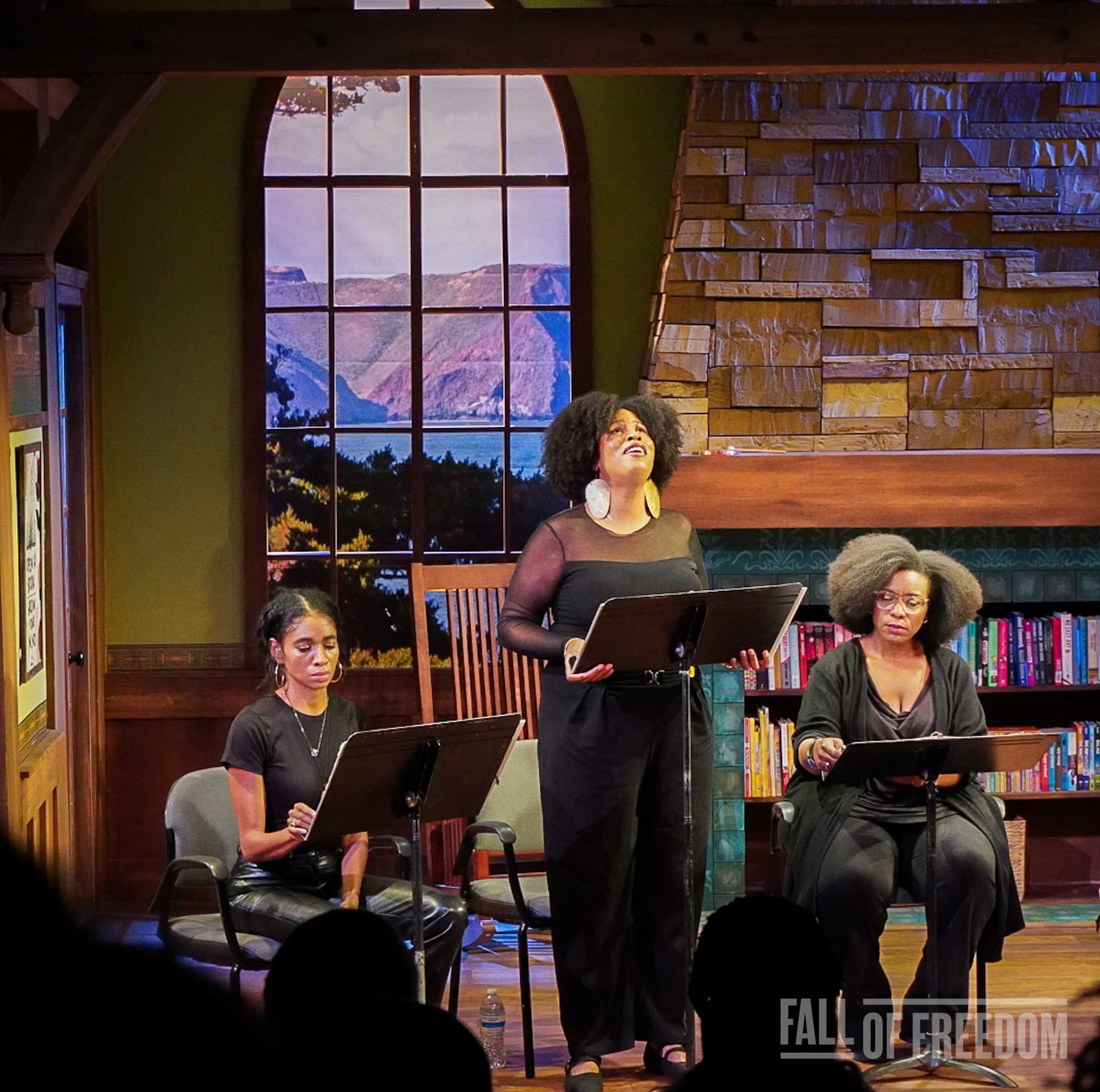
Seven Black women clad in all black sit onstage at Detroit Public Theatre. The stage is set for “Eureka Day,” a dramedy about school vaccinations, but the evening feels like an impending maelstrom ready to reap chaos on the forces that have caused the crashing of its tides. The audience, myself included, isn’t quite sure what to expect, but when Detroit Poet Laureate jessica Care moore stands and opens Undersiege with, “a poem, because goddamn,” we know it’s going to be highly relatable.
“Undersiege” is a collection of monologues, poems, and scenes written by more than 30 Black women and femme playwrights in response to questions about liberation, ancestral wisdom, rage, and their lived experiences. It was curated by Pulitzer Prize-winning playwright Lynn Nottage and Tony Award-nominated playwright (and Detroit native) Dominique Morisseau following Hana Sharif’s resignation from Washington D.C.’s Arena Stage, where she was the first Black woman to serve as artistic director.
“Given the climate of the nation right now where Black women and femmes are disproportionately under scrutiny and attack, and being forcibly removed from leadership positions in government, education, theatre institutions, corporations, etc, it has been my greatest honor to work in partnership with Lynn Nottage to assemble this collection of Black femme voices,” said Morisseau, who is also the Executive Artistic Producer at DPT. “I believe it is the job of artists to use our medium to add to the radical resistance, and Undersiege is one of many efforts to take a stand against our collective erasure.”
“Undersiege” was presented at DPT for a one-night performance on Oct. 2 and is being presented by 13 cultural institutions across the country in partnership with National Black Theatre.
This is not a play. It’s a staged reading, where the actors are seated in a row onstage and stand to read their lines from the script, as opposed to a fully built-out production.
Many of the monologues were potent and resonated with the mostly-Black audience, which filled the theatre with “mmm hmmm” and “I know that’s right” after almost every scene.
“...I knew I wanted to provide a culturally competent, accessible, theatrical experience that you could feel in your bones as an audience member,” said director Casaundra Freeman. “With the incredible material we were given from some of the most celebrated playwrights in the world, that’s exactly what it deserved.”
The one that stuck out most in my mind was a monologue about a woman named “Wendy” who stood in line for hours to vote for the first time during President Barack Obama’s first election. On her way to attend an election results party, she was assaulted by a man who was only scared off by the screams of people on the street celebrating Obama’s win. Kelli Crump hits all the notes of this deeply troubling and multifaceted piece, including the humor of the woman’s initial reluctance to connect with her fellow voters, and the deep grief during what should have been a celebratory moment.
Crump later delivered a powerful monologue that told the audience to “tune in” into the frequency of their ancestral wisdom and magic in their melanin. This impassioned speech was followed by Whitney Johnson and Bréon LaDawn’s characters who were trying to tune into the frequency Crump’s character was talking about, but only heard Musiq Soulchild’s “Just Friends (Sunny).” It was one of the few moments that the scenes were directly tied together, and offered a moment of reprieve from such a serious call to arms.
There were harrowing, gut-wrenching moments like the conversation between a woman and her inner child, who was still holding the trauma of not being able to connect with her white mother, performed by Sydni Janeé Jackson and Carollette Phillips. It even included metaphysical themes like one of care Moore’s characters being visited by a deceased relative from beyond the veil to tell her that she was “fucking up.”
Despite the common themes around the complexities of Black womanhood in America, at times, the production felt scattered. Since the scenes were written by different playwrights with different voices, and were performed back-to-back, there wasn’t always enough time to sit with what you just watched before the next one started.
There were so many characters that I wanted to spend more time with — a testament to the poignant and skillful writing. While this led to some feelings of disconnection, it also spoke to the multitudes of Black women in both our daily experiences and unbound creativity.
Near the end of the first act, which lasted nearly two hours, the production began to feel like it was dragging, and many audience members left during the intermission. Though the production continued, I found myself stuck with Wendy at the election party, and dreaming how to tune into the frequency of magic given to me by my ancestors.
“Undersiege” was presented at DPT in partnership with the Obsidian Theatre Festival and The Charles H. Wright Museum of African American History as part of Fall of Freedom, a nationwide movement of artists and cultural institutions to resist censorship.
Follow Midbrow Detroit on social media:
Bluesky, Facebook, Instagram, Threads, TikTok, X.


