
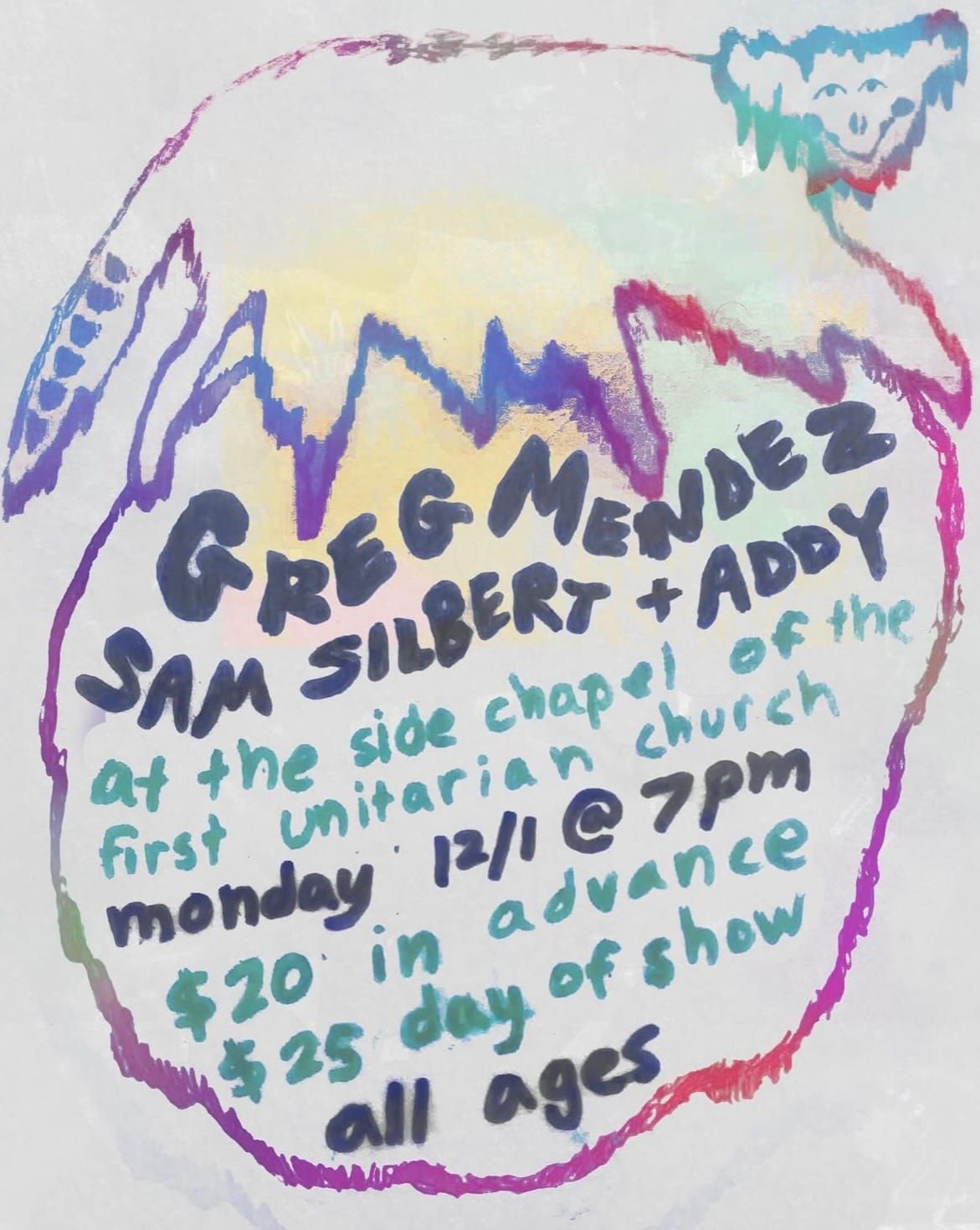
Greg Mendez – Residency (Night One) Addy, Sam Silbert
First Unitarian Church
2125 Chestnut St.
Philadelphia
Dec. 1, 2025
Monday was the first night of a weekly, month-long residency of shows curated and headlined by local songwriter Greg Mendez. The shows will each take place in the peaceful, contemplative quiet of First Unitarian’s side chapel, with its rows of creaky, near-sable pews. At one point in his performance, Mendez addressed the room: “When was the last time you were in a church?” For me it was the day before – I have an occasional gig playing guitar at a morning service in Center City – and after that service concluded I stuck around for a thoughtful talk some artists gave about the role of art in the church. One of the speakers said that, for him, “making art is a form of prayer.” That notion pinged around my mind throughout the show.
All the music leading up to Mendez’s set was gentle, and almost entirely acoustic. Sam Silbert opened the night up, accompanied by Full Body 2m’s Jack Chaffer playing shaker (keeping rhythm by watching Silbert’s hands, like a hawk). Donned, as usual, in loose, head-to-toe camo gear, Silbert shared songs that were like dust-flecked feathers plucked from an ancient bird. His enticing closing song, played on a child-sized acoustic guitar in open D tuning in a style reminiscent of R.L. Burnside, referenced “Will The Circle Be Unbroken” and end times. Addy, performing as a trio of acoustic guitar, double bass and pedal steel, was far more contemporary, the songs balancing more modern anxieties with heart-on-sleeve, adoring tenderness: “It’s deeper than bottomless mojitos for the table / It’s your finger runnin’ down my navel.”
Musically, Mendez’s songs are made up of broken chords, his right hand both segmenting and assembling with his strumming and picking patterns – sometimes plucking up with fingertips, sometimes an upswing with the edge of his thumb – and there’s a tendency in his solo arrangements for three parts to interlock: a low melody on the detuned thick strings, another melody up top, and his voice, joining or breaking off. His singing winds through the changes tentatively, dotingly, filled with cracks. I picture a Jenga tower gently swaying as he works through “Sweet 16," on the verge of collapse but holding together, despite the pained composure of its admissions: “Since you left town I’ve been livin’ in the truck / I’ve been sleeping in the truck / Just like all my friends had warned me.” Mendez’s songs are often at their best when their characters are at their lowest, not just unlucky but “shit out of luck."
“Maria,” from his breakout self-titled album two years back, is the perfect apotheosis of this mode of his writing. The song has a unique musical energy in his discography: it announced itself with its signature chord (spelled, low to high, Ab-Eb-G – try this one at home), Mendez strumming the singular, jumpy rhythm, and the whole room shot up in the pews, captivated before the story even began. And does it ever: “You wanna hear this story about the time we got arrested at a crack den?” The narrative accrued details, the refusing-to-resolve oscillating chords loosening vivid memories – “Krys and I came crashing out the window, but they were waiting” – and pivoted to its coda on the crushing observation, “Earlier that day we were both clean.” Finally, the harmony offered tantalizing resolution only to disrupt itself, as a new, needling, declarative voice entered: “But then somebody said, ‘Come back to me,’” telling the narrator all the ways he’ll fix him right up: “because it’s easy,” “I’ll make you happy,” “I’ll make it easy,” “because I’m wrong.” It’s that last one, the one that finally resolved the progression and put the song to clean rest, ending the back-and-forth (and, it’s implied, led to the events of the song’s first half) that does me in: the idea that sometimes the thing that hooks us is the wrongness itself, that there’s part of us that would rather be ruined than put back together again.
Among the privileges and perks of seeing each installment of this month-long residency (the beautiful space, of course, and the opportunity to see Mendez’s hand-picked selection of openers, all artists he adores), the one I’ll prioritize recommending is the chance to hear several new, unreleased, or very old songs that he doesn’t often play, a getting-in-his-bag borne of the need to keep each show different. The setting of the chapel, and the first-person confessional narratives of the songs, got me thinking about so-called confessional songwriting, and songs don’t get much more universal, in the spiritual world, than one Mendez played about halfway through his set, on his Casio. “I tried to play this a total of one time at a show, and I royally fucked it up,” he told the audience, eliciting chuckles, before (flawlessly, I’ll add) singing a devastating song comprised only of these words, repeated three times, a naked plea: “Please forgive me / for my flaws.” Then, a final: “Please, forgive me.” I’m not sure where I land on the notion that “to sing is to pray twice,” but as that song filled the chapel, for a moment, it was easy to agree.


