
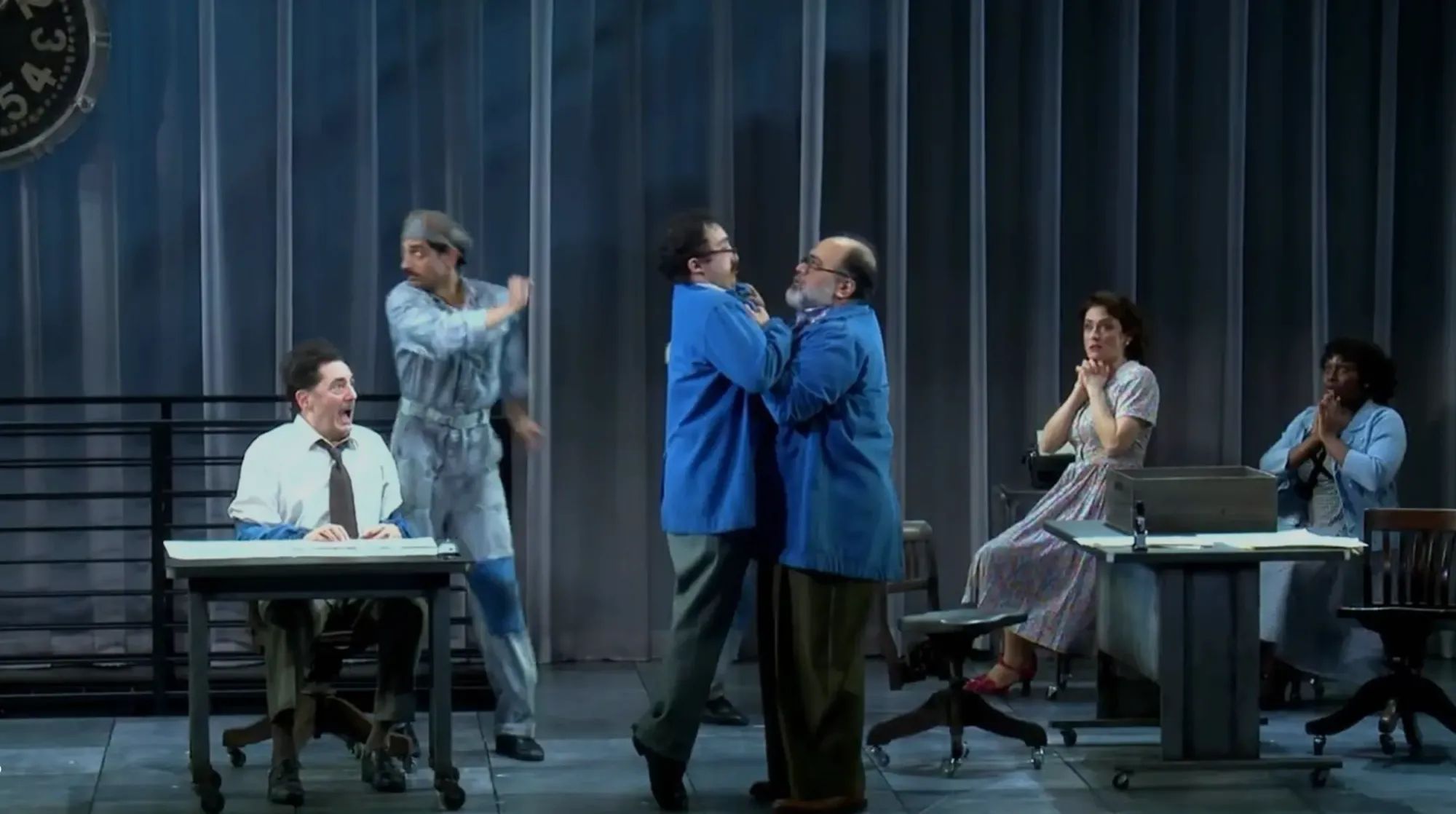
Rhinoceros
By Eugene Ionesco
Directed by Liz Diamond
Yale Repertory Theatre
New Haven
Through March 28
There was a gap of more than six decades since I last saw Eugene Ionesco’s play, Rhinoceros. That long stretch, as I think about what I just witnessed in Yale Rep’s imaginative and startling production, could be connected by an insular journey.
In 1964, I had a ticket for a campus staging this Theater of the Absurd work, with a cast of undergrads. I had caught the theater bug by then, going to everything that my Midwestern university produced, and occasionally even finding myself on stage. As gripping as these productions were, only two stuck with me since, and both in the last few months have had their revivals at Yale Rep.
Hedda Gabler, by Henrik Ibsen, still flashes at times in consciousness. I was struck by the principal character’s desperation and skills at manipulation, though I didn’t quite get it. I would have been too impatient then to accept the argument that understanding comes with aging, and with our own familial struggles and losses.
The early 1960s, after all, were a buttoned-up era, a time, Ionesco would have pointed out, of conformity. A time before the urban riots, and before the war in Southeast Asia that tore America apart and in which I served, and where I began my boots-on-the-ground education.
When I saw Rhinoceros back then, I had never heard of Eugene Ionesco. I had no idea about his life story, that he had grown up in Romania. He watched dumbfounded as his friends, one by one, embrace that country’s new and deadly authoritarian movement, or that later he had survived Nazism in Vichy France.
But I remembered many lines from “Rhinoceros,” which I’ve been quoting since, such as “I will not capitulate,” the last thing the hero Berenger says on stage. And the false syllogism as two primary characters argue logic as everyone around them seems to be growing horns and other perissodactyl features.
In the original version, the logician gives the example, translated from the French thusly: “The cat has four paws. Isadore and Fricot have four paws. Therefore, Isadore and Fricot are cats.” In the campus version I saw, this had been changed to the simpler, “Socrates is a cat. All cats die. Therefore, Socrates is dead.”
But back then I didn’t really know what the play was meant to do, even in that era before everything broke apart on campuses and in society in the late ’60s. The play was some sort of metaphor, I knew. But I didn’t get it.
I remember overhearing two women, both professors I presumed, as they walked out of the theater, agreeing that the play “had something to do with Communism.” Confused, I scoffed at the idea.
In the present-day production, and given 60 more years of learning about the world outside of a protective university campus, I finally understood the play’s intent, as well as felt its power.
For one thing, the cast in New Haven is composed of Actors’ Equity members (and a few Yale drama students in minor roles). Soo it is more proficient than the show I saw a long time ago.
This version is quick, whittled down to one act of several scenes requiring only 90 minutes of a theater-goers’ time, not counting the standing ovation. As such, the false cat syllogisms didn’t make the cut. Still, the show in New Haven is a reminder that in the arts perfect timing is as big an asset at great dialogue, characterization, and plot.
For who can see the play now without thinking about MAGA and its chief carnival barker luring huge crowds into his tent of depravity with blatant lies? The joining of the crowd, the need to be acknowledged, welcomed, part of an “enlightened transition,” without any independent research make no sense, say logicians and people who care about human rights and the truth worth telling.
I should offer a word about the craft of Yale Rep’s work here. It is magical. The acting, the lighting, the design, the sound, the balletic staging. In the lead role of Berenger, the well-intended but fervently intoxicated hero, Reg Rogers shows off his comedy chops — he even has hilarious hair — as he falls into despair as everyone around him develops horns and rhino skin, and learn to speak in a malevolent roar.
Phillip Taratula, as Berenger’s buddy Jean, who actually turns into a rhinoceros on stage, shows extraordinary range in voice and movement. Other cast members excel as well.
After the matinee performance on March 14 ended and we filed out, I cornered a few witnesses to the production to see what the play meant to them.
The man in the row just in front of me said, “Yale Rep sure knew what it was doing a year ago when it scheduled this. What an example of timing genius.”
I asked two women lingering outside if the play’s intent registered and is relevant today. They could not answer quickly enough.
“Oh, yes,” said one.
“Unfortunately. That’s why I hated it.” The other said, “I loved everything about it.”
So, at the very least, I had stumbled upon an example of non-conformity. A sign of hope? Evidence that at long last, we won’t capitulate?
Rhinoceros runs through March 28. For tickets, see yalerep.org, or call (203) 432-1234.


