
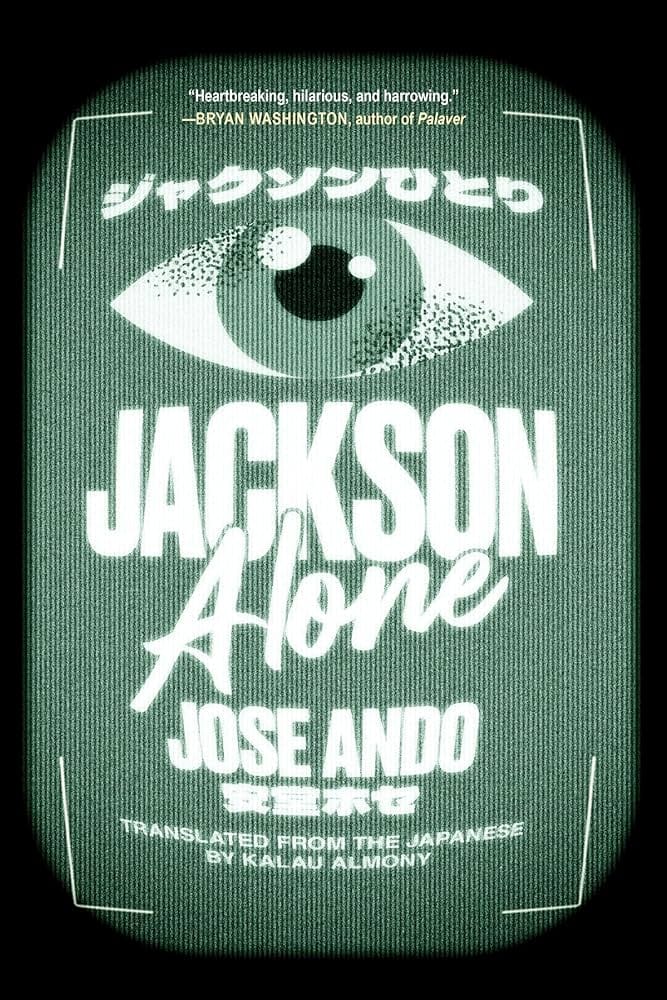
Translated by Kalau Almony
Published January 6, 2026
Jackson Alone follows Jackson, a massage therapist living in Japan. As a mixed race queer Black man, he keeps a remove from most of his clients, a farcical veneer of friendliness pointed resolutely outward. Jackson receives a black and white patterned shirt in the mail that turns out to house a QR code. When scanned by his curious coworkers, it reveals a pornographic video of Jackson, or at least someone who looks very much like him.
When his team captain accuses Jackson of being in the video, he immediately denies it.
“Why did you assume this was me anyway?”
“I mean, it looks like you.” The captain’s response gets a laugh.
“What about him looks like me?” Jackson says.
“The way he looks.”
“The way he looks. Can you be more specific? Which parts exactly look like me?”
Though the captain cannot prove it is Jackson, the damage has been done. It is now up to Jackson to unravel the mystery of where the shirt and the video came from and uncover who might be targeting him. In the process, he meets three other men who look an awful lot like him and who have also received the same shirt. Together, they attempt to hunt down who is behind the video. Along the way, they decide to use their likeness to perform a doppelgänger experiment on the people in their lives and punish those who have wronged them.
Jose Ando’s sparse novella endeavors to take on big issues such as racism, classism, queer identity, the isolation of the other, and the powerlessness of living in a surveillance state. However, the narrative voice is so far removed that the plot often feels scattered, like breadcrumbs. This remove may be due in part to the translation by Kalau Almony, but the characters’ voices are extremely deadpan, so much so that we only know they are different people because the book tells us so. Perhaps this is a commentary on the perceived interchangeability of Black men in Japan, but it makes the already convoluted plot more confusing.
Jackson’s almost robotic remove from his life makes it feel as though events are happening to another character. We do not get to know his inner thoughts as he is repeatedly pulled over on his bike without cause by police or constantly objectified by those around him. The voice is so impersonal that the reader is robbed of the ability to find the characters likable or detestable. They simply are. Points of view often jump rapidly between characters, sometimes from paragraph to paragraph, without narrative warning. This may be an intentional choice meant to strip the characters of individuality, and it aligns with the themes of the story. Still, it comes off as heavy handed rather than subtle. The result is a satire without mirth and a revenge tale without a satisfying bite.
None of the characters’ pasts, presents, or futures are fully explained. While Ando’s distinctive writing is strong and intelligent, the emotional arc of the story is difficult to latch onto, and many of the most interesting elements of the plot are left dangling, unfinished. The characters switching places and pretending to be one another in their day to day lives is perhaps the novel’s most powerful idea: their interchangeability in the eyes of the world around them is a pointed and unsettling statement.
While the plot is not always clear and the characters and writing are underdeveloped, the premise of the novella itself is brilliant. Jackson Alone gives the reader much to think about, particularly when it comes to race, privilege, and power, and those who wield it.


