
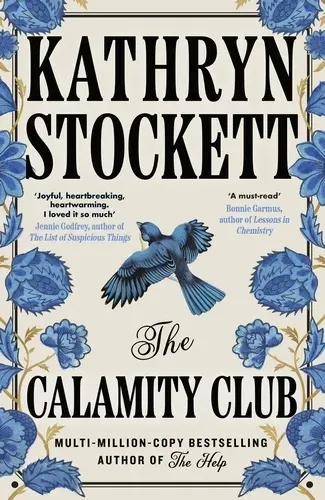
"The Calamity Club"
by Kathryn Stockett
Spigel & Grau
When a novel comes out just ahead of summer, and it weighs in at over 600 page s – well, it really needs to hook you at the start.
Kathryn Stockett (bestselling author of “The Help”) seems wholly aware of the commitment she’s asking breezy-summer-read-seeking bibliophiles to make. (A thick, heavy hardcover is hardly beach-friendly.) So the prologue for her second novel, “The Calamity Club,” features an irresistible opening scene that’s funny, tense, and dripping with Southern-baked passive aggressiveness.
We’re in an Oxford, Mississippi, drugstore in the fall of 1933. Birdie, our 24-year-old unmarried narrator, is avoiding one of the local busybodies while trying to discreetly buy 100 "Merry Widows" – aka condoms. Birdie explains to the saleswoman that they're not for her, but for someone who's "allowed to … administer them." After the saleslady emphasizes that they're to be used for disease prevention only, she tells Birdie that the pharmacy's rules require that she inscribe in a logbook who the condoms are for.
Stockett writes, "I took the pencil and let it hover a second over the paper. Should I make a name up? Would that draw more attention? But then the bells on the front door cla-clanged so I scratched the name of the first married woman who came into my head and shut the book hard. … Lord, my sister was going to kill me."
This scene achieves so much: We know we're in the Deep South during the Depression. We get a clear sense of Birdie's witty voice and personality; we have a small initial mystery to solve (i.e., why is Birdie, who tells us she's never even had a boyfriend, buying all these condoms?). And we understand that women have little to no power over their heavily policed bodies – a fact that plays a central role in "Calamity."
But this prologue also indicates what a masterfully sure-handed storyteller is at the wheel. For all the controversy kicked up by "The Help" – and there was a lot – one thing that was never in question was Stockett's talent. She spins historical yarns (that feel old fashioned) with a terrific sense of pacing and dialogue, and a distinctive voice that keeps you turning pages.
And, as previously mentioned, there are an awful lot of them to turn in "Calamity," which alternates between Birdie's narration and that of a smart, mistreated 11-year-old orphan named Meg. Though the two exist in same time and place, the connection between them remains unclear until later in the novel. Initially, Birdie reluctantly travels from Footely, Mississippi, to Oxford to ask her estranged, married sister Frances for a loan in order to hold onto the matriarchal family home. Frances, like many virtue-signaling Oxford wives, volunteers weekly at Meg's orphanage; and because she's married to a banker, Rory, she considers herself insulated from the Depression's ravages.
But when Frances' fortunes take a turn for the much, much worse; and Meg is adopted by a couple (seemingly from central casting for a Tennessee Williams play); and Meg's brutalized mother shows up at the orphanage's door, desperate to find her daughter, these women must each ask themselves how far they're willing to go to survive and help each other.
Inevitably, this leads to some dark revelations and a looming sense of danger throughout. Stockett regularly lightens the book's bleak situations with humor. When Frances and her mother-in-law realize they must sell their home's furniture, art, and engagement rings to even come close to paying their steep mortgage debt, Stockett writes, "'If people ever find out about this, I swear I'll shoot myself,' Frances said. 'Well, good luck,' I said. 'Rory took all the guns.' 'Then I'll just slit my wrists,' she said. 'Please do it outside so you don't bloody up the last sofa.'"
Passages like this made me laugh, and thus offered temporary release (and relief). While the book is quite long, its length is justified by the gradual-but-significant changes the characters must work through to get where they want to be. Had the shifts happened more quickly, they would be far less believable.
And really, at its heart, "Calamity" explores how oppressed women, especially when times are really hard, turn to and rely on each other to somehow find a way through their challenges together.
In one scene, for instance, friends are helping Birdie primp for a date, and she asks them why. "I looked away from myself in the mirror, but I couldn't help smiling. I hadn't had close women friends since high school, before they'd all gone off and gotten married. 'Oh, I been wanting to do this a long time,' Flossy said. But this didn't feel like they were trying to fix me or like Frances who … only took an interest in my looks so I wouldn't embarrass her. They seemed to simply want me to look like a better version of myself."


