
By Allan Appel
Holiday Show: Sidney Harris Cartoons
mActivity
285 Nicoll St.
New Haven
Through Dec. 27
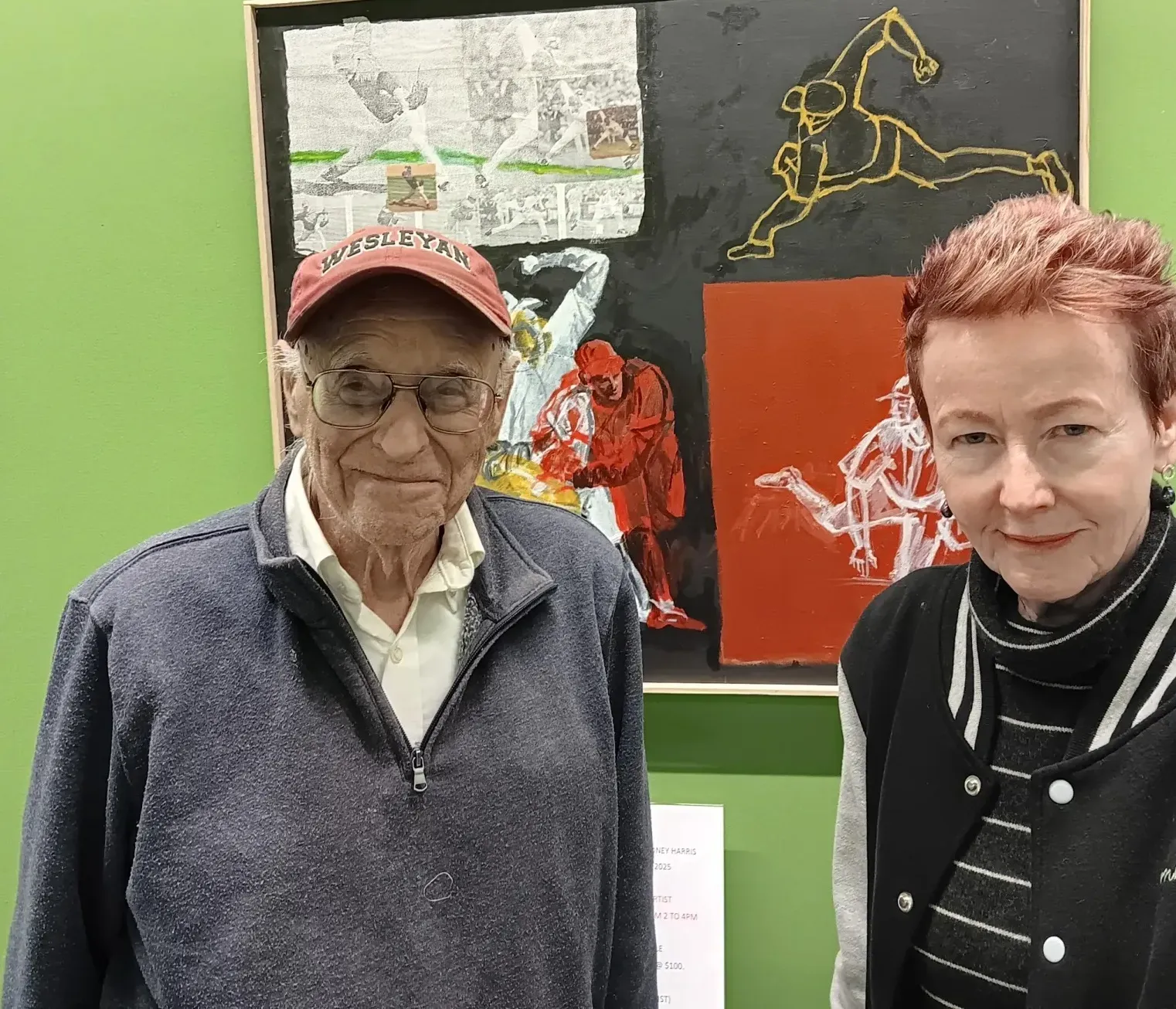
Sidney Harris, 92, walked into a gym, not to lift weights, but to look at art. His own art.
The Brooklyn-born, Erector Square-based artist has been making cartoons for decades — sometimes six or seven a day — for about 35,000 lifetimes so far.
Yet when Harris walked into mActivity on Nicoll Street a week ago, he found arrayed in front of him a current one-man show of his work.
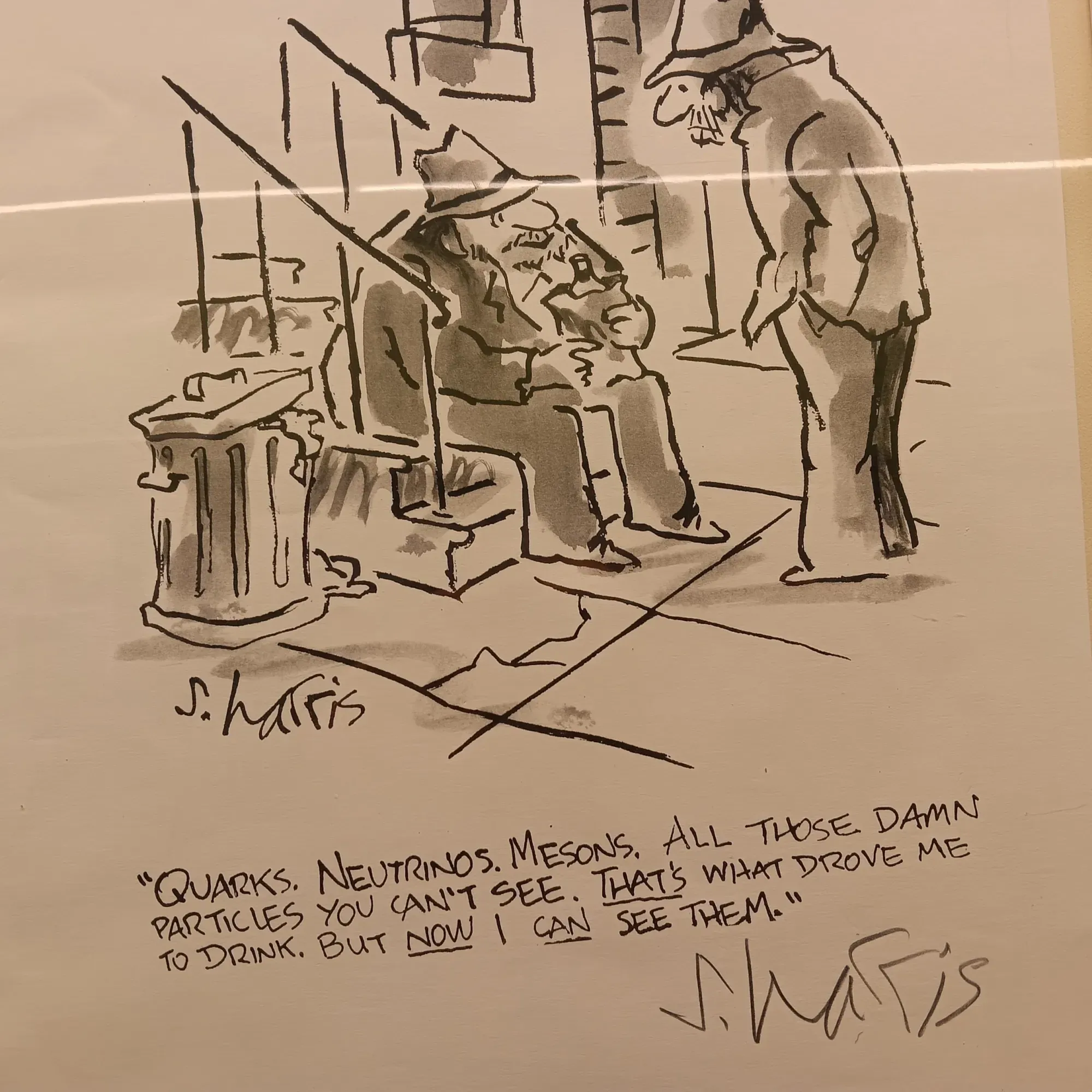
On display are selections from his four decades as an under-the-radar but accomplished artist, with a specialty for the quirks, quarks, and contradictions of science, and with examples of his published work in magazines from Playboy, American Scientist, National Lampoon, and The New Yorker.
That’s because the East Rock gym, it turns out, also contains a gallery, in a corridor running from the gym’s entryway to the machines that make you sweat.
There, going on ten years now, curator Barbara Hawes has helped nurture the side of mActivity that is also a unique art exhibition space and a cozy community gathering spot.
You don’t have to work out to hang out.
Through Dec. 27, Hawes is presenting a pop-up exhibition of Harris’s work — compilations of his cartoons, signed individual prints, and paintings of New York City scenes, and because this gallery has gym hours, from 6 a.m. to 9 p.m. Her four shows a year have drawn an estimated 400 people a day.
At an exhibit reception Sunday night, Andy Morgan and Sean Duffy, an East Rock couple who use the gym, recognized Harris’s name from The New Yorker cartoons over the decades, and stopped by to meet the man.
And, as it turned out, also to buy “Anagram Café.”
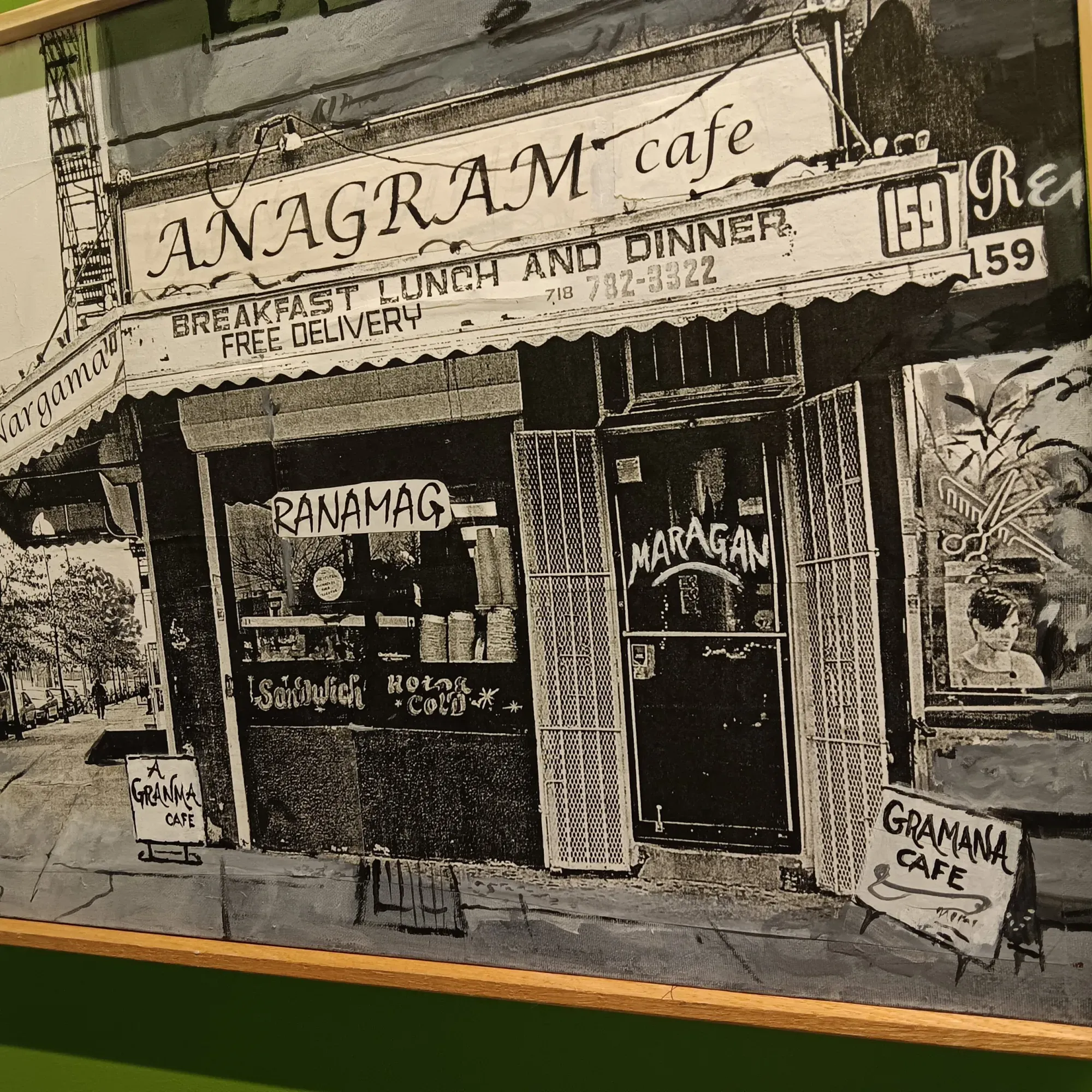
They were taken by the precision of the street scene, they said, along with the fun of the word play in a work that, Harris said, began as a cartoon based on a photograph, and then morphed into a collaged painting.
“You come to the gym,” Morgan said, “and then you pause to look in a great space like this.”
“One of our rules,” he added, “is we don’t have any more wall space. However, we’re going to make room for this.”
Harris’s work is not only witty, but accessible, very much affordable, and wryly joyful.
Wendy, an East Rock mom with teenage boys, stopped by and told Harris that one of her family’s favorite activities is to look at cartoons together. Combine that with the fact that her father is a scientist, as is a brother.
“I have scientists on both sides of the family,” she told Harris, proudly, “and we’re fans of your work.”
As her 12-year-old, she said, can’t decide whether to become a chemist or a physicist, among Wendy’s purchases (she preferred not to give her last name) were “Eureka: Details to Follow” and “Damn Particles,” Harris’s compilations on chemistry and physics respectively.
A self-taught cartoonist, Harris dropped out of Brooklyn College at age 20, and, he said, just went into his room at his parents’ house where he had grown up and taught himself how to do it largely not to impress anybody, but, with simplicity, just to make money.
Actually, he said, “I thought I would write humor and then I saw I could do a cartoon faster than an article.” And so the cartoonist was born.
His work is carefully observational, never political, reflecting a love for baseball (he’s a Mets fan) and, uniquely, a special interest in the funny side of science, which, as it turned out, is what brought him to New Haven.
The ambitious freelance cartoonist found an interested editor at American Scientist magazine, which had its headquarters at that time on lower Whitney Avenue, Harris recalled. The editor liked his work, asked for more and more of it, and then gave him a kind of contract; a contract is the holy grail for a cartoonist.
“It may not guarantee they buy a certain number, but they pay more for each one,” he said.
When Harris remarried and wanted to make a new start with a new wife, he figured why not go to New Haven, home of American Scientist, whose editor loved his work. A relationship was born, and eventually hundreds of cartoons published.
He used to go into New York once or twice a week and gather with his cartoonist buddies, walking the avenues peddling their work to the other outlets at their offices in Midtown, The New Yorker, National Lampoon, and Playboy.
“Mr. Heffner picked my best stuff,” Harris said, to the tune of 450 cartoons published.
“Who says,” Harris quipped to fellow Erector Square artist Mark Aronson (who was also attending the reception), “that people buy Playboy only for the pictures!”
Playboy and National Lampoon went out of business. Editors retired. The whole landscape changed, with fewer outlets, exacerbated by the pandemic.
So Harris retired. That is, he stopped poring over, for example, scientific tomes and journals and reading and reading often long hours into the night, until something clicks, something that would work as a cartoon; and only then would he reach for the pen and begin to draw.
Hawes said she discovered Harris when she was touring other artists’ studios at Erector Square and her curator’s eye told her to stop here.
She said more than 30 prints or cartoons and a dozen of Harris’s cartoon book compilations sold already. “Sidney’s work is joyful in a very dark time.”
Click here for the archive of previous mActivity exhibitions since Hawes initiated them in 2015. The first up in the new year will be an exhibition of two artists, the work of photographer David Ottenstein and the ink drawings of Anne Doris-Eisner, all in wintry lines of black and white. It opens on Jan. 15.


