
Sensus Mag Release
Ulises Books
1525 N American St.
Philadelphia
July 12, 2026
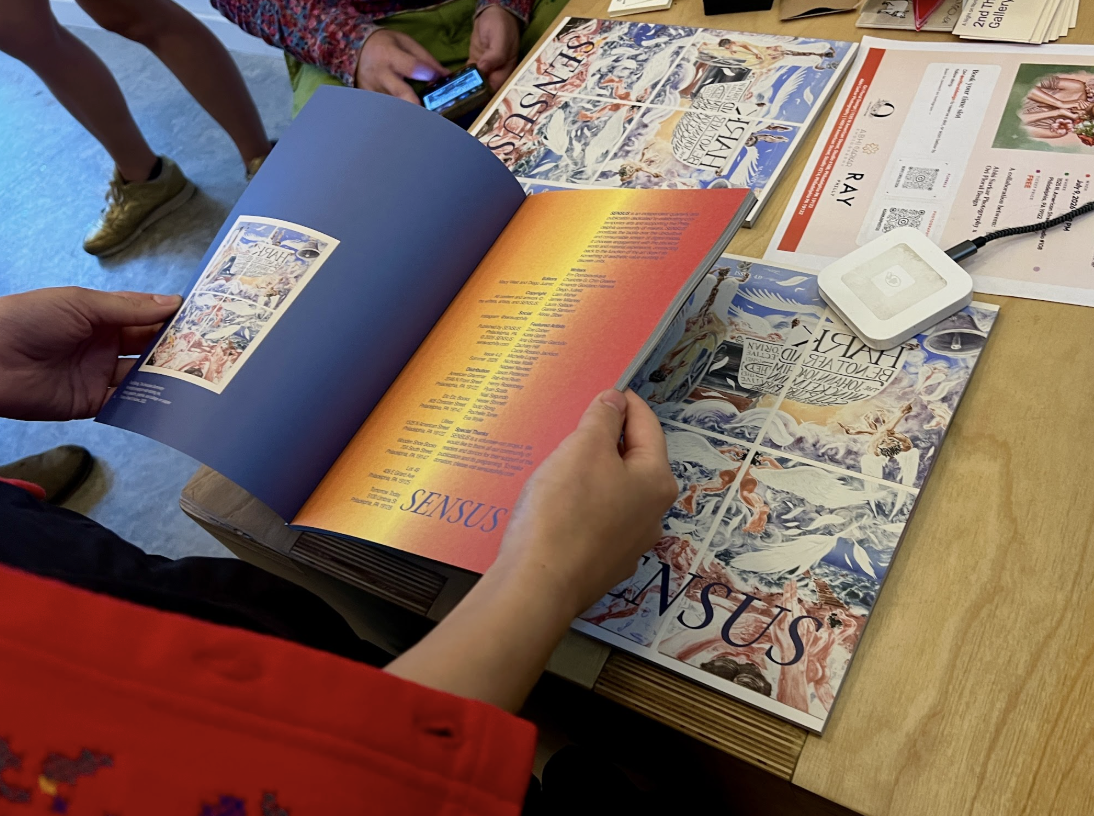
Ulises Books was filled to the brim on Thursday for the fourth release of local arts print publication, Sensus Magazine. This release party wasn’t too dissimilar from any other you may have been to: strangers and friends chatting in clusters, swanky fits, murmurs about “the abstract and the poetic.”
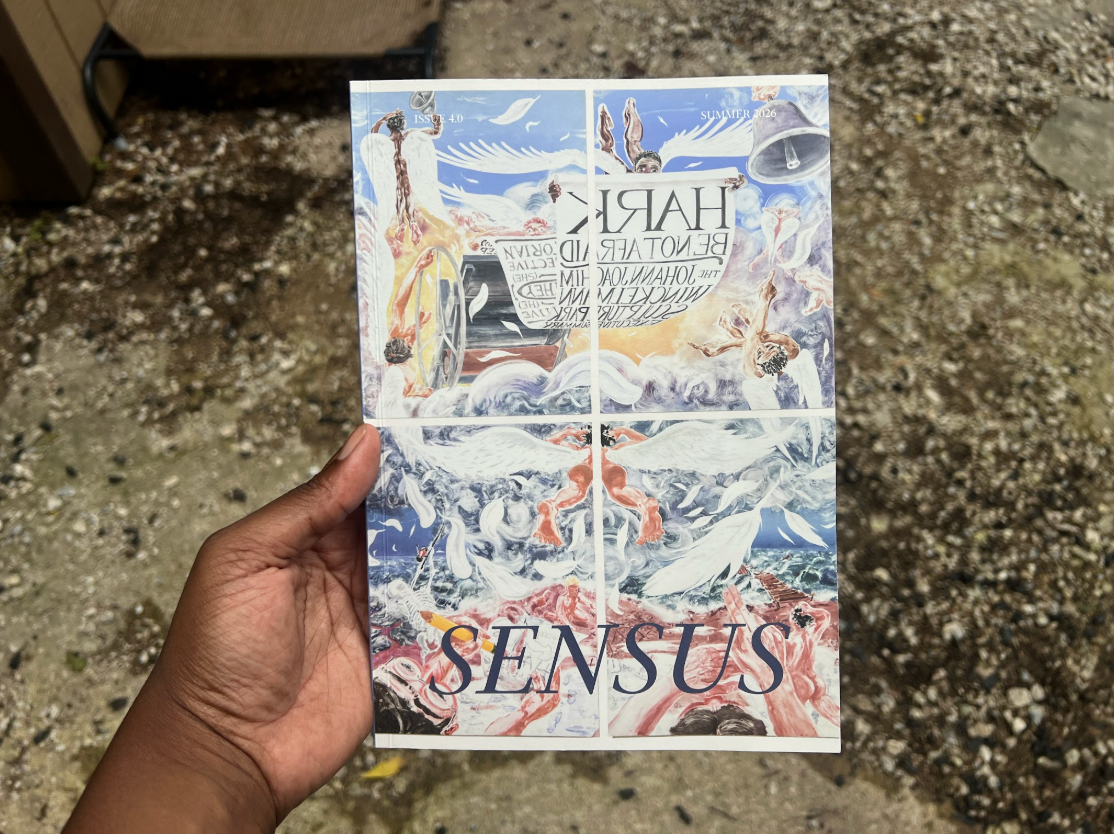
I was drawn to attend by an interest in reading more arts writing as a novice arts writer myself, as well as to see what other artists are up to in the area. But I was also pulled in by the magazine’s cover illustration that popped up on my social media feed: a gouache painting by artist Todd Strong, depicting angels and humans whirling back and forth over the horizon, a printing press in the skies and an artist on earth.
Sensus opens with an editor’s letter that's really a transcription of a casual conversation between editors Macy West and Diego Juárez, initially discussing their birthdays, then lamenting over the use of the term "facism" to describe "when a coffee shop won’t remake your latte," when it’s actually a term with real meaning and real weight. They discuss the general lack of specificity in the world and how it results in a kind of virtue signaling that keeps one from doing "the right thing."
I thought to myself: who’s to say making art and making books and printing magazines can be the "right" or even "real" thing? As an artist myself whose practice lacks any explicit social-centered motive, I often slip into the waters of believing that any works I’ve made that aren’t focused around a greater message or meaning, and are squarely masturbatory or self-serving (which…may be true to a certain degree). But regardless of intention, creation itself - like language - is a tool, right? For disseminating information, for collaboration with others and for deeper, potentially therapeutic reasons, even if it may feel a bit hedonistic. Why else would we be doing this?
In a conversation between artist Michelle Lopez and the two Sensus editors also published in the latest magazine edition, the trio discuss the reception of the Whitney Biennial (in which Lopez’s installation video and sound installation Pandemonium was featured) and the common critique of it being "apolitical." Questioning the role of art, Michelle mentions: "it’s really to distill everything that’s happening in the world into a new form. To me, that feels more than political. To be an artist, to make art and survive is totally political."
Another featured conversation between two multi-media artists based in Philly, Nabeel Naveed and Gianna Santucci, brings the collection of writing home. In a section titled "On Power," the two artists have a dialogue around Naveed’s newest works, discussing “abstraction as a tool to communicate knowledge […] considering power, agency, and censorship." Toward the end, Santucci asks "Do you think artists have a responsibility to the larger public?" Naveed’s answer is: "there’s not responsibility to the public at all. Or to the money, or to the clutter, or to the cube. I think you have a responsibility to yourself, though, and I think the responsibility to yourself is to truly understand the depth of yourself, and the depth of yourself is conspired in the politics of today. So you exist, and you are political."
Right, we owe it to ourselves. Regardless of whether I think my work is apolitical or not, perhaps it inherently is. Nothing exists in a vacuum, of course.


