
Found Objects, and the Missing Pictures
Sean Kernan and Frank Bruckmann
Kehler Liddell Gallery
New Haven
Through April 19
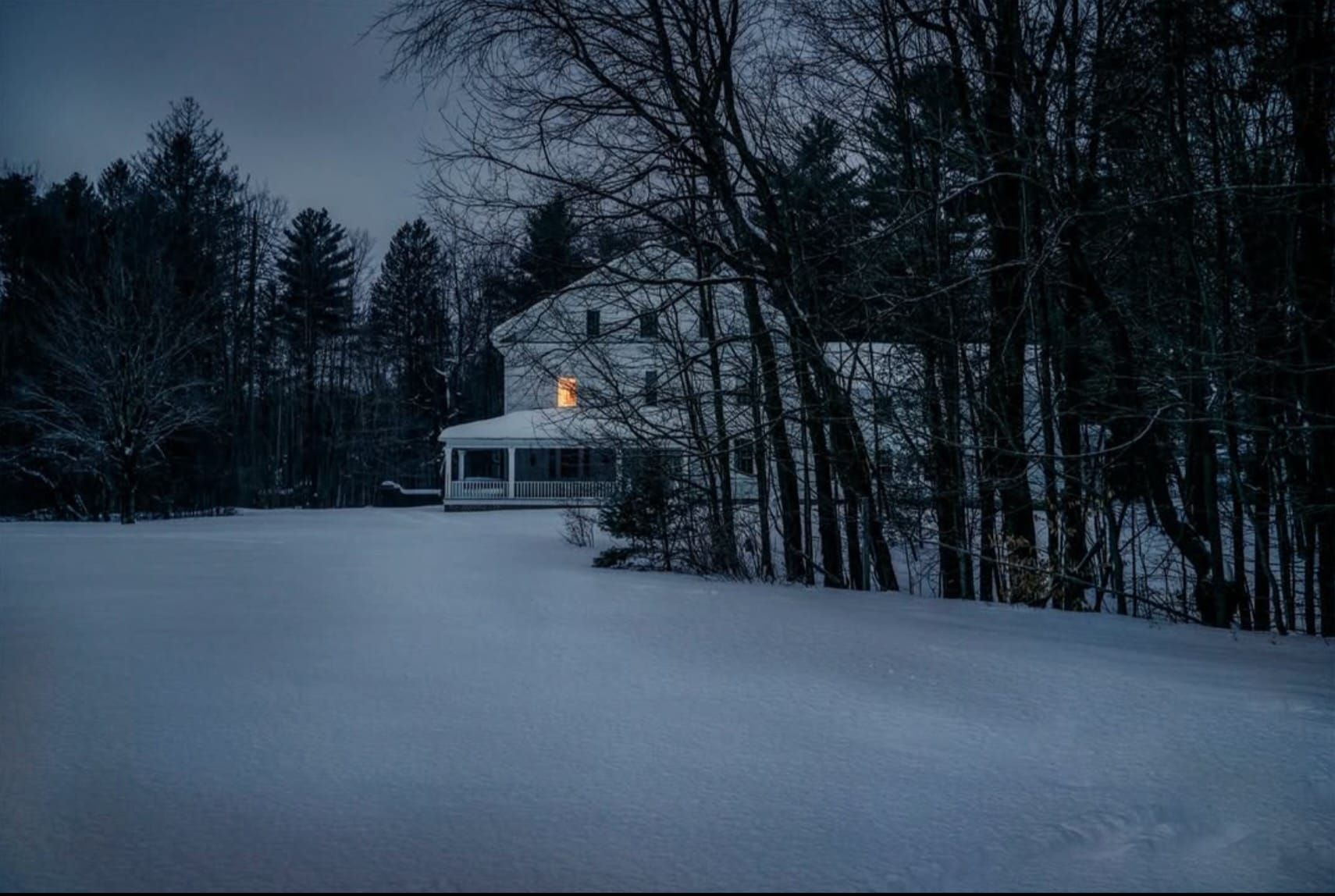
Pines in thick mist. A house in a snowy field, a single light on. Printed wallpaper, showing its age; tattered curtains, worn floorboards. American flags in the attic, thin with neglect.
Sean Kernan's short film The Visitor is full of engrossing images that convey both the vividness and unreliability of memory. On Friday, the photographer screened The Visitor as a companion piece to his photos on display as part of Found Objects, and the Missing Pictures, a show of Kernan's work alongside that of painter Frank Bruckmann, running now at Kehler Liddell Gallery in Westville through April 19.
The Visitor's rumination on the vivid fragments of a half-recalled past, which can nonetheless carry a lot of potency, proves to be an angle to approach Kernan's photography as well as Bruckmann's paintings.
Kernan's great-grandfather bought the house in Upstate New York when he was a younger man. It has stayed in the family ever since. Kernan's grandfather grew up in the house and, though he moved to New York City, summered in the house with his family, which included Kernan's father, who had profound memories of the place. "My father formed memories the color of sunlight," a caption in the movie explains, "and when I was a child my father passed them on to me so vividly that they began to feel like my own."
Kernan visited as a child as well, "and there I made my own memories," the captions in the film relate, of "huge American cars from the '50s, old men in seersucker suits, ladies in flowered hats, and cousins whose names I could never quite remember."
"Over time," the captions add, "my memories became tangled with my father's, and looking back years later I was no longer sure which might actually have happened to me."
So during the pandemic shutdown — the house is now unoccupied — Kernan visited the house to try to sort out fact from manufactured memory.
As captions in the movie explained, even though he was staying there by himself, he left the hall light on at night.
The Visitor could be a straightforward exercise in nostalgia, and some of Kernan's choices in the film, particularly in the soundtrack, evoke some of that. But his clear eye for sharp yet ambiguous details make the film more complex, landing it in more eerie territory. As the camera pans around the house, we see how the grand place used to be a refuge for generations of family members; we also see how lack of human occupancy has frayed the place around the edges, whether it's in a stain on a wall or threadbare curtains. The tone of film implies that whatever untangling Kernan may have managed to do possibly led only to more questions. Uncovering some parts of the past also revealed how other parts, perhaps, lay even further out of reach. What did it all mean, that the family was there for so long? The answer resides in the house, but remains ineffable.
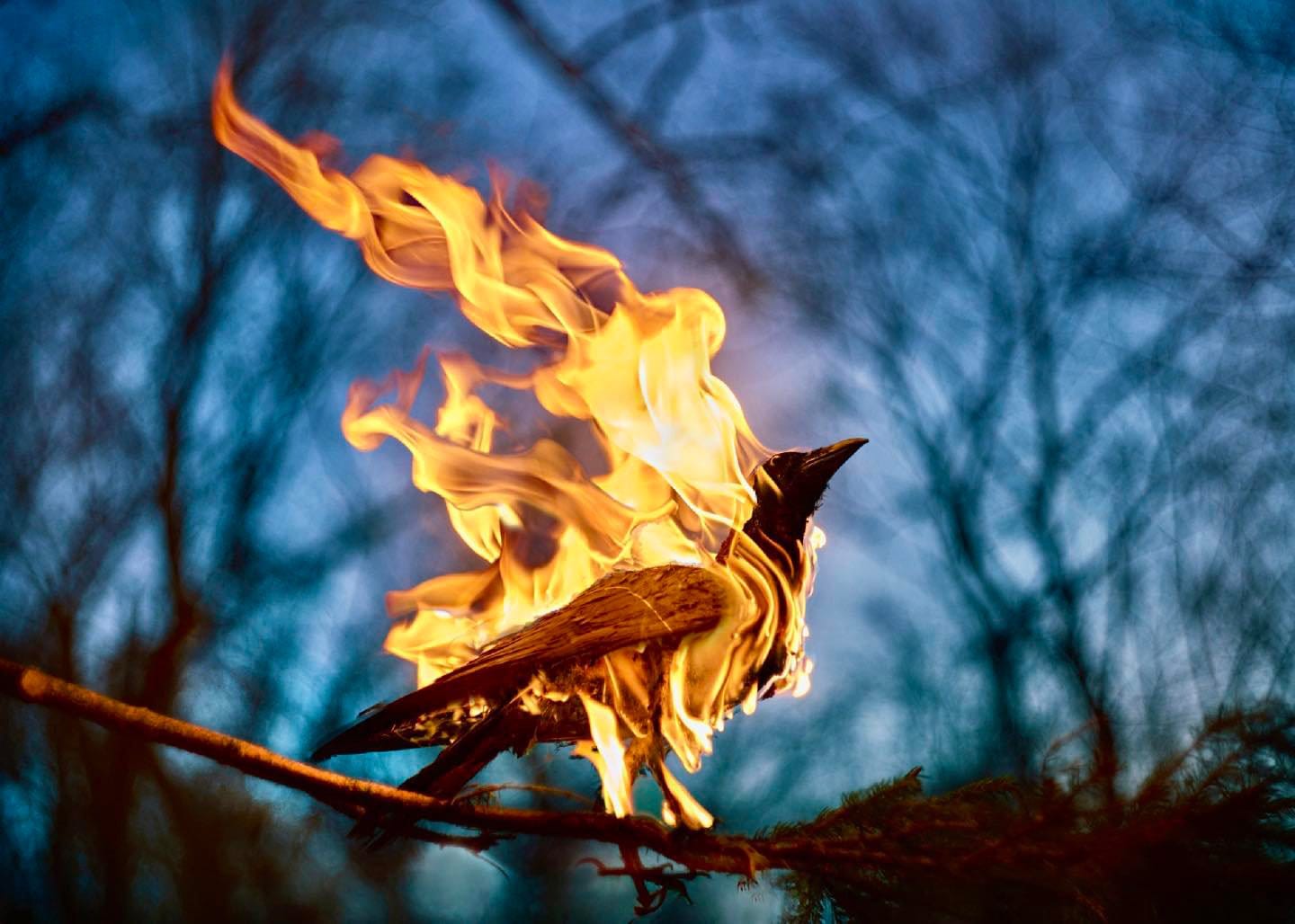
A similar view pervades the photographs from the house that Kernan took during a different visit, as well as series of arresting images Kernan took in which, an accompanying note explains, he sought to look "beyond content, concept, and intention to see if there was perhaps a vision functioning somewhere below my perception across more than 40 years, thousands of miles, and countless changes of mind. The set changes and evolves with each iteration. I think of each group as a single work with an unreliable story and unclear boundaries."
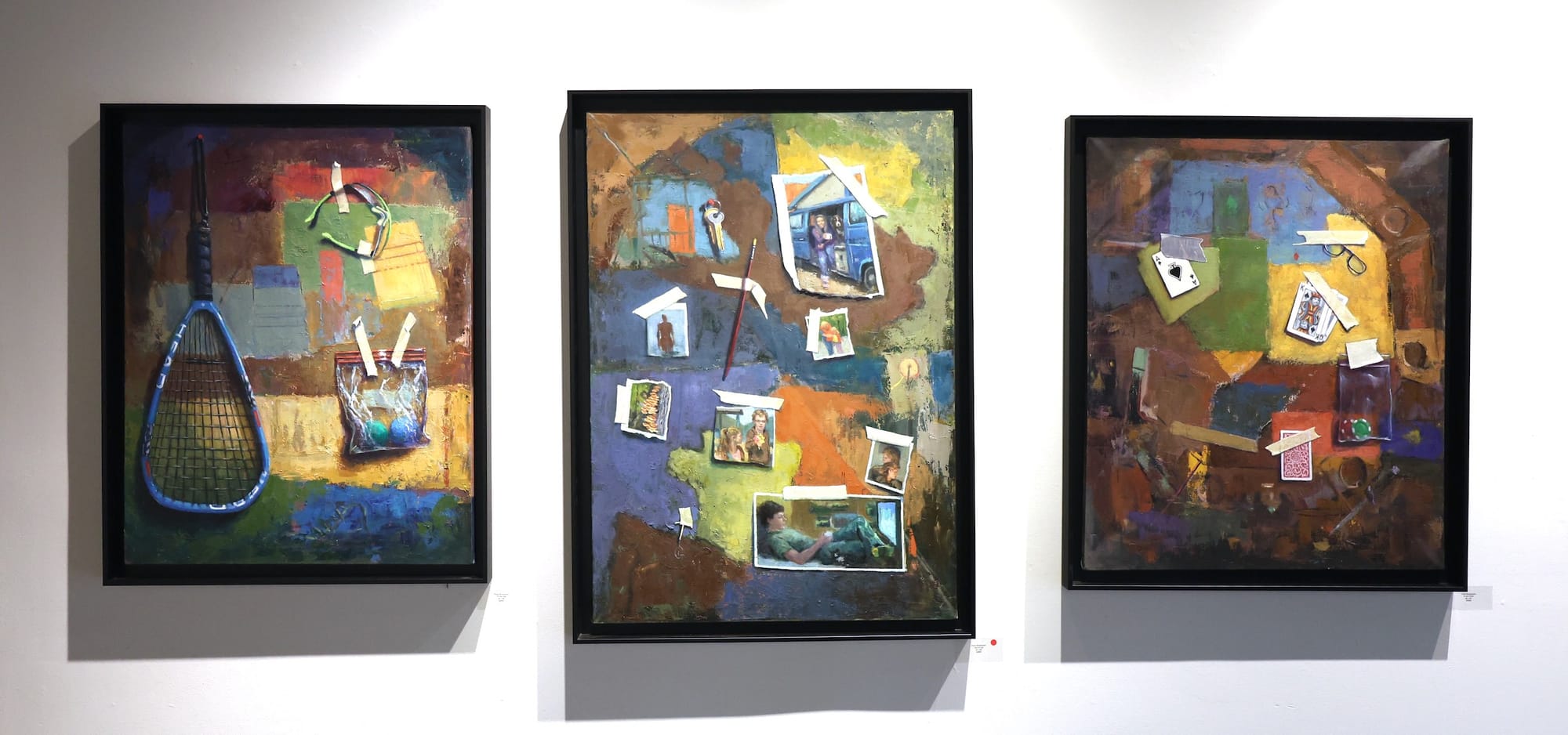
For Kernan, the limits of vision work as a metaphor. For Bruckmann, the limits of vision are a physical reality that he plays with in his contributions to the show. "Trompe l'oeil: An artistic term that refers to the realistic optical illusion of three-dimensional space of objects on a two-dimensional surface," he writes in an accompanying note. "Trompe-l'oeil represents a novel direction for me, an experiment, and an exploration of the possibilities of paint. These paintings should be viewed from a distance before being approached to fully appreciate the paint quality I am striving to achieve. I have a condition called amblyopia that affects my binocular vision and depth perception. In this body of work, I am attempting to comprehend spatial relationships on a more profound level, aiming to create a sense of depth in my paintings that I do not actually possess. I enjoy the juxtaposition of an abstract background contrasted with the more realistic images on the surface while using colors and design to help create the image."
Bruckmann, an accomplished landscape painter, brings his technical facility to bear in creating his paintings, to glorious effect. The objects that appear on the canvases do in fact, at first glance, seem to be three dimensional, to disorienting effect as one moves closer to the canvases to investigate. But there's more going on that just technique. Like Kernan, Bruckmann uses his artistic practice to reach into the personal. "This series serves as a self-portrait representing distinct aspects of my life, encompassing my painting studio, family, travel, relaxation, and even a part of my exercise regimen," he writes.
Moreover, Bruckmann writes, "the majority of these paintings have a former painting underneath. I am experimenting with the idea that some ghostly images may or may not appear in the future, possibly 20-50 years or more down the road." In this way, though Kernan and Bruckmann are working in different mediums, their interests dovetail. Both are interested in the meanings and textures that lay below the surface of things, acutely aware of how they can subtly affect our perception of those surfaces, even as they remain out of sight.


