
“Bastard”
By Devin Scillian
Purple Rose Theatre Company
Through Dec. 20, 2026.
Though the Purple Rose Theatre’s production of Devin Scillian’s “Bastard” is a never-seen-before world premiere, there’s something immediately familiar about it that makes you feel comfy — at least for a while.
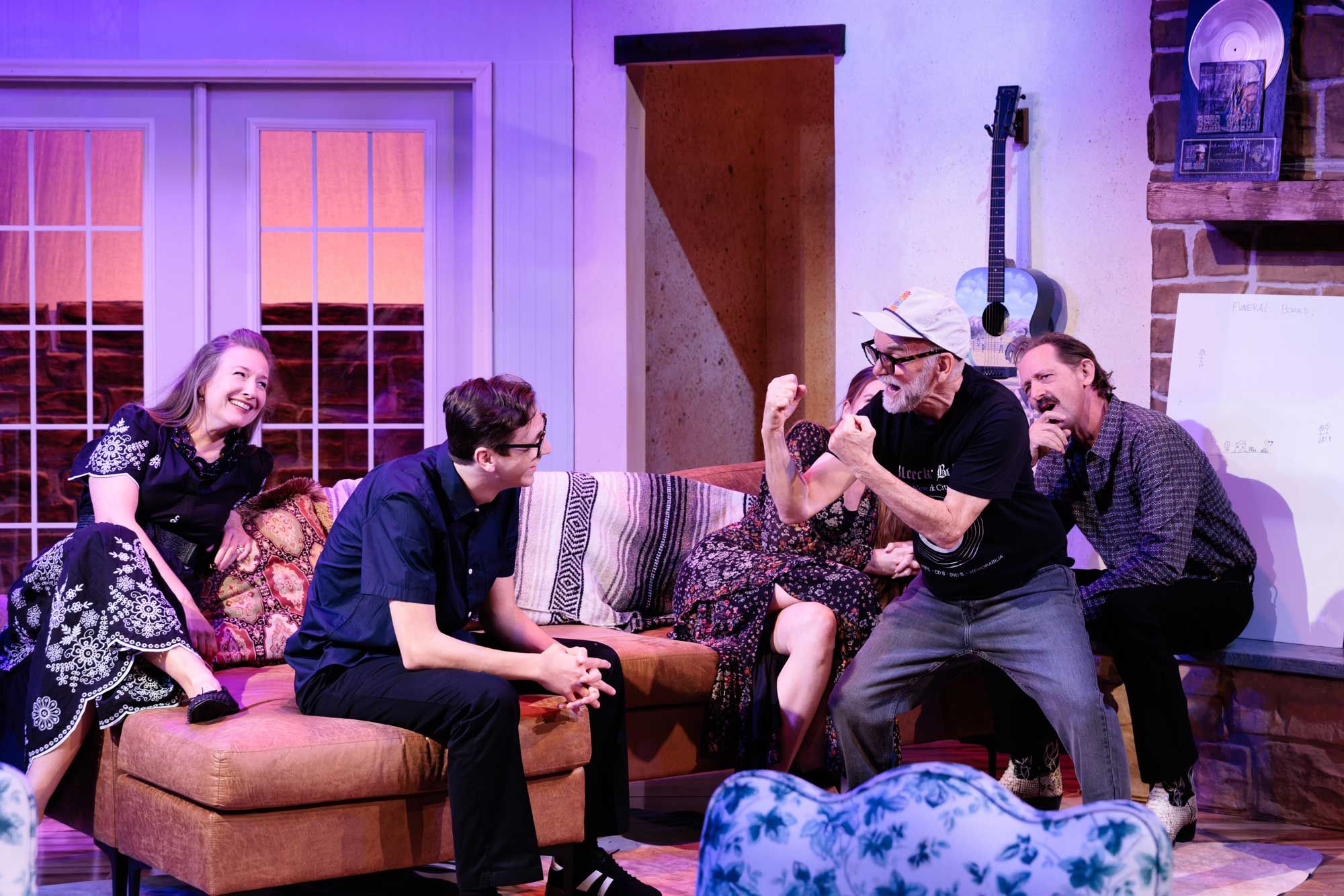
This is likely because the play’s story unfolds in one Texas family’s longtime home (meticulously created by scenic designer Sam Transleau), where — as everyone gathers to mourn a beloved matriarch — well-worn in-jokes, petty squabbles, recalled memories, and fast food provide an all-too recognizable grief backdrop. You’ll likely feel the urge to climb into your favorite sweats and join the characters on the couch yourself.
Why? Because like many quasi-functional families, the Lamberts have a rapport with each other that’s built on warmth, wit, and love, despite their occasional conflicts and grudges. There’s oldest son Jake (Mark Colson), who scored three country music hits early in his career, but whose star has since faded in middle age, leaving him playing occasional cruise ship gigs to pay alimony while living at his mom’s. There’s younger brother Beau (Joe Kathrein), a responsible, grounded financial professional who’s traveled in from the city, with wife Mary Beth (Hallie Bee Bard) and high-achieving teenage son Cameron (Danny Ayotte) in tow. There’s Jake’s longtime manager Shiner (John Seibert), who seems to have earned status as an honorary member of the clan. And there’s Jake’s current, 24-year-old girlfriend, Sparrow (Hope Shangle), who’s self-possessed enough to claim space in this full house, even in a time of grief.
Yet “Bastard” isn’t so much about grief as it is about family secrets, and the power those secrets exert. Obviously, I won’t reveal spoilers, but I will say that — due to a number of clues, some more blatant than others — I guessed at the Lamberts’ secret long before it was exposed on stage, thereby muting what’s intended to be a shocking moment of revelation. Plus, I’ll admit that the play’s central “twist” strained credulity for me. (Let’s just say: I had questions.) Then, shortly after one of the play’s biggest laughs, the lights dimmed and I thought, “intermission” — but no, the actors were lining up for curtain call.
Now, I consider myself to be someone who can tolerate a good bit of narrative ambiguity, but in this moment, I thought, “Wait … this changes everything for everyone. Doesn’t the playwright owe it to the characters and to us to explore the next, post-bombshell phase — even a little?”
Whether you believe he does or doesn’t, we don’t get the semi-closure of a coda in “Bastard.”
Yet it’s telling that despite its flaws, “Bastard” marked one of the most enjoyable theatrical experiences I’ve had at the Rose in a while. For even when the play’s central dramatic question wasn’t yet clear, the simple act of spending time with these characters, who are fun and sharp-tongued and generally loving, was kind of a joy in itself — which is a credit not only to the actors (and Rhiannon Ragland’s direction), but also Scillian’s impressive gift for dialogue. (Scillian also created the show’s original music, including a snippet of Jake’s controversial hit “Beer Wagon,” and a spare, spiritual tune that gets its own quiet moment to shine.)
In terms of casting, Colson convincingly exudes the swagger, ego, and disappointment of a has-been music star who’s long been creatively and personally stuck; and Seibert is always a joy to see on stage — in this case as the Lambert family’s constant (and caustic) plus-one, who knows he must keep finding one-off gigs for Jake in order to keep him financially afloat. But the surprise for me was Shangle; though her young girlfriend role could have simply been played to type, Shangle (and Scillian) instead make Sparrow an old soul who, at times, possesses more perspective and wisdom than those who surround her.
Of course, Transleau’s inviting, homey, thoughtfully detailed set design — including Jake’s framed gold records, tons of condolence flower arrangements, guitars that have the feel of dusty decor rather than go-to creative tools, and a pair of old comfy chairs covered in a floral print — plays no small role in drawing us into the family scene. Lighting designer Mario Raymond’s choices work in tandem with Ragland’s direction, particularly when a handful of tableaus suggest the passage of time, and when dimmed lights require us to focus solely on a funeral song and its singer. Erin Routh Smith’s costumes, meanwhile, underscore each character’s traits without ever letting us forget we’re still in Texas — though otherwise buttoned up, Beau still wears cowboy boots — and sound designer Eric Hohnke helps further ground us in the Lamberts’ world.
For a while, that’s a pretty engaging, lively place to be. And there’s a good deal to love in the first half or so of “Bastard.” Scillian and the Rose’s talented team of artists got me on the hook. The problem is, though, they kind of just left me there.
Follow Midbrow Detroit on social media:
Bluesky, Facebook, Instagram, Threads, TikTok, X.


