
Poetry Out Loud workshop
NXTHVN
New Haven
Jan. 31. 2026
Life for me ain’t been no crystal stair.
The first time Journey Rosa read these words, from the poem “Mother to Son” by Langston Hughes, they were in eighth grade.
They saw the piece again on Saturday at a workshop at NXTHVN, where high schoolers were asked to choose a printed poem to study. Now in tenth grade at Sound School, Rosa was seeing with a poet’s eye.
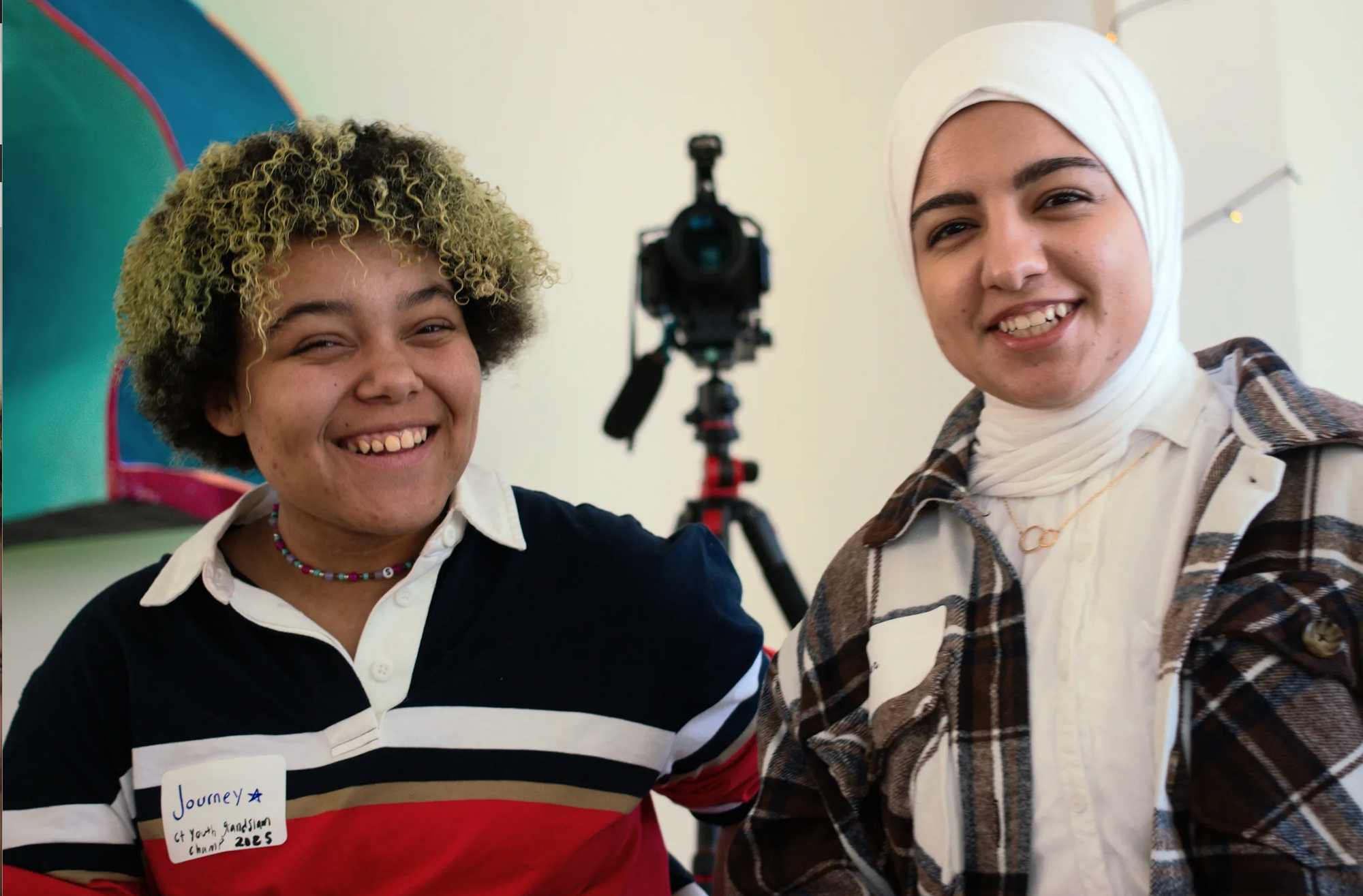
Rosa, along with a dozen other teens, was at a Youth Summit hosted by local spoken word educational program The Word. Students grappled with the fundamentals of poetry, guided by teaching artists from The Word and Connecticut slam team Verbal Slap.
These days, Rosa is on a mission to find every opportunity possible to write, share, and learn about poetry. The Word is heeding the call—not just from Rosa, but from high schoolers across the state, as well as the state government itself. It’s the organization’s first year of partnership with the Connecticut Office of the Arts, using their tried-and-true creative methods to help get kids excited about reading poetry out loud.
It’s all part of a nationwide competition called, well, Poetry Out Loud, prompting students to read existing works of poetry in front of an audience. The students are judged based on qualities ranging from presence to interpretation to something called “evidence of understanding.” Rounds start at the school level, then statewide, regional, and national, with a $20,000 scholarship waiting for the final champion.
The Youth Summit Saturday was free and open to any high school student in Connecticut. Some teens in the room were practicing directly for the Poetry Out Loud competition. Others just wanted to feed their interests in poems and public speaking.
Teaching artist Lynnette Johnson watched as students came out of their shells over the course of the four-hour summit, moving past fear and nerves to make their voices heard.
When she addressed the room at the start of her workshop session, Johnson asked the young poets to raise their hands if they were nervous. Then, “If you were nervous and you still spoke up, raise your hand up higher.”
She asked the high schoolers to consider that fact. What did it mean for someone to be nervous and speak up anyway? Students piped up with answers, and she repeated their words for everyone to hear.
“It means you were brave.”
The class felt like a theater workshop. Together, everyone in the room brainstormed over the sentence I went to the store.
What kind of store could it be?
“The bodega,” suggested New Haven poet laureate and artistic director for The Word, Yexandra Diaz.
Okay, on the way to the bodega, we saw a car. What kind of car was it?
“It was a lowrider,” said one of the teens. As the suggestions snowballed, their inquisitive notes faded, taking on more decisive tones. Students giggled, realizing they didn’t need to ask permission for their seeds to be planted. The room was willing to work with whatever they had to offer.
By the end of this exercise, the trip to the store was infused with a vibrant blend of sensations and memory. It was evidence of understanding.
Then Johnson asked for a volunteer to try reading a poem. She did so in a characteristically egalitarian way. She wanted to share a piece, she said, but didn’t want to be the one to read it. Could someone help her out?
Rosa was up to the challenge. It was a poem called Allowables by Nikki Giovanni.
“I killed a spider,” Rosa started. By the end of the piece, Giovanni, through Rosa’s voice, declared that she shouldn’t be allowed to destroy something just because she’s frightened.
Johnson asked the room to help her find the metaphor. Is this piece just about killing a spider with a book, or could it represent something else?
The students gave her something to consider: What if the person with the book was a government? And the spider was a person?
Johnson then asked the students to find the deeper meanings in the poems they had in their hands. Rosa turned to the Langston Hughes piece, telling me they can now see metaphors they may have missed as an eighth-grader. They had simply gone through more by this point, they explained.
High school senior Bayan Albakkour looked at her poem of choice, a piece by Abraham Lincoln encouraging a young woman named Rosa to celebrate her love with her “beau.” Albakkour told me she relates because she likes writing love poetry.
“As you know,” she said, “love is a very strong feeling.” Wrapped up in it are personal stances on understanding, patience, and commitment. Even when love goes awry, she noted, poets can give advice based on what they’ve gone through.
Though the official reason for the summit was to practice reading other people’s poetry, the participants’ true passions couldn’t help but shine through, from the students all the way to the mentors. The day culminated in an open mic, and every poet who spoke set down their papers to read their own pieces instead. Diaz challenged the other teaching artists to try pieces they’ve rarely shared before.
Rosa performed a piece called Five Minutes, recounting a childhood where they had to grow up too fast, and where love was equated with vanishing.
“But I don’t want to vanish anymore,” they said to the crowd. “I want to exist without apologizing.” And here they were, doing just that.


