
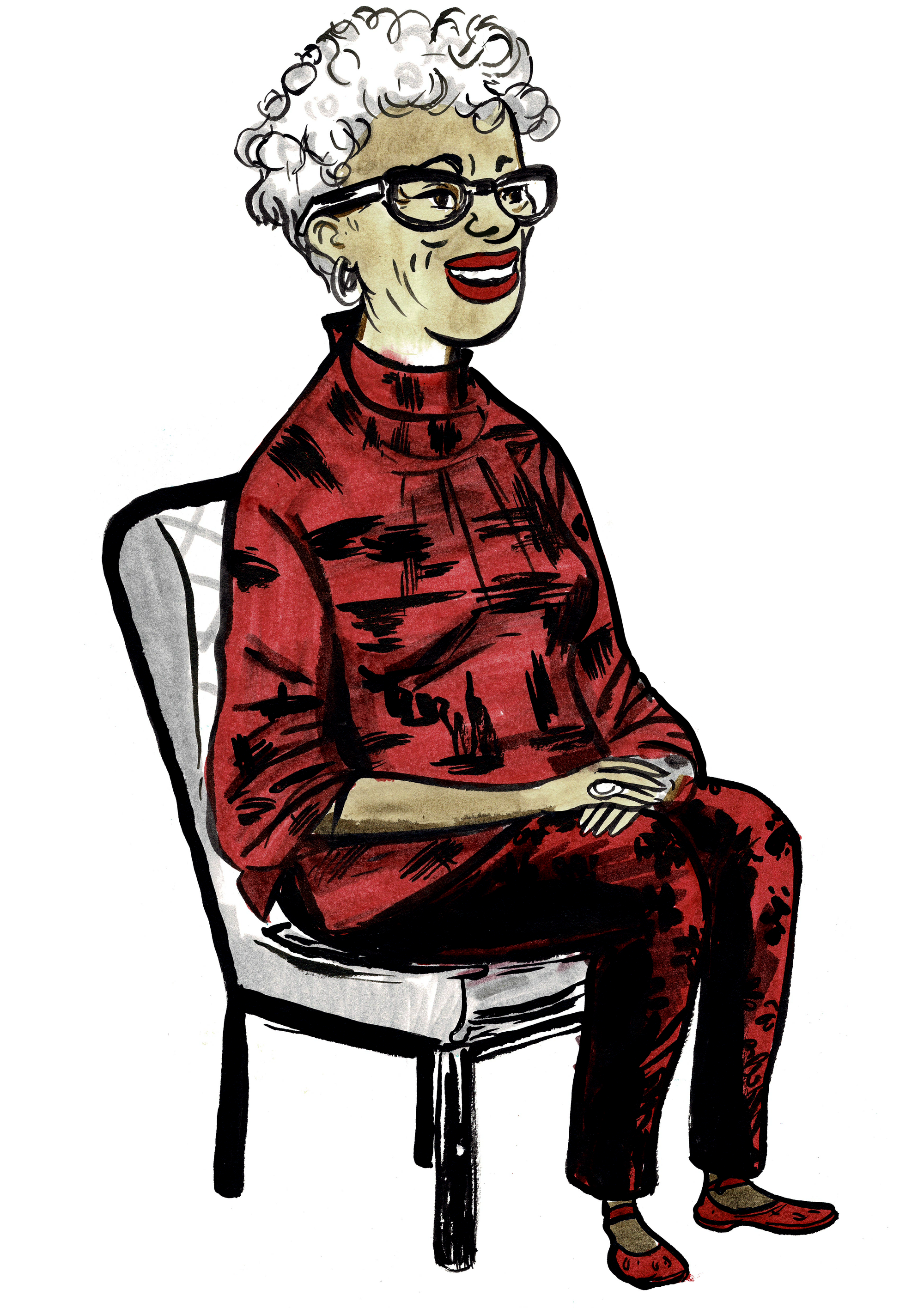
Poetics of Memory by Mildred Howard
Oakland Museum of California
1000 Oak St, Oakland
On view through October 18, 2026
“This is Mildred Howard’s moment,” Lori Fogarty announced to rapturous applause. This, after five decades of creating, was her first proper, curated retrospective. “Mildred presents both the personal…the urgently political…and she has more friends than people I have known in my entire life!”
Indeed, seated next to Fogerty, the woman of the hour gave off the vibe that she’s never met a stranger. There’s something comforting and disarming about her presence.
“The first part is…Well, come on and check it out,” Howard beckoned, as one would welcome a guest into their home. It’s a suiting metaphor, because Howard is a capital “A“ Artist, someone who lives in their practice. This is her home. It’s the rarest of treats to be guided through a retrospective by the actual Artist!
The exhibition is not chronological, and weaves between eras and media: photography, sculpture, painting, video – Howard hasn’t shied away from challenges. She was reminded of a now quaint technological advance: “We would spend hours on the color Xerox machine,” she recalled, motioning to a glass-paned door, the Artist in faded 70s color peering out. On the opposite wall, the Artist is frozen in time again, some half century before, defiant with a painted face.
Farther along, the work veered into the personal. “It’s a history of the United States with a few missing pieces,” she remarked as she turned to a painted photo in a rustic window frame of a young black man in military fatigues. “He came back from World War II with a steel plate in his head. I grew up with stories about him.”
That recollection was the only time I witnessed Howard’s energy dip. As mentioned, Howard’s work represents the personal and the political, and this piece revealed a potent intersection of the two.
Howard had more history lessons to offer, both personal and political. “The first governor of California was black,” she told us, referring to William Liedesdorf, the unsung father of San Francisco, who oversaw California’s transfer from Mexico to United States in 1850. We were now in the great Hall, among superhuman sized figures, shrouded and monochromatic fabric, symbolizing the erasure of people of color, like Liedesdorf, from history.
“People talk about Trump — he wasn’t the first. We’re just fortunate that we live in a place like this… where we can speak about it. I just hope he gets a whiff of this.” She wasn’t referring to it, but one of her pieces, the capital building in miniature with the dome obscured by a chicken head, could well have been about current affairs, but it was vintage 2007.
At the exhibit's end, Howard was content to field questions and regale us with stories.
“Aretha was perhaps seven years older than I. She played piano at my house.” Howard remembered The Diva’s visit to her East Bay some 60 years before.
Music looms large for Howard. Not just Aretha, but Funkadelic, Prince, Bill Evans. Evans’s “Peace, Peace“ played on a loop throughout the exhibition, a little loud and intrusive at first.
But music isn’t her sole inspiration. “Ideas come from the everyday. Ideas are always there, you just have to look more closely.” That is, at its essence, the artist’s way, as I understand it. We’re out there, tuning into frequencies well outside the usual band; keening our ears, squinting to make out the imagined. Exploring.
“My reaction to the color red? It hasn’t changed! I still like it!”
“What does Juneteenth mean to me? Well, I’m Black!”
She motioned to the far wall, a triptych of 8 mm film played on a loop. Howard had shot it at 14, during a trip to the Midwest and South to visit “relatives and ancestors”, as she put it. Even as an adolescent, the artist emerged. “Texas,” she clarified of the South. Like many, my parents included, Howard’s folks were part of the Great Migration. My parents were from Arkansas and Alabama, but I spent my wonder years in Texas, a nine year, accent-corrupting interruption to my life in California.
Texas is a very big state, but I was curious to know where exactly her family hailed.
“Galveston.”
I couldn’t believe it. Auspicious too, with the Juneteenth holiday commemorating the date of June 19th, 1865 when Union Major General Gordon Granger arrived in Galveston (then, Texas’s preeminent city) to enforce the Emancipation Proclamation. “Oh my goodness! I lived for a number of years in Dickinson!”— a neighboring community in Galveston County.
Dickinson is a deep cut. No one has heard of that hamlet. She was surprised, and recalled an aunt who lived there. She asked how it was now and I assured her it has remained terrible. I intended to say that I was happy her family had found their way out, as had mine, but my joke came out weird.
“Ma’am, I appreciate what you had to say about creativity, broadening practices. I teach art at CCA…” for the next short time anyway…..“and I try to impart that to my students, to take a broader view.”
“Yes!” she agreed.
I didn’t want to take more of her time or the chance on putting my foot in my mouth again, so I thanked her and left, salmoning through throngs of excited museum goers as the doors opened to the public. I wondered how many jaws dropped to see the artist, there with her creations, and holding court. I’ll have to leave that to my own imagination.


