
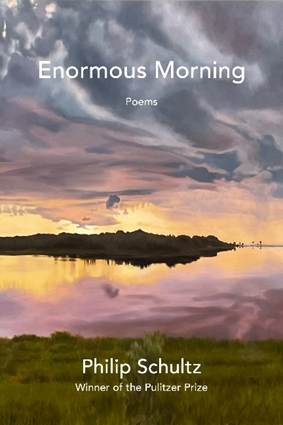
Enormous Morning
Poems By Philip Schultz
W. W. Norton & Company
March 10, 2026
Do you remember the first time an elder talked to you like you were an adult? Do you remember that magical, trepidatious moment when you first received real wisdom, the kind that requires a lifetime to accumulate? If you don’t remember, let Enormous Morning remind you.
A gentle, grandfatherly energy flows through the new collection by Prize-winning poet Philip Schultz. It mercifully never tips into condescension.
Now 81, Schultz is self-effacing but smart as he winds through relationships past and present. The collection contains multiple elegies, a wedding poem, and three birthday poems, including one for each of the author’s two adult sons. But longtime readers of Schultz won’t be surprised to learn that the past is never far from his mind.
Throughout his career, Schultz has written volumes about his father, a big-talking hustler whose hustles never worked out. For most of his childhood, Schultz and his parents had to squeeze into his maternal grandmother’s house. When he was a teenager, the family finally moved, “into a basement apartment just over the city line, / renting not owning but now Mom owns two bedrooms, / one bath, three closets and a kitchenette / big enough for three, certainly me, sixteen,” as he writes in “Something and Nothing,” the long poem that ends the collection.
Although his father still makes an appearance, Enormous Morning focuses more on Schultz’s mother, as the poet wrestles with her life of consistent disappointment. Now older than his mother ever was, Schultz reaches out to his mother’s memory with compassion, respecting the tremendous effort she put in—had to put in—to build their meager life. Consider this passage from “Sacrifice”:
…Half her life a filing clerk, the other half
counting coins from my father's vending machines,
disappointment the salt she soaked her feet in each night.
…
she sang to me at night about being strong and good,
surviving the bitterness that lives in us like bad dreams.
Sometimes I walk the house at night the way she did,
looking for the strength to undo all the hurt and shame,
be a little more of what she gladly sacrificed
Schultz resists demeaning or pathologizing his mother’s endless tolerance for his father’s empty promises. Instead, he appreciates how hard she worked to give him better than she had. Indeed, rather than drawing a contrast between his achievements (e.g., Pulitzer Prize) and the absence of external rewards in his mother’s life, he attempts to emulate his mother. I have no doubt that Schultz harbored frustrations toward his mother, but as a poet he understands that complicated compassion is far more compelling than “the bitterness that lives in us like bad dreams.”
The same compassion radiates out of my favorite poem in the collection, “My Neighbor Ed.” The eponymous neighbor is an unpleasant sort, who “complained if anyone parked near / his tired house, got angry every time my sons / skateboarded down his street.” Seemingly no one misses the man, as his obituary went unwritten until Schultz picked up his pen. Without denying the man’s sour nature, Schultz finds pieces to exalt:
Ed, I’m grateful for the light in your kitchen window,
behind the plastic, for the gift of knowing someone lived here,
among the richer, vacant second houses and ominous silence
enjoying as best you could what remained of your brief
and nameless journey just around the corner from where I live mine.
I love that ending comparison, that admittance that in this world we’re (almost) all along a brief and nameless journey. “My Neighbor Ed” revived an old ache—my childhood memories of an elderly man who lived in a rundown trailer a quarter mile down the road. The place was freezing in the winter and only had a hot plate for cooking. Still, he’d make beef stew with dumplings for my mother and I when we went to, as she put it, “make sure he was still breathing.”
Enormous Morning isn’t fully concerned with the quotidian. Schultz also writes about political topics, including the January 6 coup attempt and the mishandling of the COVID-19 pandemic. Unfortunately, I find that these are his least successful poems. “Navalny,” named after the Russian dissident who died mysteriously in 2024, is the collection’s weakest piece. However, that shouldn’t dissuade you from picking up Enormous Morning for yourself. The same grandfatherly earnestness flows through his political poems, and I find that energy invigorating.
I’d recommend Enormous Morning to people who like to putter on Sundays, take long walks with no particular destination, are prone to nostalgia, and don’t take themselves too seriously.


