Caribbean Indigenous Resistance / Resistencia indígena del Caribe ¡Taíno Vive!
Peabody Museum
Through June 21, 2026
Archeologist and curator Stephanie Bailey explained that in her Puerto Rican family, her grandmother never identified as Taino. “My grandmother doesn’t look indigenous, but her mother does, irrefutably,” Bailey said.
Looks don’t mean proof. A dive into their lineage, which revealed many mestizo ancestors, offered some evidence. But the real connection came when Bailey took her grandmother, her mother, and her two children to the Centro Ceremonial Indígena de Tibes in Ponce, Puerto Rico.
“While we’re walking through the museum,” Bailey said, “we’re looking at all the cases, and my grandmother’s stopping at certain areas,” looking at the artifacts — cups and combs and other household objects. “Mami had pieces like this inside of her house,” Bailey’s grandmother said. They then moved to a case that had a ceremonial seat for a cacique, or chief. Her grandmother stopped again. “Papi had a chair like this inside of her house,” she said.
“That was her a-ha moment,” Bailey said. Before that, “she had a hard time understanding why I wanted to bring this connection and presentation to people, and why I wanted to speak about the culture, and aid the overall community” with “revitalization…. It was that piece that gave her the understanding as to why it was important for me to create that cultural continuity. That was her form of cultural continuity.”
A hundred such a-ha moments lie in wait in “Caribbean Indigenous Resistance / Resistencia indígena del Caribe ¡Taíno Vive!,” a traveling exhibition amplified with pieces from the Peabody’s own collection running now at Yale’s Peabody Museum.
For the Peabody, it’s a way to connect explicitly to New Haven’s broader Caribbean community. For Bailey, part of the curation team for the exhibition, it’s a way to connect to her own living heritage and traditions — and help others of Taino descent do the same.
The term Taino refers to an indigenous population of the Caribbean, the first people Christopher Columbus encountered when he arrived there. DNA evidence suggests that the Taino populated the Caribbean through a slow migration that began from the coast of South America and moved essentially northward about 2,500 years ago. The Taino weren’t the only indigenous group in the Caribbean; the earliest humans appear to have settled there about 3,500 years before. (As James Joyce wrote once, “Christopher Columbus, as everyone knows, is honored by posterity because he was the last to discover America.”)
Estimates suggest there were between 1 and 2 million Taino in the Caribbean before Columbus. Colonialism brought military conquest, slavery, starvation, and disease. By 1520 — within 30 years of Columbus’s arrival — there were only a few thousand Taino left. It was easy for the colonizers to consider the culture extinct. But thousands of people in numerous communities across the Caribbean consider themselves of Taino descent, even as they mixed with other peoples in the riotous melting pot of the Caribbean, and they as well as scholars point to a host of continued linguistic and cultural practices to demonstrate it. As Cuban Taino leader Francisco “Panchito” Ramírez Rojas is quoted in the exhibition, “you ask me if there was extinction. I’m telling you no…. My elders said the same thing. I repeat: ‘They killed many, and many died, but here the Indian is still standing.'”
The show was originally curated by the Smithsonian and has been traveling the country since 2023, said the Peabody’s interim director Erika Edwards. “When we heard about it, we were very excited to try to host it,” she said. When the Peabody reopened last year, “one of our goals was … to make ourselves as meaningful as we can to the greater New Haven community,” and New Haven has “a really strong community of Caribbean folks, from Puerto Rico, Dominican Republic, Haiti, and Jamaica…. We want to share this exhibit with everyone.” In six months, the exhibition will move on to the Mattatuck Museum in Waterbury, including artifacts from the Peabody’s collection.
The exhibition begins with three artifacts that “started it all,” said Bailey. Those artifacts are representations of cemí’no, the 12 Taino spiritual entities “responsible for different aspects of our world, the spiritual world, and our relationships,” as the exhibition states. The cemí’no are “the vital forces to who we are as indigenous people,” Bailey said.
Among those cemí’no are Guabancex, who brings wind, water, and hurricanes; Yocahu Bagua Maorocoti, who cares for yuca; and Opiyelguobiran, who guards the cave to Coabey, the underworld and land of the dead. As the artifacts show, ancestral Taino maintained their relationships with the cemí’no through a variety of practices. An effigy of Yocahu Bagua Maorocoti might be buried in a field to ensure a good harvest. Other cemí’no could be accessed through ceremonies in which a cacique, or chief, took a cohoba, or hallucinogenic powder, to go on a spiritual journey and connect with spiritual forces.
“One of the things that cements a living, thriving, breathing culture is access to language and access to spirituality systems,” Bailey said; it is “how we still live and maintain in our communities today.”
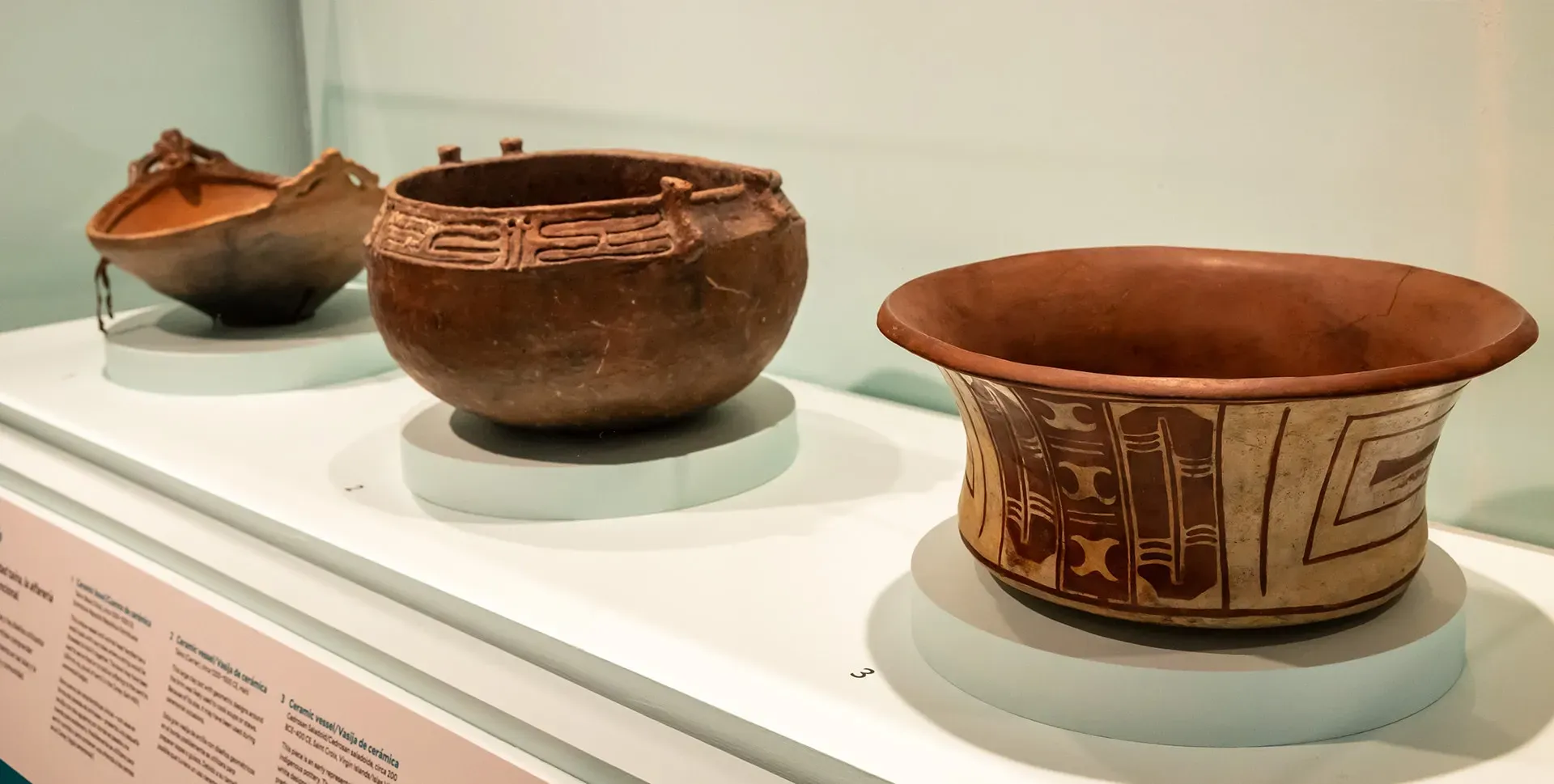
A series of ceramic pieces from the Peabody’s archives offers evidence of how early the Taino arrived in the Caribbean. The display of “indigenous ingenuity,” Bailey said, also shows how advanced they were as artisans — “the overall skill that they had” as craftspeople, architects, and civilization builders, Bailey said. One piece is considered to be a “marriage bowl,” Bailey said, a direct antecedent of the type of vessel that would hold a Puerto Rican sancocho, a type of stew, today. “There was likely an iguana sancocho inside of that bowl,” Bailey said. Three short films about a contemporary Taino potter accompany the pieces, “to show that continuity,” Bailey said, that the practice of ceramics continues today.
A display case elsewhere in the show dives into the details of how the caciques communed with the ancestors and cemí’no for guidance. Another one details Taino dress, jewelry, and henna-like body stamps. Still another one focuses on social practices, from a political ball game, to the way warriors commemorated their fallen compatriots, to the ceremonial cacique seat that Bailey’s grandmother recognized, and reconnected with her culture.
The Roots Of The Roots
The Taino relationship to plants sprouts up in several places in the exhibition, beginning with the roles that several of the cemí’no have. Another part of the show focuses on the canuco, a garden the Taino developed that focused on planting symbiotic plants close together, akin to the three-sisters gardening method deployed by indigenous people across the Americas. The exhibition highlights work that Carlos Torre, a professor at Southern Connecticut State University, did with students at the Sound School to start, nurture, and document their own canuco.
In Europe and the United States, it’s “miles and miles of hay, miles and miles of corn and wheat, that destroys the land” even as “it gives you a lot of yield,” so “you really make money.” A canuco, however, “makes the food more nutritious because the plants help each other,” connected by their roots underground. “And it makes the soil better. So this is sustainable agriculture.” Torre said that he explained one possibility of plant combinations for a canuco to the Sound students, and they came up with five. “They’re really excited about doing this,” he said.
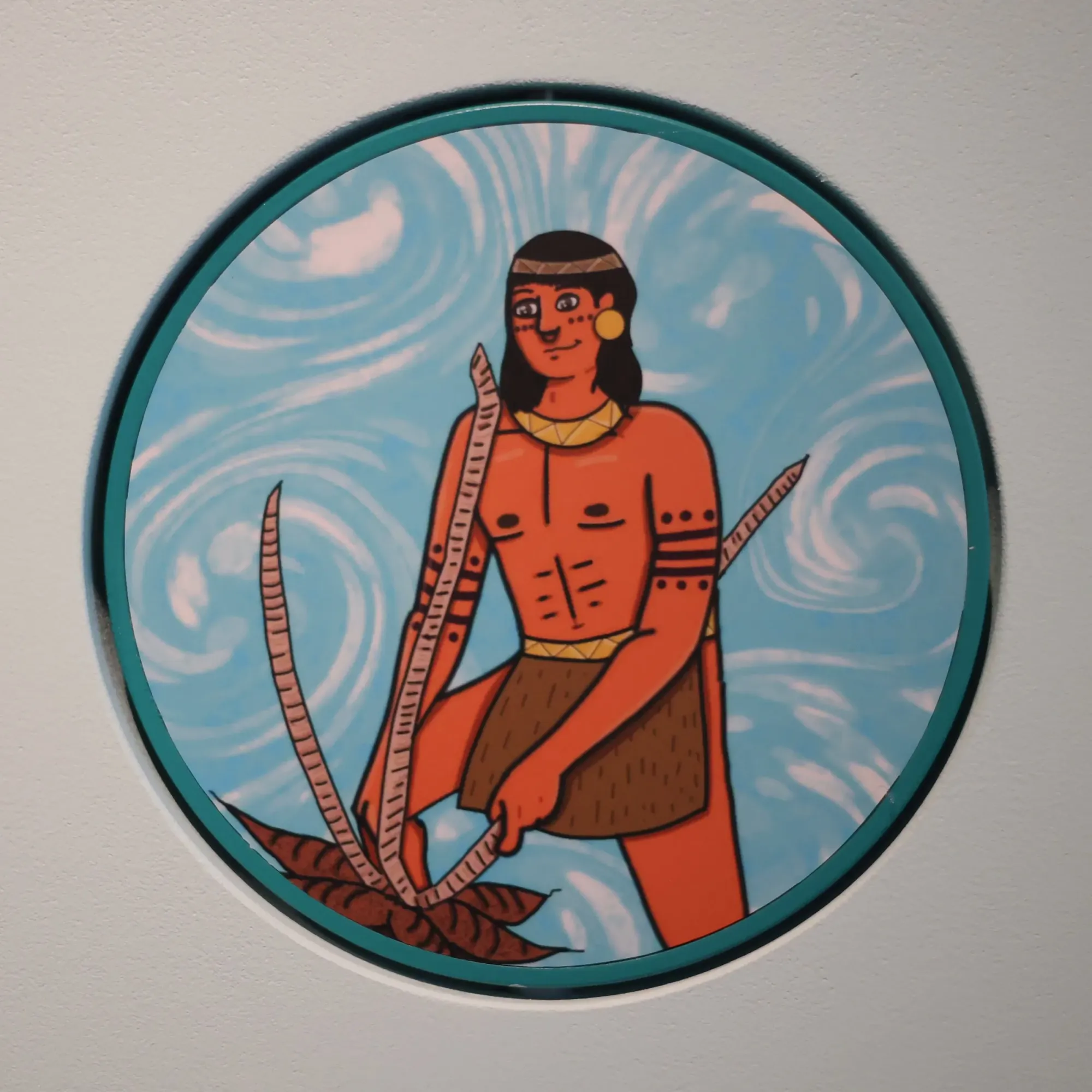
Another part of the exhibition focuses on three different plants of particular importance. Yuca was “a staple for our ancestors, and is a staple for us still today,” Bailey said. “If you’re looking for comfort food, boiled yuca with anything on the side, usually onions with sailfish, is the way to go.” Yuca’s strong connection with a specific cemí’no illustrated how sacred the plant was to the Taino. “Not only is it created and cultivated and held by one of our cemí’no, but it also sustains our people.” She explained how the yuca root could also be grated and pulverized into a paste, then the poisonous liquid extracted and the remaining powder used to make cassava flour. In addition to being a staple starch, “sometimes we’ll just add in coffee,” or the bread made from it is eaten with peanut butter and drunk with coffee.”
The unbroken traditions were the point. “The ancestors didn’t leave. They just evolved into what we are today,” Bailey said.
Looking over a final case in the show about the Taino conception of the afterlife, she returned to that theme. Bailey had a memorial to her great-grandmother in the display. “Her skills with medicine, her ability to raise community, is what instilled all of those habits into my grandmother,” and by extension, into her. That has let Bailey “create a space like this, where you guys are able to delve into an open aspect of view of who we are as a people. And then we’re able to share those indigenous values with you,” so “you can carry it and share our stories. So in the legacy of who we are, we create this.”