Patti Smith
John Lyman Center for the Performing Arts
New Haven
Jan. 27, 2026
Without New Haven, might there have been no Patti Smith?
“New Haven looms large in family legends. I’m happy to be here,” the renowned rocker-artist-writer told a delighted audience that filled Southern Connecticut State University’s John Lyman Center for the Performing Arts on Tuesday night.
In her deep, resonant voice, Smith revealed that her father Grant Harrison Smith was raised in New Haven and appeared in the local papers because he was a gifted runner. Her mother Beverly was born in Bridgeport; her parents met at a church dance in New Haven.
It’s a pity there was no Q&A after her book talk/performance Tuesday night, because more revelations about her New Haven affinity would have been rabidly welcome.
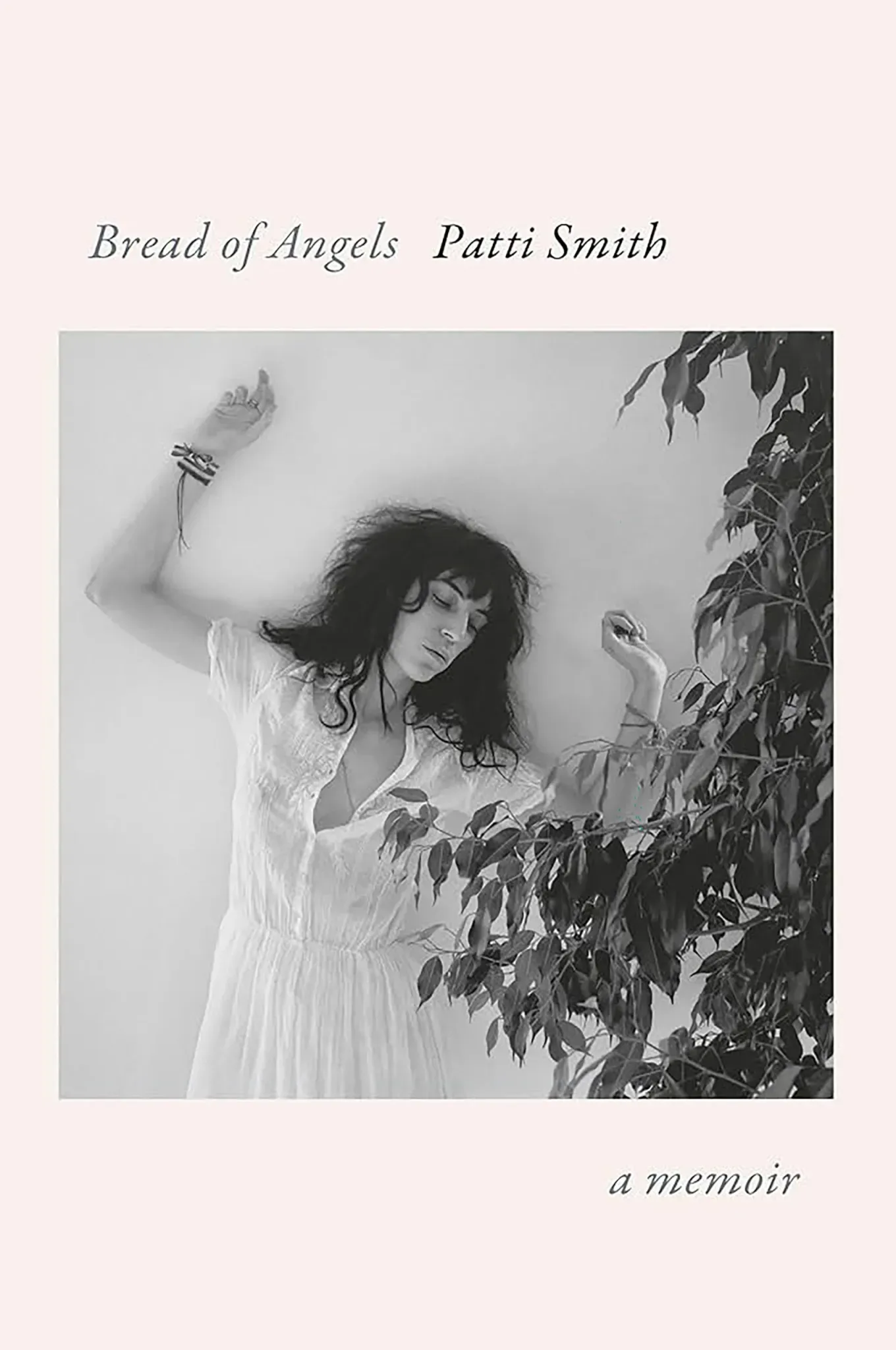
Can you blame people for wanting to be part of Patti Smith’s world? It is a privilege to be made privy. In her latest memoir Bread of Angels, Smith brings readers deeply into a childhood consumed with exploration – “the most precious times of life,” she says – and the “adventures and trials” that shaped her adulthood.
Consider lines from the memoir like God whispers through a crease in the wallpaper, a drop of water bursting as an equation: The acuity of Smith’s vision makes entire luminous worlds of what some may consider mundane. Like much of her work, Bread of Angels is a testament to Smith’s lifetime surrender to curiosity and the art of storytelling.
At SCSU, Smith presented the story of Bread of Angels the only way she could, through song and poetic prose. The songs she chose for the evening – among them her own “Dancing Barefoot” and Bob Dylan’s “Man in the Long Black Coat” – were both crowd-pleasers and companions to the text, extending its themes of devotion, grief, resistance, and love. As she sang and read, Smith’s expressive hands traced the emotional contours of her words, amplifying their poignancy.
She also showed the audience her humorous side. Her story of defeating childhood bully Jackie Riley, a boy “with bright red hair and an equally fiery temper,” elicited thunderous applause and laughter. “This is a true story, no embellishment,” she assured us.
Smith read a passage in Bread of Angels about “the work of a writer,” concluding that the “artist seeks paradise in life.” She paired it with a cover of Charlotte Day Wilson’s somberly mellifluous “Work.” Smith made the stunning song about the labor it takes to love her own, speak-singing added lines: There’s keys to everything/keys to wisdom/ keys to treasure/ here’s the key to my heart, so turn it.
“That song and the thing I just read don’t quite work,” she laughed. “But I wanted to read that thing, and I wanted to sing that song.” This moment encapsulated Smith’s approach: She makes what she wants to make, does what she wants to do – and it is all art.
Throughout the evening, there was a sense of time collapsing in on itself. Smith’s references to lost friends, political violence, and enduring struggles situated the evening firmly in the present, even as her stories stretched backward through decades. The result was a reminder that art does not exist in isolation from the world; it responds, absorbs it, and bears witness. Smith does not shy away from this responsibility. She embraces it, insisting that to be an artist is to be awake.
In remembrance of lost loved ones, she sang a confrontational “Beneath the Southern Cross.” Smith acknowledged her late friend Tom Verlaine of the band Television, then paid tribute to Renee Good and Alex Pretti, both of whom were murdered by ICE: “We are all Minnesota right now. We have to stand with those who do the right thing.”
As Smith and longtime collaborator Tony Shanahan reverently caressed the strings of their guitars, facing one another, they closed the song with the solemn refrain, cross over, cross over. It felt like a benediction.
“This is awesome,” yelled a woman from the audience.
“This is awesome for us, too,” said Smith. “Thank you.”
This was not a remote icon dispensing wisdom from a pedestal. Smith leaned fully into the moment, attentive and responsive, visibly moved by the audience’s energy. In one of the night’s most heartening moments, we all became artists alongside Smith during the forceful anthem “People Have the Power,” which she co-wrote with her late beloved husband Fred “Sonic” Smith.
Together, we rapturously sang:
The people have the power
to redeem the work of fools
upon the meek the graces shower
it’s decreed: the people rule
“Don’t you forget it!” Smith proclaimed.
That insistence on art as power is what makes her work feel so vital, even now. Smith does not traffic in cynicism. She is clear-eyed, but ultimately hopeful. Singing “People Have the Power” together was not a moment for nostalgia; it felt more like rehearsal – for solidarity, for courage, and for the possibility of change.
As the crowd poured out of the Lyman Center, many could still be heard singing, People have the power!
By inviting us into her world, Smith reminded us that in our own we have the capacity to create, to remember, to resist – and to love.