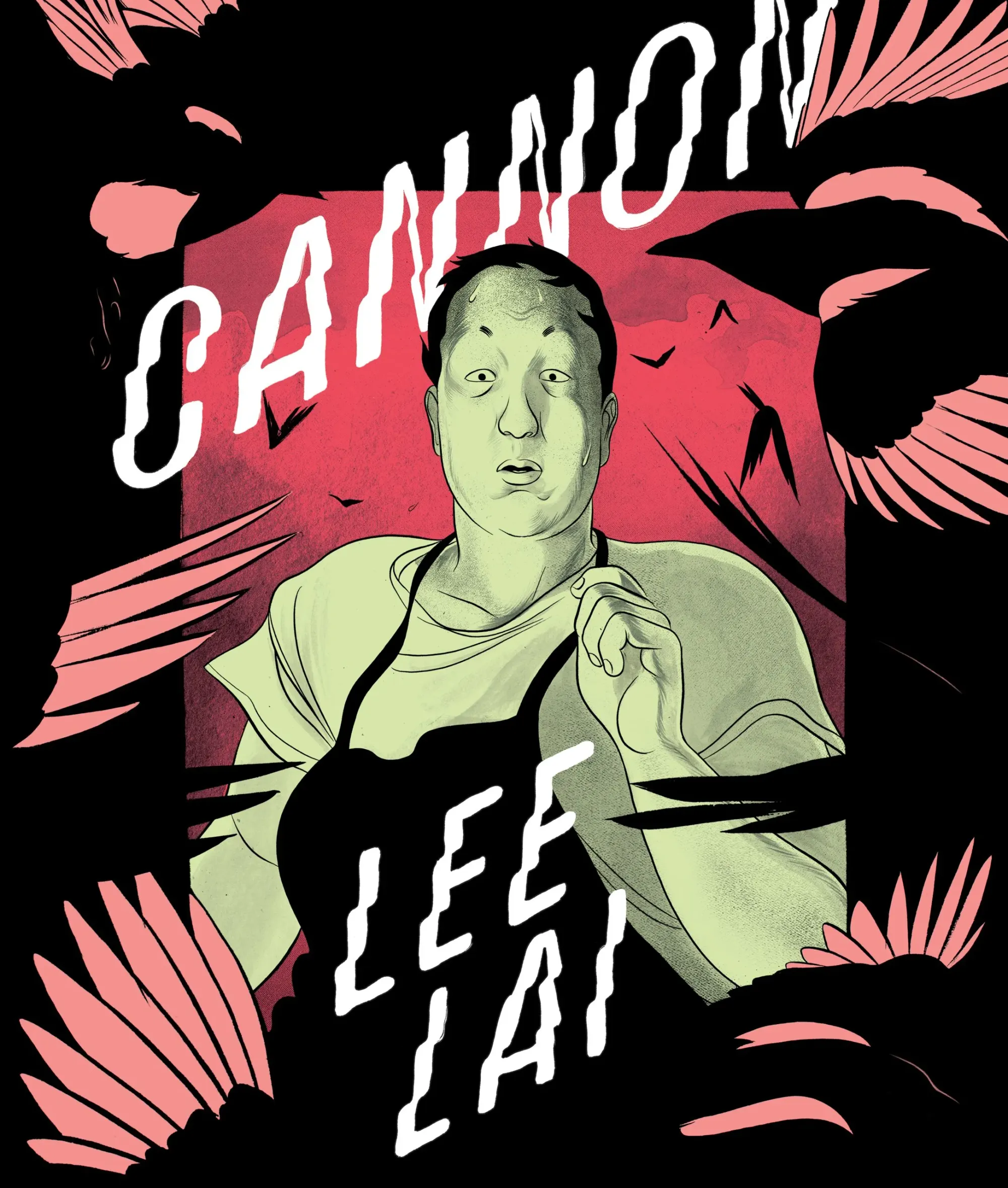
Cannon
By Lee Lai
Drawn & Quarterly
September 2025
I met Lee Lai at a comics expo in Boston Saturday. She was drawing little wolves on small pieces of paper to serve as business cards. When I commented on her generosity in giving out original art, she said she just wasn’t organized enough to think of printing them beforehand.
It was a workaround that spoke to Lai’s priorities. When faced with a choice, Lai reached for care. (Another choice could have been: no business cards.)
In front of the Lambda Award-winning author was a neat stack of copies of her 300-page graphic novel Cannon, published this September by Drawn & Quarterly. I cracked open the tome and instantly knew it was the kind of story that would change me whether I liked it or not. Lai’s publisher sent me a PDF of the novel Monday morning, and by Monday evening I was already writing this review.
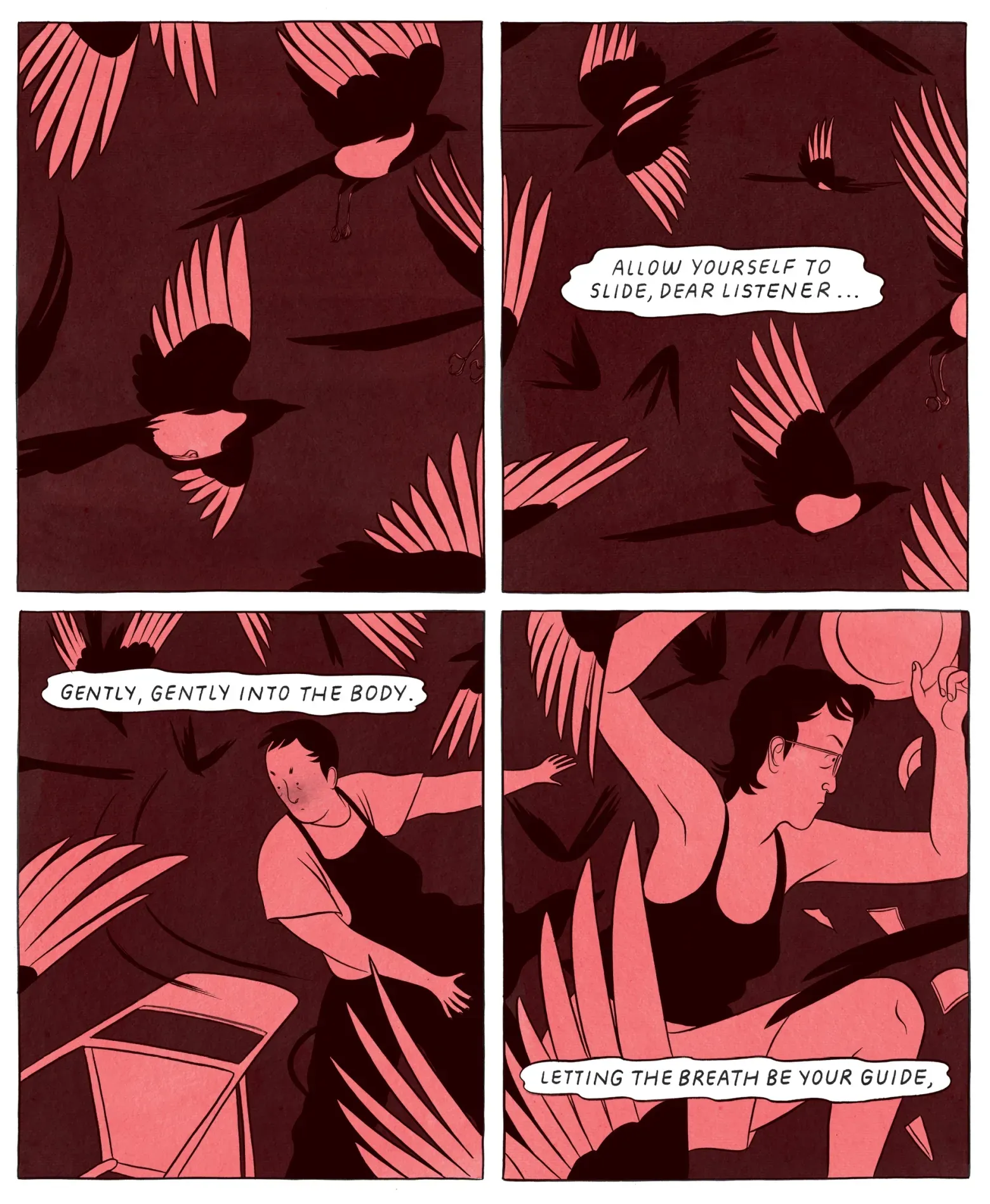
Starting heavy from page one, Cannon opens with the wreckage of a restaurant interior, observed silently by a gathering of black birds with white wing patterns so bright they appear to glow among the scene’s dark grays. They look like magpies. Seemingly visible only to main character Cannon, they return in moments of stress, of which there are plenty.
Under their watchful eye, Cannon breaks free of a script others expect, even demand, and transforms into a wild creature of her own.
As another queer Asian on “the uncool side of our twenties” (as Cannon describes herself and friend Trish), I saw in Cannon questions that have been pecking at my own mind lately. The poetic thing to say would be that the story didn’t give me answers, just better questions. I’ll take Cannon’s lead and start saying the wrong thing.
Cannon gave me answers. Not necessarily to what I should do in my own life, but to what it looks like to see a pattern play out. It was relieving to see the characters’ love lives manage to stay in the sidelines, reflecting broader themes that speak to more foundational constructs. At what point, for example, does someone become entitled to you?
When they don’t have other options, maybe. If everyone has a right to experience care, and through some incredible stroke of bad luck you are the only one who can give it to them, well, you better start caring. Right?
Over the course of the graphic novel, Cannon takes care of her aging grandfather, wedges herself into uncomfortable shapes to make her hangouts with Trish run smoothly, and goes on meditative runs that tear up her feet just so she can manage a dysfunctional work environment day after day. Everyone keeps telling her how good and calm she is. It’s a harrowing tale.
When Cannon asks for a small gesture of care from a new hookup and is rebuffed, it’s hard to say where her mind can go from there. She can’t just demand care, like the ones who have made her life so difficult. She is, as Trish describes in secret notes about her friend, “hyper-independent.”
In order to move forward, Cannon must reach into other pockets of her life. She makes two out-of-character decisions that save her from the never-ending cycle of her first answer. One of those is the leadup to the book’s debris-filled opening scene. The other is more emotionally monumental: a visit to mom.
Perhaps it’s because I’m at the point in my own cycles where I’m in between watching The Matrix for the hundredth time and Everything Everywhere All At Once for the thousandth, but Cannon’s journey reminds me of both of these groundbreaking pieces of media about the power of self-determination.
Both The Matrix’s Neo and Everything Everywhere’s Evelyn Wang break free from the patterns that define their lives by performing unexpected acts. They must stay one step ahead of systems laying out a suffocating future. Their spontaneity does more than provide a reprieve from the same-old; it exposes the pattern as nothing more than a set of predictions, implying the existence of an entire alternate dimension of possibility.
For Neo, the trap is simple: His world is a simulation. (Sorry to those who’ve somehow escaped this spoiler for the last 26 years.) Evelyn is a victim of her own indecision, unaware that her universe is just one of many.
In Cannon’s case, the reader slowly learns that Trish, pressured to write the identity-soaked queer Asian story her literary gatekeepers expect of her, has been pulling from Cannon’s real life to do so. Cannon’s destiny has been quite literally written out. It’s up to her to choose a new path—again, not just to catch a break, but to once and for all respect the true chaotic beauty of being alive.
The challenge, then, for the Wachowskis (The Matrix), the Daniels (Everything Everywhere), and Lai is to create a character who can commit an out-of-character act. A good training sequence covers a lot of ground, but growth alone is not enough. The shock of the leap can’t be too gradual; its magic is in its spontaneity. So: In each of these stories, the main character actually knows from the beginning, however faintly, that something is deeply wrong. Hence, ominous glowing birds.
When Neo, Evelyn, and Cannon break into their full potential, the dissonance they’ve had the whole time becomes clear. What they’ve done was not out of character, not really. It’s just that a human being is not a character.
Cannon understands she is not the character Trish wrote about. There are things she might decide to do that Trish could never predict—that no one could predict, perhaps not even Lai. Am I taking this too far?
Maybe. But to me it is telling that Lai included the Trish friend-fic plotline at all, which I first read as a direct challenge to the initial depictions of Cannon’s relationships. The narrative’s “absent mother” and “crumbling patriarch” are described as “cliché and sentimental” by Trish’s writing mentor, who urges Trish to dig deeper. There are mysteries yet to be uncovered. (But also, what does this white, old-guard-lesbian mentor know about what’s cliché and what’s not for Cannon’s life? Projections abound.)
Cannon is the kind of story that rings especially true in our current era of surveillance capitalism, in which advertisers are constantly scraping our metadata for likelihoods we will buy one detergent over another, or could be subtly convinced to do so. As scholar Shoshanna Zuboff says, just as capitalists trade oil “futures” (or predictions about value), they are now trading human futures. Are there any mysteries left?
Throughout the story, Cannon is surveilled by the birds—“They sit, and they watch me,” Cannon says—and by Trish, who collapses her friend’s superposition of possible states into a single, clichéd storyline with every stroke of the keyboard. I feel a fondness for Cannon, as well as a protectiveness that requires me to stay a certain distance away. As a reader, somehow I feel Cannon’s story is safe with me. I won’t intrude by projecting on her too hard.
I’m taking cues from the source; through style choices, Lai gives her own characters some much-needed privacy. Lai shows us only three months of Cannon’s life, skimming the past with brief flashbacks and sending the birds into an open sky for the story beyond. Cannon’s triumph isn’t in a simple refusal to care, one that could ease a reader into predicting a new set of things for her. Instead, her redistribution of care, like life, is case by case.
Cannon is an answer to the crisis of being alive, managing relationships, and racing to outrun your own fate. And when Cannon decides she’s not cool with how the story is going, she takes the plot into her own hands. Lai lets her. The answer, it seems, can always be rewritten.