
By Allan Appel
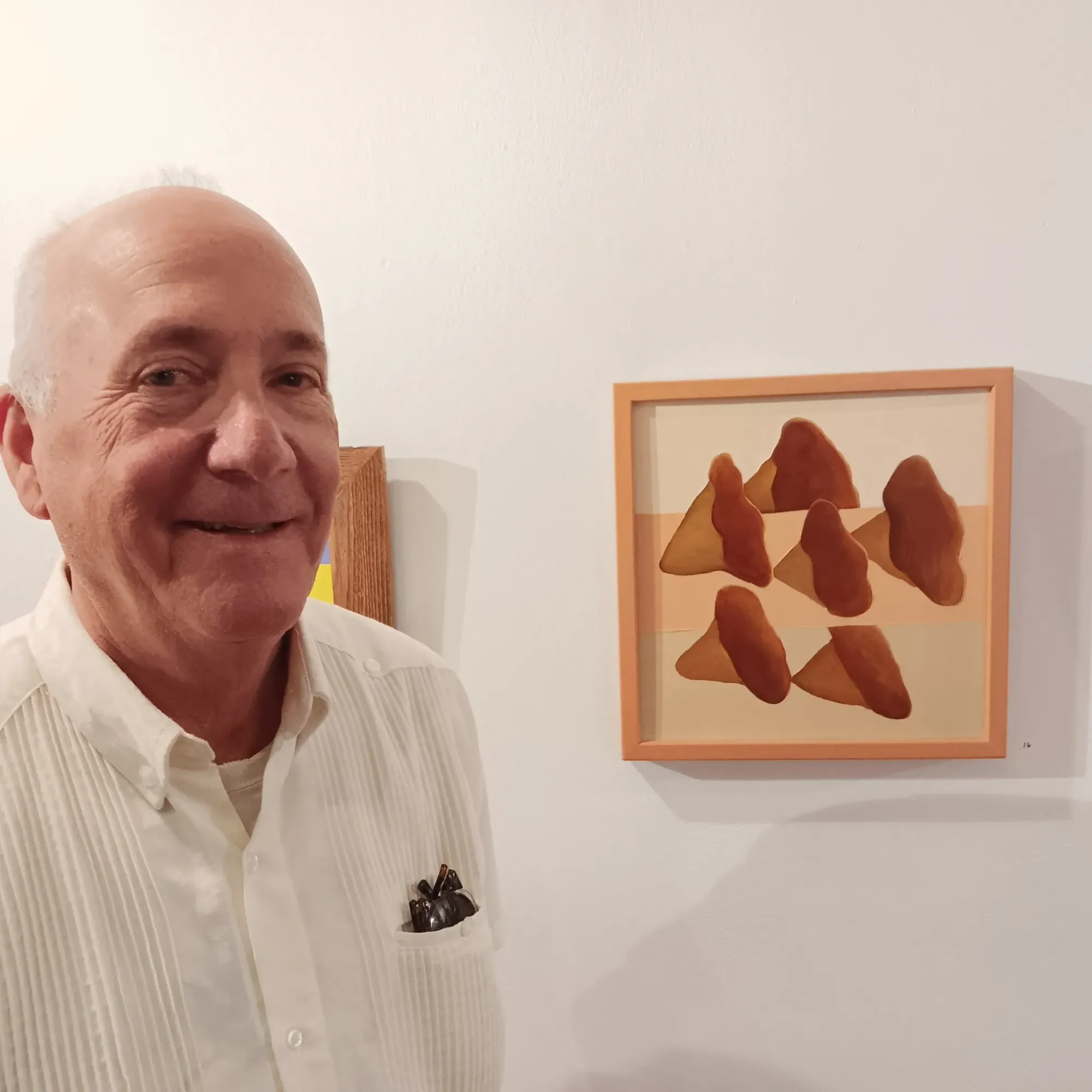
Conescapes
Mark Aronson
Aisling Gallery (Study at Yale)
1157 Chapel St.
New Haven
Through Sept. 15
It’s hard to imagine a better subject of an art exhibition to visit during the dog days of July and August than ice cream cones.
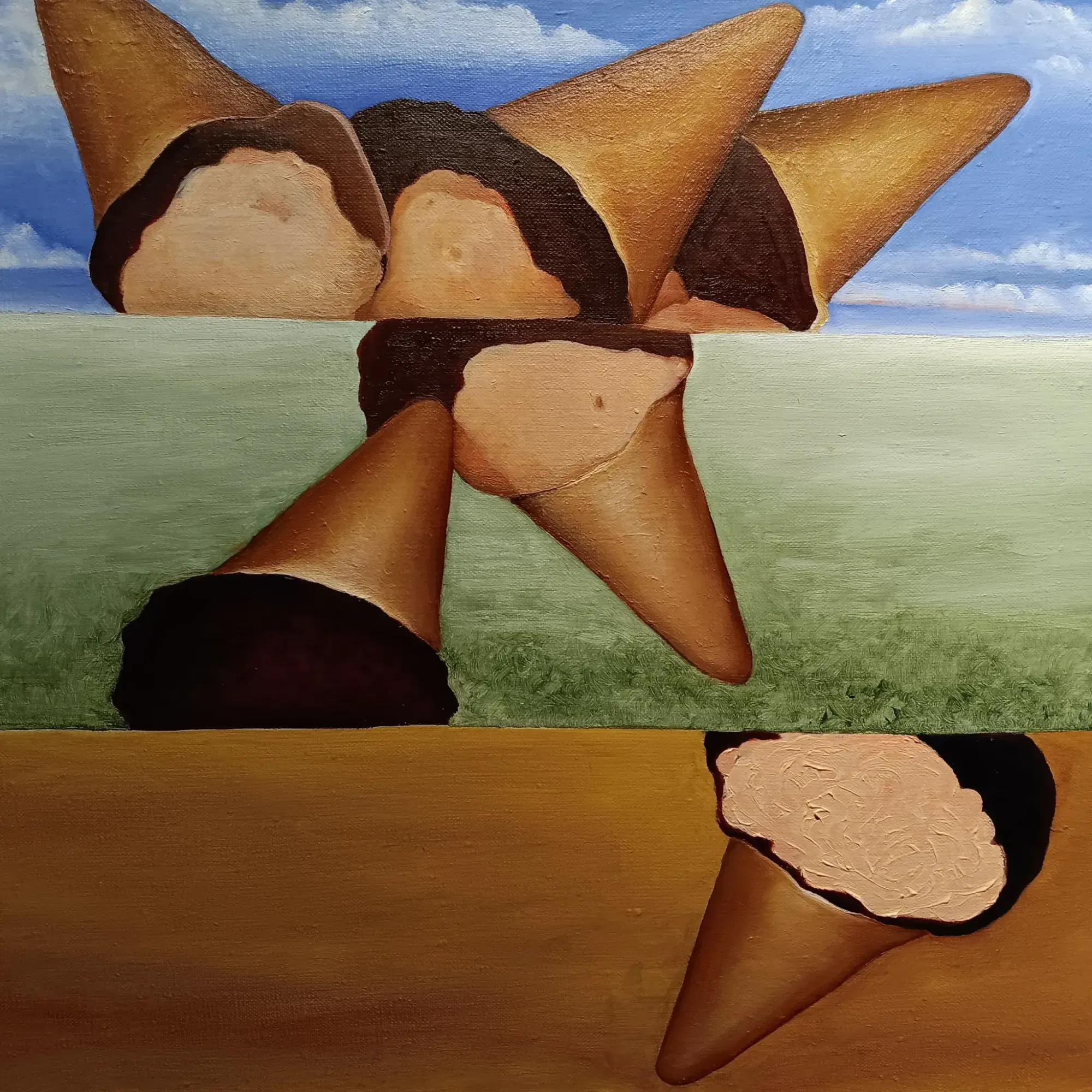
Conescapes, Mark Aronson’s cool and flavorful new show at the Aisling Gallery, right off the lobby at the Study at Yale hotel, is then the place to have, well, not a lick, but a rewarding look, from a selection of mounted treats.
With 31 small to tiny oil paintings on paper, panel, and canvas, Aronson, the senior paintings conservator at the Yale Center for British Art, offers up a visual fantasia with a cast of characters that includes, to use his own statement, “cones, scoops, spoons, bowls, and sometimes landscape.”
Yet their real roles in the life of each painting is to “juxtapose form color, line, and value.”
In other words, nothing to do with real ice cream! (Darn!)
That’s to be expected from a conservator or restorer turned painter (a not uncommon career move, says Aronson) who has spent his life examining the layered surfaces on 17thand 18th century paintings, and studying pigments and glazes to see how old masters pulled off their magic.
“These are very serious paintings in terms of the painting vocabulary,” said exhibit curator Maria De Los Angeles, who recently left a professorship at Yale School of Art to take up a position at the Maryland Institute College of Art. “But they are also funny and whimsical.”
There are flights of cones, and an ascension of cones — graceful, athletic pirouetting cones, cones that are frequently aerial and cones battling with each other, or lining up to dance or march. They seem to spend a great deal of the life Aronson has given them to admire each other inside the frames that Aronson himself made for them to inhabit.
How they preen and pose showing off to each other who has the best line, or who has the most dazzling texture, the most alluring point where two lines of the cone converge.
In fact, as you move through the cozy exhibition space, you quickly stop thinking at all about your childhood favorite ice cream (no matter the temp outside) because the show charmingly de-enchants you from the initial associations, visual and otherwise, with the sugary stuff.
One viewer at the July 6 opening told Aronson that some of his dark mounds looked less like chocolate ice cream and more like russet potatoes. That was fine with him.
The pleasure of the show is the sly and entertaining way it presents and re-enchants you with something new. There are roughly four sections: cones on flags, or three horizonal stripes of paint, which Aronson puns as “conflagrations”; cones on leaves, which he calls “conefalls”; a smaller number of cones vacationing in the mountains or by the sea, which he calls “conescapes”; and “fleshcones.” (Do we hear flesh tones?)
This latter is a series that Aronson painted using the 26 different types/tubes of paint, from different sellers, which he obsessively has collected. Each – certainly to the eye of a paintings restorer – is a decidedly different hue, yet offers itself up as “flesh.”
In other words (you see, he’s got me going), the exhibition “re-cone-oiters” you back to the life and color of shapes, and perhaps also to the meaning of color. In other other words, it does what art is supposed to do, shifting perspective, helping you see the invisible, reminding you of the basics, and via a most enjoyable vehicle.
Which is evident from its whimsical origins.
To that end Aronson, with a slight affect of the sinner eager to confess, said, “Here’s where it began:”
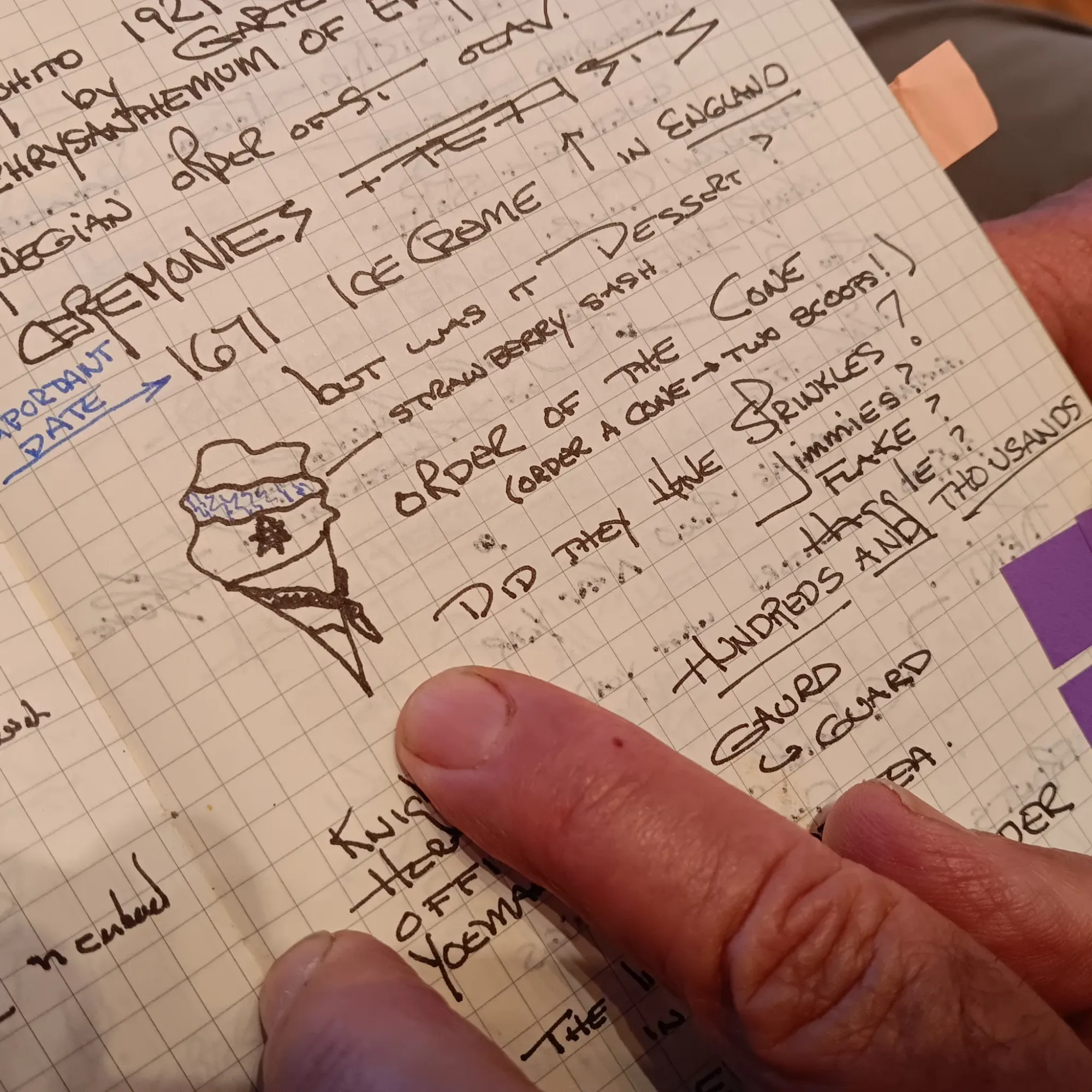
He pulled out his dog-eared doodling notebook that tells the story of the triggering experience, from 2008, that launched him on this ongoing “whimsical engagement with the notional Royal Order of the Cone that in 1671 established Garter Brand Ice Cream in service of the English Monarchy.”
He was attending a professional conference at Windsor Castle and listening to a lecture on the history of the Most Noble Order of the Garter, the group that defends the king. He was dutifully taking notes and growing a tad bored, he recalled. Then he learned that a 1671 “feast of St. George,” the protector of the Garter gents, was the first occasion in culinary history in which ice cream was served to an English monarch.
It was probably vanilla and served to the king and those at the high table, not to those at the lower tables, because it was so rare, such a luxury.
Aronson found himself, amid the note-taking, drawing that first cone, and drawing, and drawing. Soon the Royal Order of the Cone emerged. He has never stopped.
So far he is the only member of the order. But if you’re a friend of Aronson and he sends you a postcard from his travels, rest assured there will be a cone doodle, a kind of honorary membership card.
So Conescapes emerged from 18 years of cone doodle immersion, drawing after drawing. That process was accelerated by the pandemic: “It was hard to doodle when you’re on Zoom, and I missed the studio.” So he began painting the cones. Everything in the exhibition was created from that spring of 2020 until now, with a push this summer in the run-up.
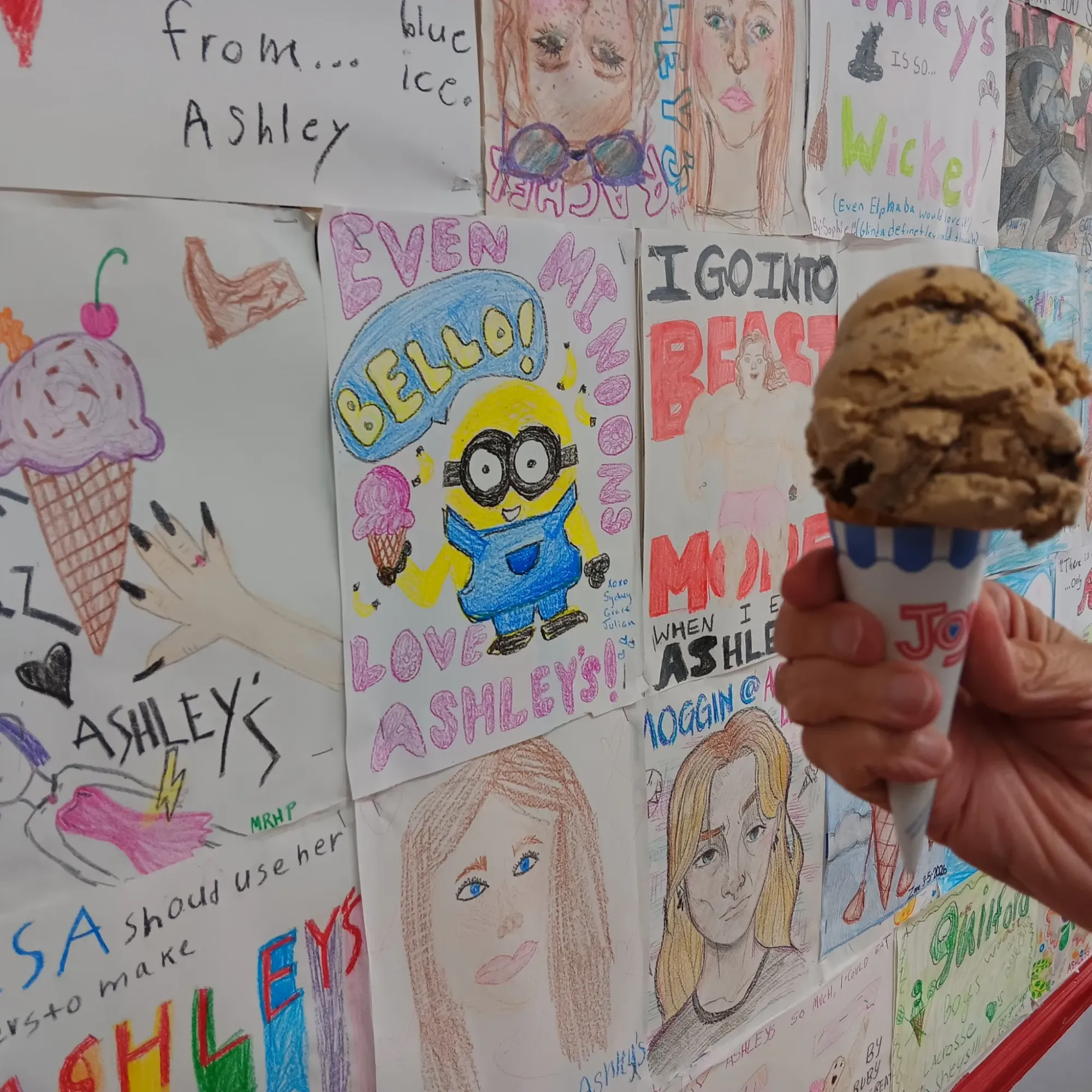
Then Aronson added another group of “amazing artists.” These would be the works of children done while waiting for their treats, the pictures of cones that decorate the wall of his favorite ice cream parlor, Ashley’s in Guilford.
And have we mentioned that the total number of works in Conescapes is 31? That number, of course, echoes Baskin-Robbins 31 flavors (one for each day of most months, boys and girls), an establishment many of us grew up with.
Did Aronson intend this? Why not 32 works or 30? Whimsy demands an answer. Unless, of course, it’s more than serious whimsy at play here, as if a cosmic revue of the show has already been sent from the cones beyond.
To learn more or to purchase, temail markaronson@gmail.com.


