
Doo-bee-doo-wop-doo-wop, Lady Stout sang.
Doo-bee-doo-wop-doo-wop-wop-wop, Penelope Clark Stewart, a 10-year-old fifth-grader at Worthington Hooker School, rejoined.
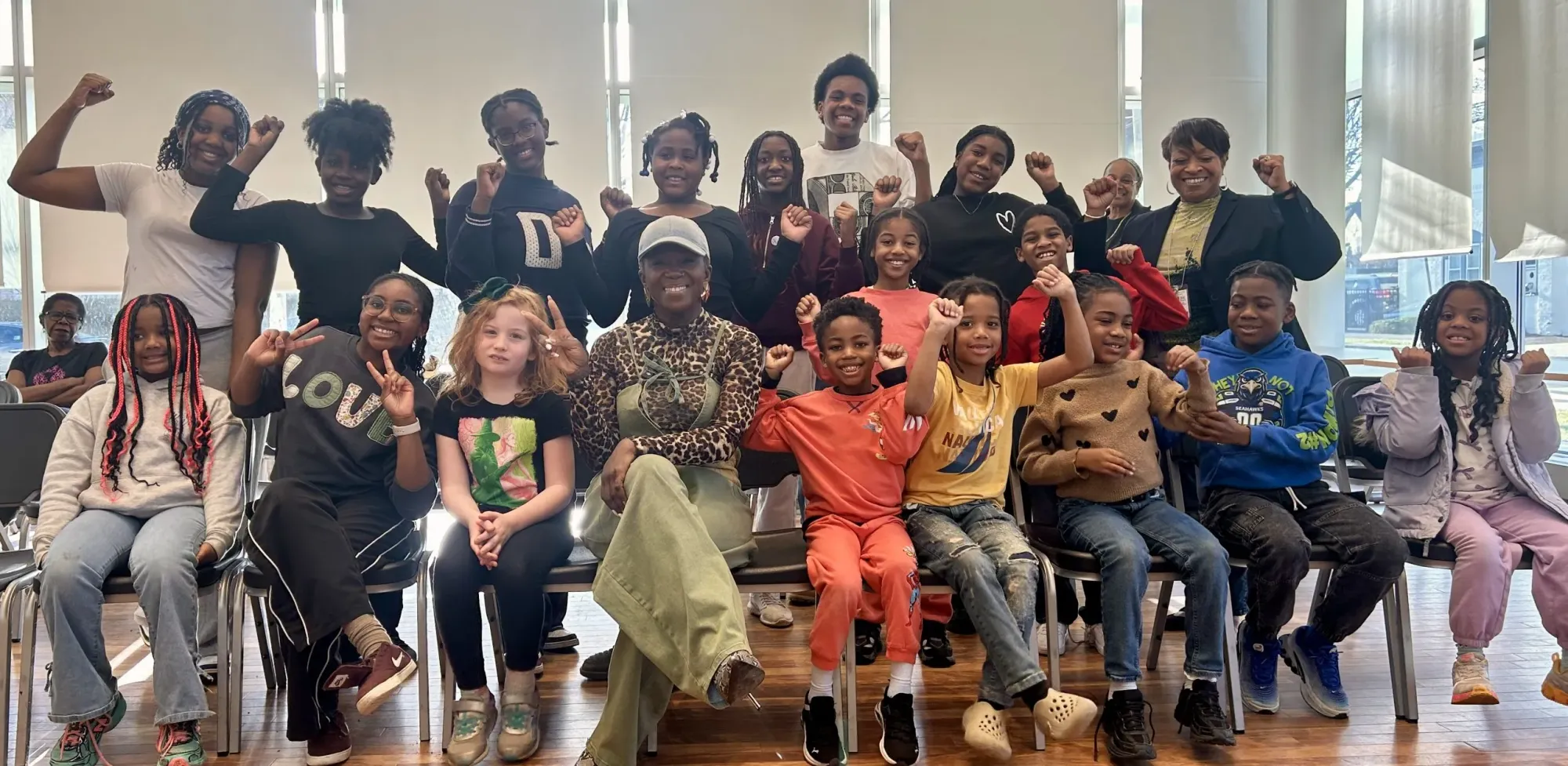
The occasion for this rapid exchange of improvised syllables, or scatting, was a vocal performance workshop led by Lady Stout, aka Denise Renee, at Ashmun Street’s Monk Youth Jazz & STEAM Collective K-8 after school program. The New Haven-raised, Apostolic Love & Faith Tabernacle-reared powerhouse vocalist has performed with artists like Alicia Keys, Stevie Wonder, and Patti LaBelle.
“What I learned from Stevie Wonder is to be free, have fun, and never forget your love for the music,” Lady Stout told Stewart and her 21 classmates at Wednesday afternoon’s event. Her takeaway from touring the globe for three and a half years with Alicia Keys: “You can be a star and still be kind, still have grace.”
The program, founded by New Haven icon Marcella Monk Flake, blends music, STEAM (Science, Technology, Engineering, Arts, and Mathematics), and humanities for youth. The twofold mission, according to Flake: to prepare underserved youth for future success through activities like mock trial competitions, instruction in human anatomy, and coding robots, as well as training in music, dance, and art.
The other part of the mission: bringing in professionals that show them what they can be. “Our children need to see people who look like themselves in finance, medicine, engineering, and more,” Flake said.
“Stout heard about our program and she said ‘sign me up,’” she said. “She’s had good fortune and she wants to pay it forward.” That begins with her kids, her 15-year-old son, Hubert Powell IV, or Hubeats, and her three daughters, all accomplished musicians who performed at her rousing tribute to the legendary Nina Simone at Flint Street Theater last Friday night. She also heads Vocal Elite Company, where she trains the next generation in vocal technique, as well as performance coaching.
The idea, Lady Stout told the group, is learning good habits and “becoming masters at whatever you decide to do.
“Before you sing, before you perform, you always want to warm up,” she said, before leading the students in neck stretches and shoulder rolls. “I want you guys to release any anxiety, let it go.”
There were lessons in breath control, with a challenge to recite the entire alphabet in one breath at a steady tempo. “Breathing is the foundation for your singing,” she told them, the metronome clicking away, as a boy drew in a deep breath, his eyes fixed in concentration. “Not lmnop. L-M-N-O-P.”
She taught them how to hold a pitch, for seven seconds, then ten. “Your breathing is going to carry you through your performance,” she said, before pausing to declaring the group ready to apply the technique to a song.
“I feel I can fly,” she began, her voice swelling, incandescent, through the space.
The group sang the words back to her.
“Let’s add a note,” she said. They did, their sounds lengthening, growing in body. Soon they were singing in rounds, with Lady Stout harmonizing.
The final challenge was improvisation. “Feel the room first,” she told them. A few students closed their eyes. “Think about what you’re going through, how you feel, and apply it to the music.”
Stewart was the second volunteer to take the stage. Teacher and pupil mimicked instruments, riffed off each other. “Let’s hear some words,” Stout told her. “I feel good, I feel good, yeah,” Stewart sang. “Every-thing is working for me to-day, I can go on my-ah-ah-ah way,” Lady Stout returned. “I can go on my-ah-ah-ah way,” Stewart sang back.
“It felt great,” said Stewart, who sings with the All-City Choir as part of Yale School of Music’s Music in Schools Initiative, as the workshop was wrapping up. “I love singing and I just want to keep doing it, and now I know there’s someone I can learn from and who can inspire me.”
At the front of the room, Lady Stout was surrounded by a group of kids. “May I come back?” she was asking them. “YES!” they chorused.


