
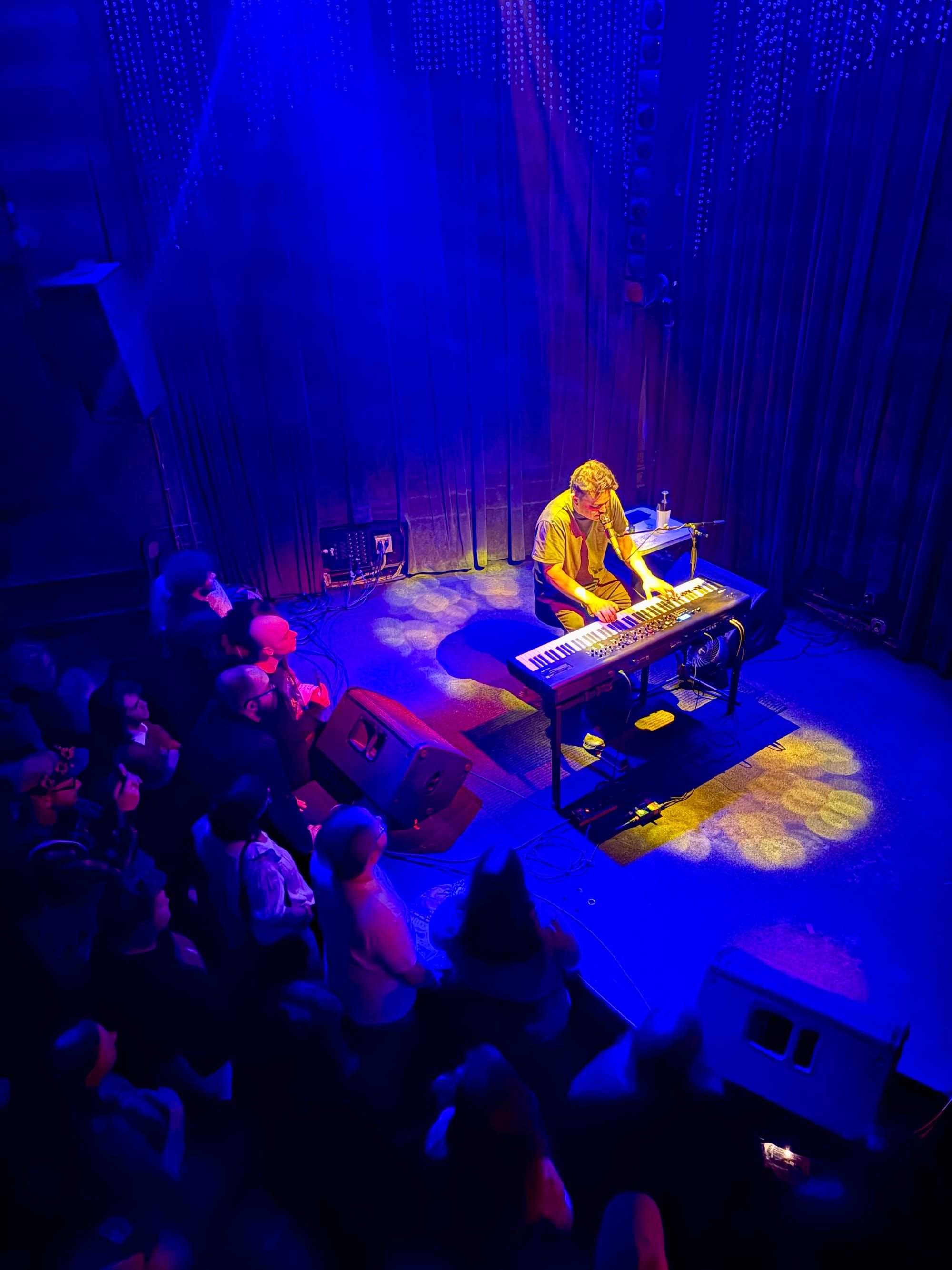
Spencer Krug, Lizdelise
Johnny Brenda’s
1201 Frankford Ave.
Philadelphia, PA
Sept. 28, 2026
What good is a journeyman if he doesn’t take you on a journey? “Thanks for coming out to watch a guy play a keyboard,” Krug said with a friendly shrug before embarking on a rampant, expansive hour-plus set spanning his long, wide and diverse discography and songwriting life. The Canadian musician best known for bands like Wolf Parade, Sunset Rubdown, Swan Lake, Frog Eyes and his solo project Moonface – indie rock staples all originating from perhaps its most iconoclastic (and Canadian) era – brought the goods with passion, his cold-medicine-infused body and mind be damned.
Right out the gate, with the old Moonface song “The Fog,” Krug charted us a course for mystery, abstraction and wild beauty: “he cannot tell the difference / between a heartbeat and a wave / he has a bad, bad sense of time,” he sang over a steady repeating pattern in the left hand – Ab, Bb, C and back down to Ab on the low-end downbeats, F up top on all three but the first – conjuring a murky, narrow, droning and cyclical environment for his characters to live and die in. When he finally sang of the titular fog, his right hand burst into high-up, fast, technicolor triplet patterns over that bass ostinato, a gorgeous and sudden display of classical-piano chops that established unmistakably that this is a performer who can wring a ton of feeling out of his instrument and his voice. (“It’s just this for, like, an hour,” he joked modestly, as if anyone would mind. Then he threatened to one day lip-sync an entire show, after teasing us for being one of the only forced-to-stand-the-entire-time audiences he’s played for in the solo-piano context.)
And that voice! It was great to hear it outside of the context of electric guitars and loud drums, just to more clearly hear and appreciate Krug’s expressive powers and often weird and unexpected lyrics. (I really love Pitchfork writer Brian Howe’s description of Krug as a sort of “PG-13 Xiu Xiu,” especially in the sense that sometimes, it’s creepier and weirder when you don’t make things explicit or obvious.) Naked and unadorned, it was easier to appreciate the constant little wonders baked into Krug’s songs and musicianship: that quaking, aching vibrato, his curious harmonic adventurousness (lots of strange cadences and seemingly-random modulations), his unvarnished sense of humor. Of course, the most crowd-pleasing moment – and there were many, the room was packed with grateful diehards – was arguably his performance of the Wolf Parade classic “I’ll Believe In Anything,” a decades-old song that’s come full circle, and is just as powerful, and maybe even more desperate in its pleading, when it’s just Krug and eighty-eight keys.


