
Jean Scott
Calamities
Koffee? on Audubon
New Haven
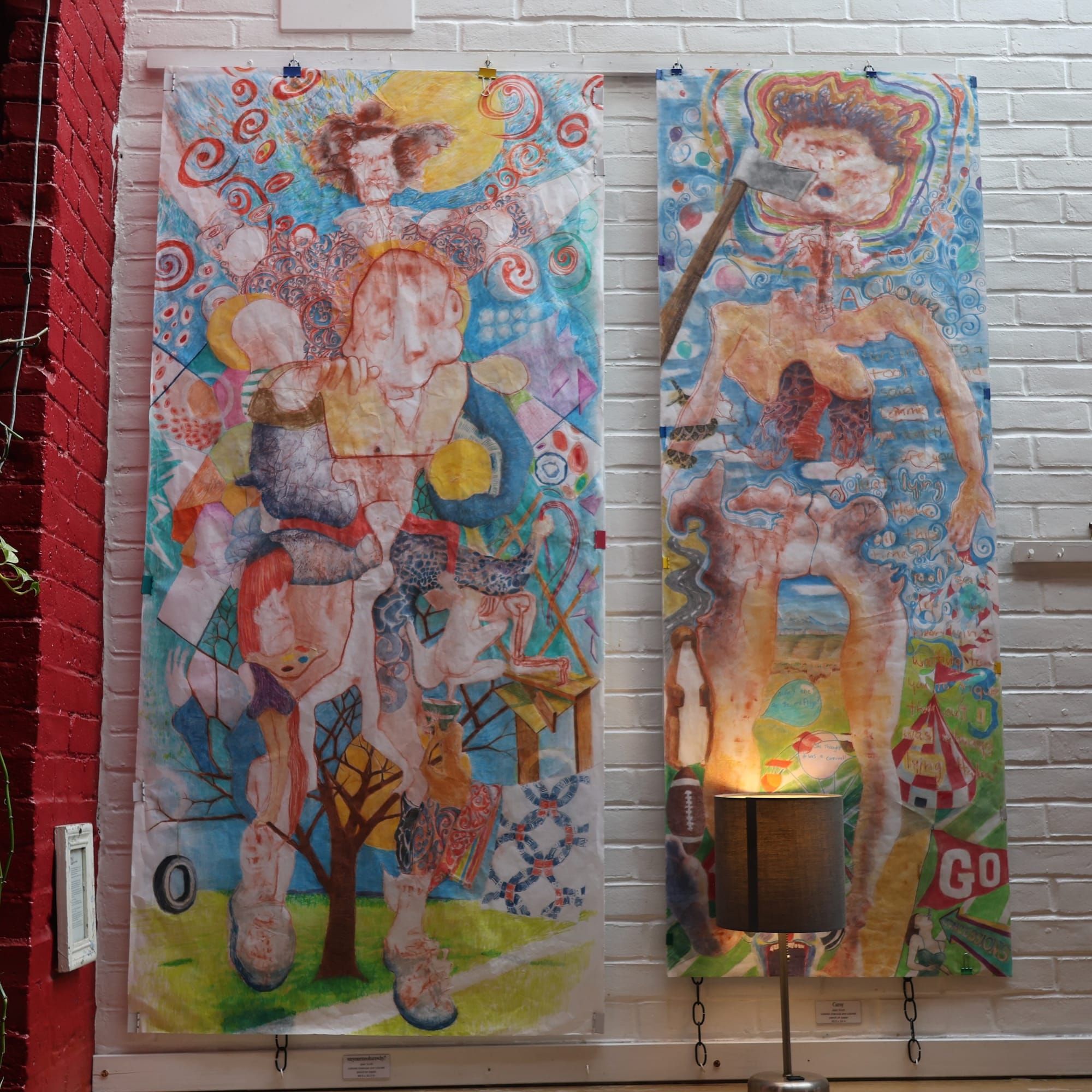
The colors in Jean Scott's pieces veeyeseetecoharewhy? and Carny are festive, summery, redolent of sunny days at their peak, verdant fields, shimmering blue skies. But the forms suggest figures in tumult, bones and muscles being stretched from one shape to another. The jarring dichotomy plays out in the details. In the corner of Carny, for instance, is a woman being hit in the face with a tool. Is it a joke, a pratfall? Is it an assault? The piece doesn't say, allowing it to be both.
The pieces, Scott said, came from a place of "profound grief," to the point where she initially hesitated to create them.
"I feel this," she thought, "I don't need to know what it looks like." But the artistic process carried the possibility of transformation. "To look at myself, it changes it.... It looks like a monster, and that's what I feel like." She liked the "surprise" of it, things "emerging consciously, unconsciously, and I just decided to go ahead and push that." She ended up somewhere tragic and comic, somewhere grief and humor could co-exist.
The pieces are part of Calamities, a show of art by the New Haven-based Jean Scott running now until the end of the month.
"I decided to call this show Calamities when I noticed that alarming things are happening, or have happened, or are about to happen, to the people in my drawings," Scott writes in an accompanying statement. "All of these works (except one) started as transfers I made by holding a piece of paper in front of myself and moving a stick of colored charcoal over the outside surface. I can't really see what I'm doing during this process. The result gives me a starting point that is already imperfect. That helps me try to make a good picture instead of a nice one. Sometimes I can tell right away what these first marks want to become; other times I need to study before I make a move. I may see imagery developing that I didn't consciously intend. Some of it is deeply personal; some of it refers to things outside of me that have earned my attention. I like the immediacy of starting this way. It's fast and mutable, if you don't mind stray lines and smudges."
"The struggle shows, and that feels honest," Scott adds. Hanging the show at Koffee? also feels direct to her, which is why, in lieu of a traditional opening and closing reception, Scott is instead taking her lunch break from her job every Wednesday in March to be available in the coffee shop from about 12:15 to 1 p.m. "I'll wear a name tag so you can find me if you want to say hi," she writes in her statement.
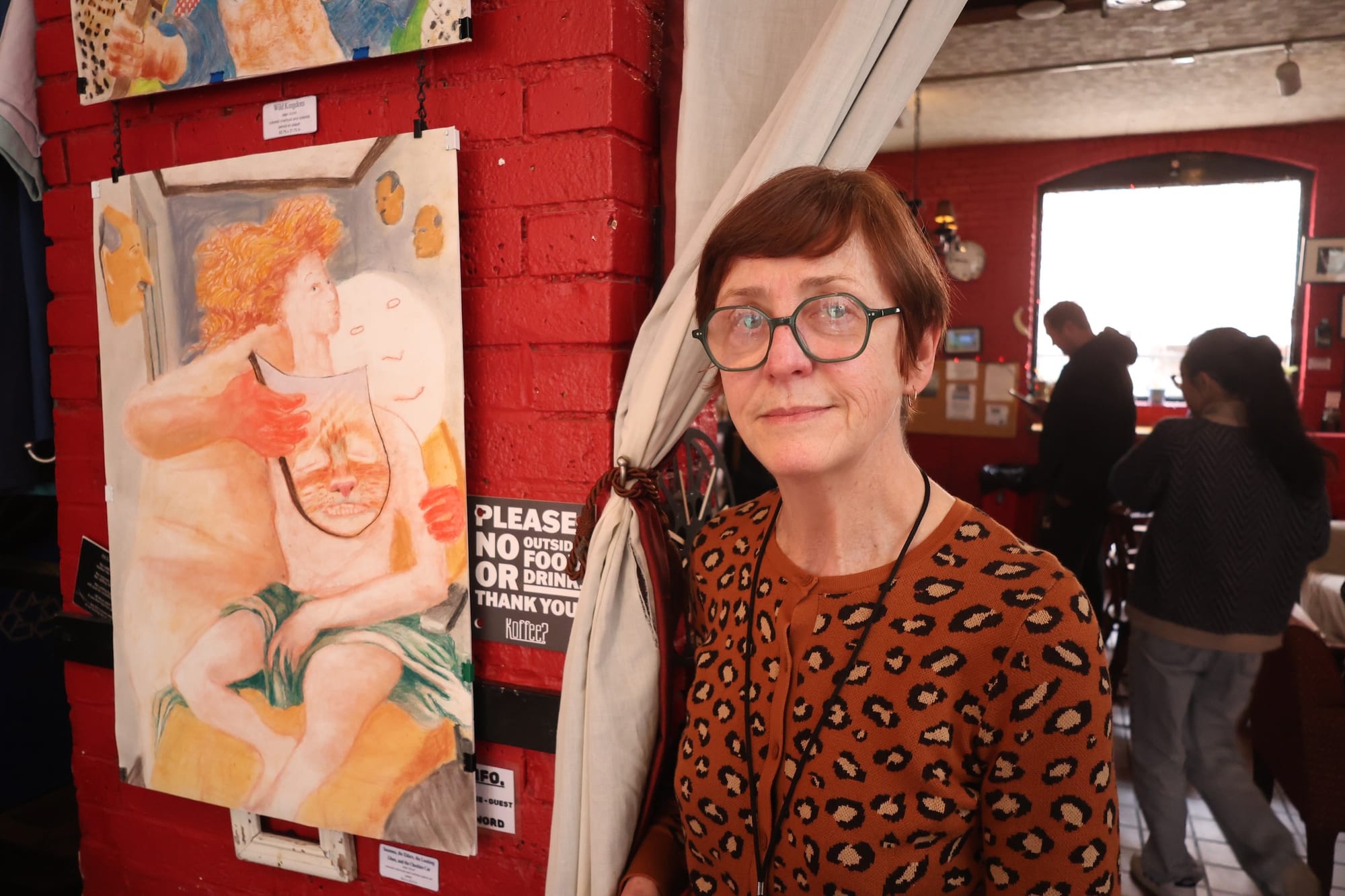
Dropping in on a recent Wednesday found Scott to be true to her word. A year ago, Scott explained, Koffee? put out a call for artists interested in showing their work in the Audubon Street space, curated by employee Angelica Nuttall. The slots are now booked up through 2027, with some occasional reshuffling.
"A really cool thing is that the artist has total control over what you're going to show here," Scott said. She chose to put up works she had made most recently, getting measurements to make sure they would fit in the room. "I was afraid the larger pieces would be too large, but they're not," Scott said.
For Scott, hanging her art in a coffeeshop is a welcome reprieve from two now-common things in the art world: either searching for pristine gallery space or hustling for clicks online. "You're told all the time on social media that you need to do this or that better, you need to promote yourself," she said, in order to get virtual attention from an online audience with a short and perhaps distracted attention span. The eyes on the art on the walls of Koffee?, by contrast, were real. It felt "like an open studio experience, where I get to have a bunch of my work instead of one piece in a group show."
The relaxed nature of the show also stood in contrast to a gallery with stark white walls. That can be "intimidating" for people, she said, like "shopping in the most high-end, clean environment ever," the kind of store where the people who work there "show you one object at a time." And while the open studio programming in the fall, from Erector Square to West River Arts and elsewhere, have become anticipated events, Scott pointed out the immense effort the organizers involved make in order for artists to show their work for a couple days out of the year.
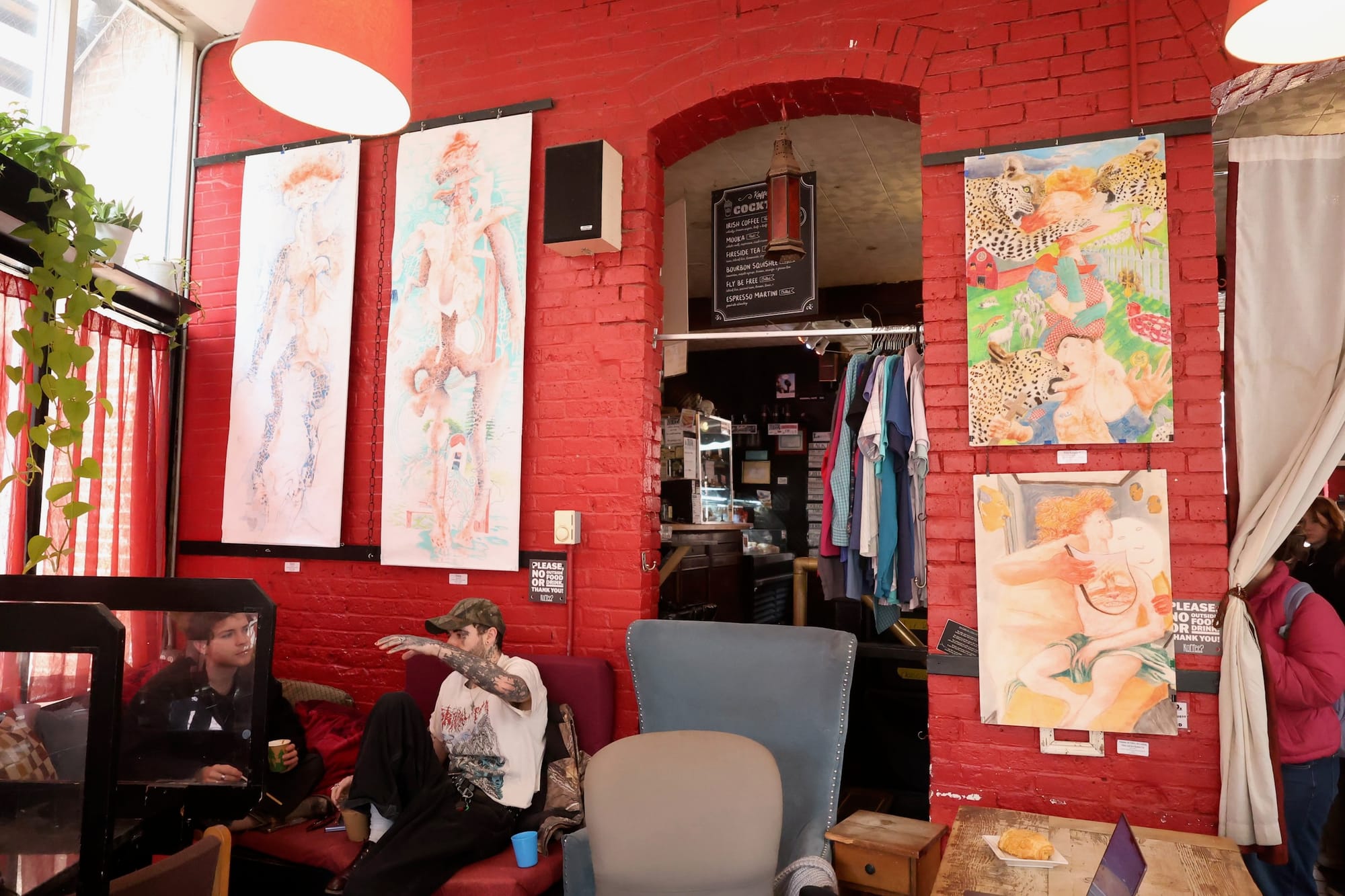
Koffee? as an art spot also feels like an oasis. With the loss of Artspace in 2023 and the recent closing of the John Slade Ely House as a hub for art downtown (the Ely Center of Comtemporary Art has moved to Fair Haven), "it feels like almost a moment where we have to go back to an '80s mindset where you've got to do it yourself," Scott said. A storefront is a "heavier lift" than it was then. But "there are human things we still need to do," that is, seeing art in person, in a livable space, as part of one's day-to-day life.
After all, as Scott pointed out, outside of "the Hollywood of the art world," the lives of most working artists are intertwined with the day to day, beginning with work — whether it's a gig that allows them to practice some of their art making skills or just a job that provides stability and a livelihood. Scott lives in New Haven and works downtown at the Connecticut Financial Center. "I have this poster that says 'beware of artists — they mix with all kinds of people, and so are the most dangerous,'" she said.
And at Koffee, the chance for someone to mix with Scott's art rises — and with it, the chance that her artwork "detonates a thought" in a viewer. Scotts sees art in the end as "a way of communicating," of "offering a gift ... even if I'm not in the same room at the same time."


