
By Connor Arakaki
Jimmy Gavagan
New Haven Jazz Underground series
The Cannon
New Haven
Sept. 10, 2026
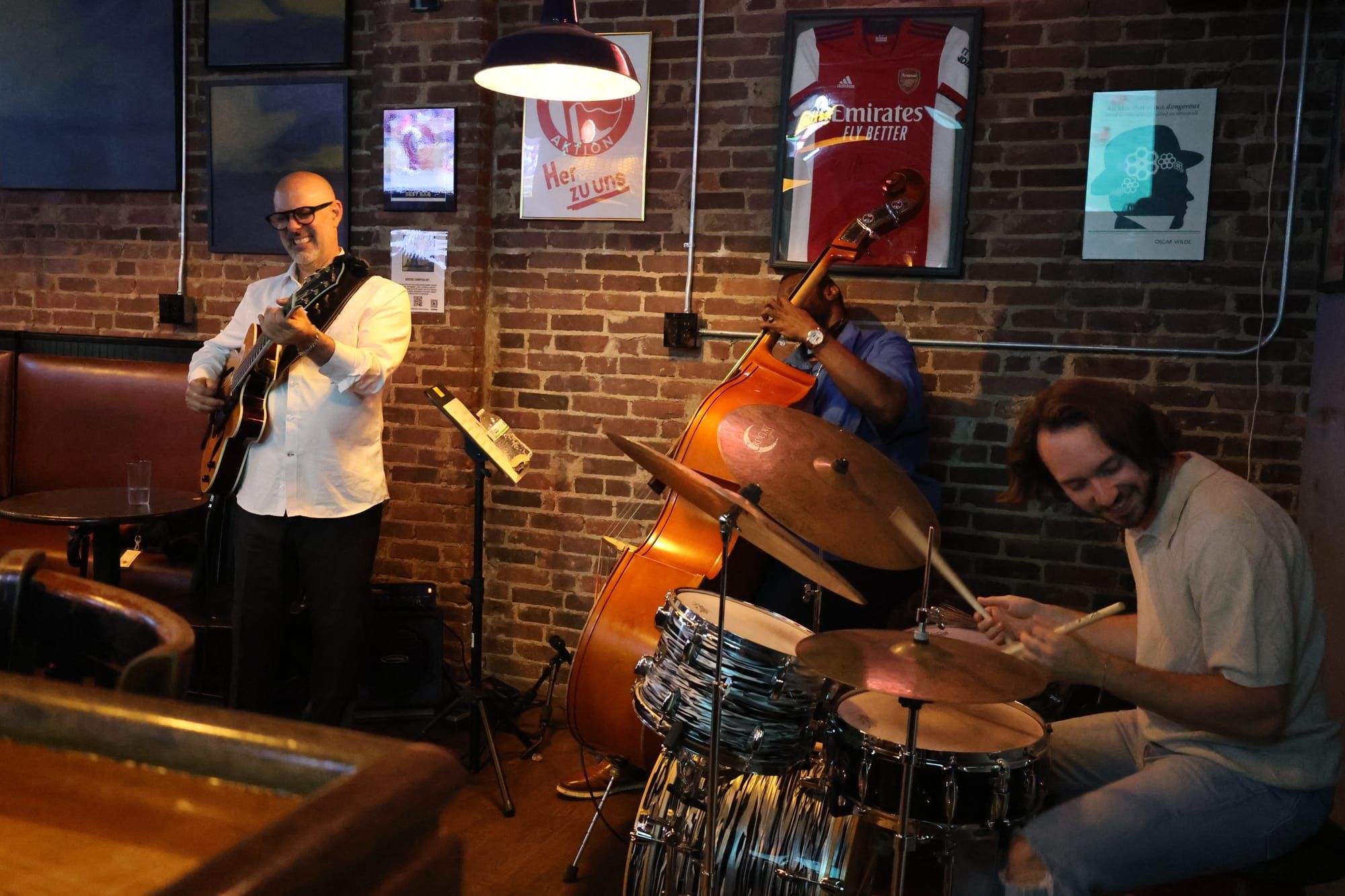
Beneath a pair of red championship Arsenal football jerseys, drummer Jimmy Gavagan spearheaded a disarmingly charming setlist with his trio for an intimate crowd at The Cannon on Thursday evening. The trio’s genre-sweeping performance effortlessly braided iconic standards with envelope-pushing tracks, marking the latest concert in the New Haven Jazz Underground series.
For Gavagan, the evening represented the community integral to his development as a musician, one that has followed him from the classroom to the bandstand.
Nicholas DiMaria, who founded the Underground in 2019, tapped Gavagan to perform at the Dwight Street pub. DiMaria said it was an “intuitive choice.” The pair met nearly a decade ago, when Gavagan was a freshman studying music at the University of Hartford’s Hartt School of Music, which was a common network from which bandleaders like DiMaria booked local musicians. “He did a couple of gigs with me and then the personality collected,” Dimaria said. “He was eager to learn, to put it all out there, and that developed into an exceptionally strong friendship.”
Wes Montgomery’s acrobatic groove “Four On Six” kicked off the setlist, drawing in a crowd of 20 to Gavagan’s long-standing partnership with bassist Stephen Porter and guitarist Rich Goldstein, who were his teachers at Hartt. (Porter and Goldstein are also alumni of Hartt, and are respectively now a staff accompanist and guitar professor at the university.) Porter’s deft time-keeping of the track’s signature ostinato riff and Goldstein’s harmonic flair on his archtop guitar clicked together with an understated swagger.
Between songs, the trio laughed over the common ground that had first brought them to music: classic rock. During their training at Hartt, jazz cast its spell on them. Goldstein, who discovered and studied the genre in the pre-streaming era, recalls the pilgrimages he would routinely make to local record stores to track down albums recommended to him—followed by the three-week waiting period for them to arrive in-store. “I still have a bunch of my first vinyl records,” Goldstein said. “You sit down and read the liner notes, look at the pictures—you spend an intimate moment with each record because it’s new.”
Meanwhile, Porter’s introduction to jazz was tied more directly to its history surrounding Hartt’s campus. His studies of local jazz history were, he said, “when I truly developed a taste for it,” leading him to the history of the New Haven and Hartford train stops along the route between New York to Boston that traveling jazz musicians often followed. The evening’s performance empowered Gavagan to toss the melody to his former teachers.
“Getting to play with these guys has been a learning experience and a pleasure,” he said. “Playing alongside seasoned musicians was the most I got out of the [Hartt] curriculum.”
The honeyed ballads “Darn That Dream” and John Coltrane’s “Naima” slowed the night’s tempo, lending to the warm acoustics of The Cannon. Amid plenty of distractions—consider, Caddyshack (1980) on the left TV, the army of Arsenal merchandise along the barstand, a Thrasher skateboarding competition on the right TV—the trio conjured a rich, propulsive melody, all the more one absent of horns and reeds. The trio coasts what Gavagan describes as the “ebb and flow” within the setlist, or even just within a single song, fluctuating between restraint and eruption in their instruments with an ease so masterful that it was almost casually cruel.
Such interplay was especially apparent as the set closed with“Jeannine,” during which Gavagan foregrounded his drums in the soulful and buoyant tune, manipulating the kit as much for texture as for rhythm. The dry, ringing snap of Gavagan’s sticks catching the rim sliced through the September night’s humidity, and the swingtime melody outpoured for groups eating at The Cannon’s outdoor patio. Midway through “Jeannine,” a woman in red danced through the entrance, drawn in off the sidewalk by the sound spilling onto Dwight Street.
The Cannon was never a space designed to demand silence, and the trio never seemed interested in pretending otherwise. That was the ethos Gavagan credited for tonight and for the Underground’s residency there more broadly—a room where jazz musicians, as DiMaria put it, are “salt of the earth,” used to making any space work. “That sense of community is so integral to New Haven’s kind of music and the history of jazz,” Gavagan said. “Everybody plays with everybody.”


