By David Sepulveda
SOMA: A Collaboration of Music, Art and Film
Bregamos Community Theater
491 Blatchley Ave., New Haven
June 9, 2026
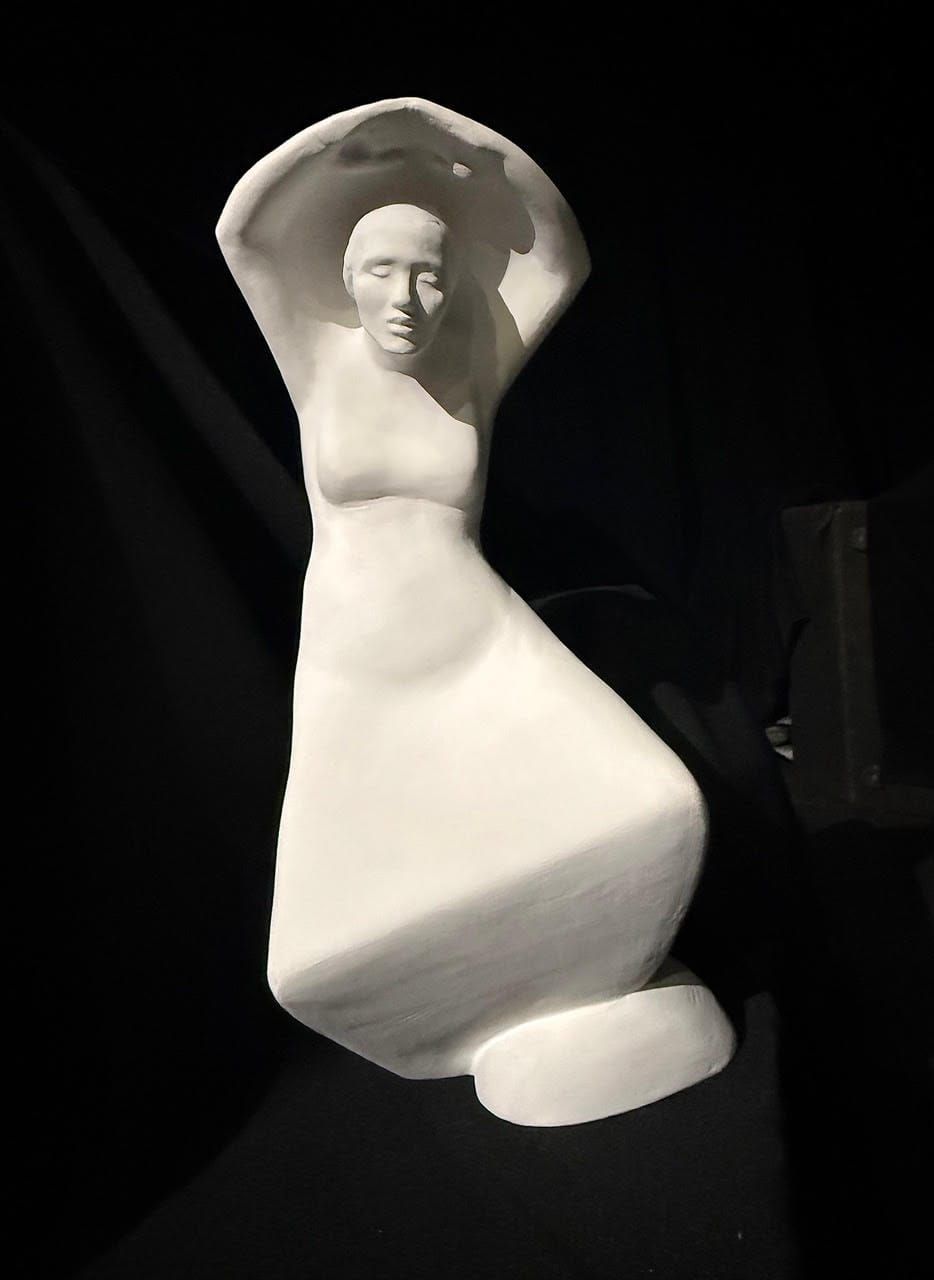
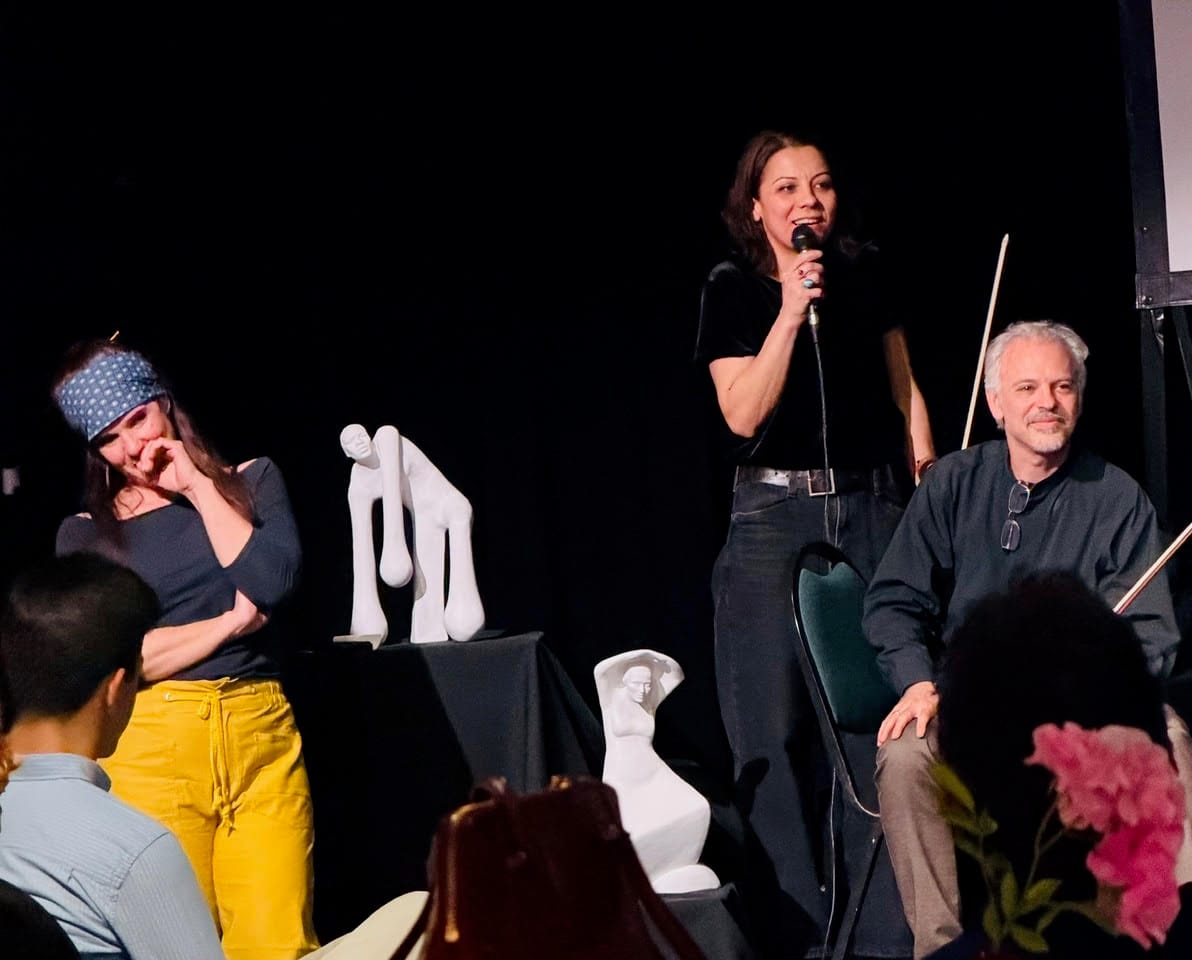
For one evening only, the stage at Bregamos Community Theater, purposefully darkened, was framed by the gleaming white, figurative sculptures of modern master Susan Clinard — part of her evocative “The Weight We Carry” series.
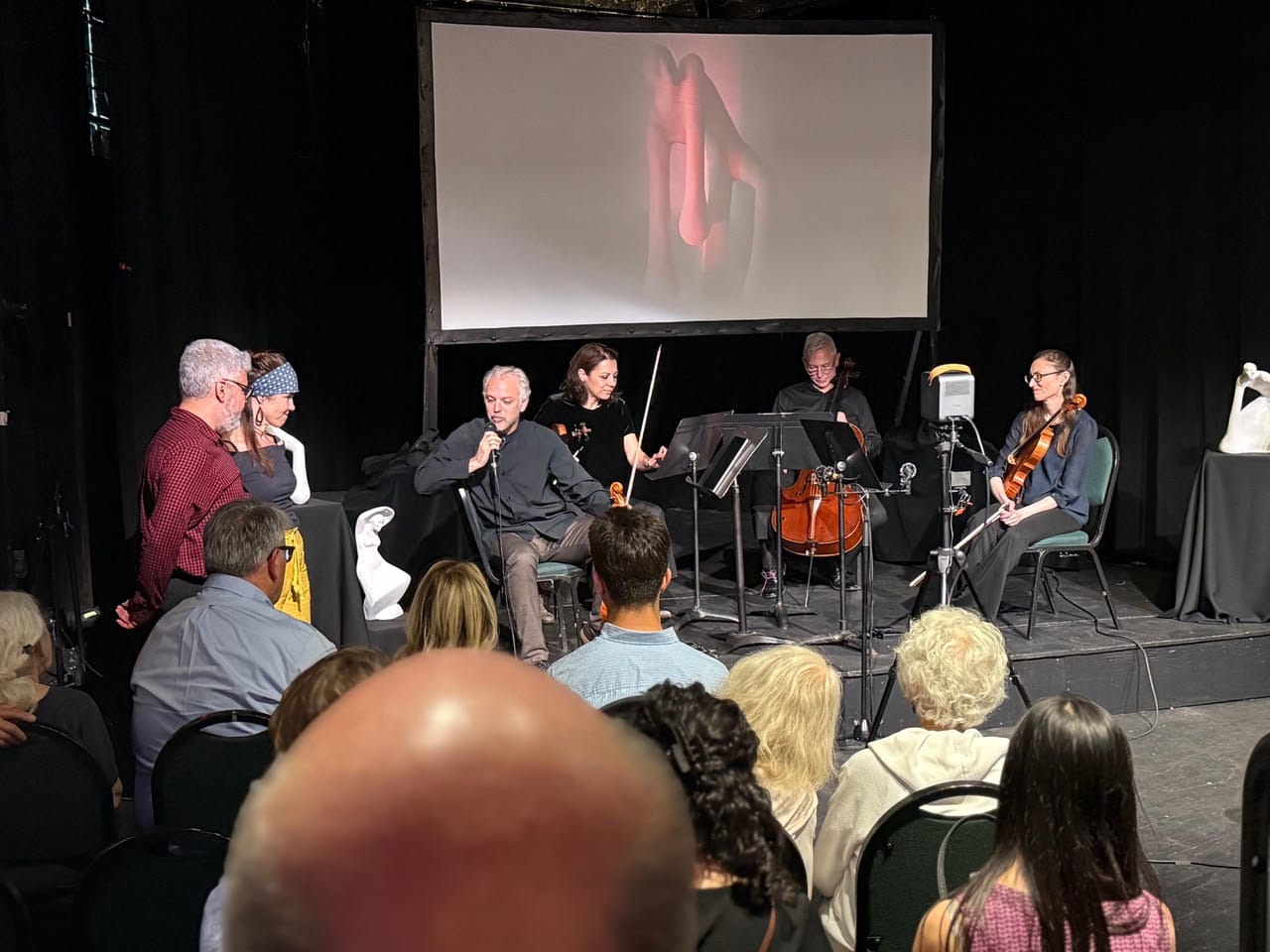
The artworks were the catalyst, the inspiration for a magnificent collaboration and intersection of arts disciplines at the theater that included musicians of the orchestral collective called The Knights and the art videography of Antonio Garcia Escolar for the world premiere of a work by Puerto Rican composer Luis Gustavo Prado's Second String Quartet, titled SOMA.
The etymology of the word “Soma” has roots in ancient Greek and means “body.” According to the SOMA program, the word refers “not to the clinical body, but the body as living archive: the place where history is stored, where wounds are inherited across generations, and where the decision to remember becomes an act of resistance.”
The June 9 presentation was produced and curated by violinist Yaira Matyakubova, who is the artistic director of Music Haven in New Haven, with artistic direction by Gustavo Prado. Quartet performers included Colin Jacobsen, violin 1, Yaira Matyakubova, violin 2, Miranda Sillaff, Viola, and John Franklin Koen on dello.
Matyakubova said the project was made possible by the Mela Haklisch Innovation Fund, designed for the New York based ensemble, The Knights, to constantly innovate and invigorate the concert experience. “As a member of this group, I was a recipient of the grant that opened up the doors for this project.” Inspired by Clinard’s “immense artistry,” Matyakubova said her goal “was to find a way for our community to experience Clinard’s art, and through music we were able to achieve a sense of journey through time. The composer took this idea to a new level of depth.” She also acknowledged support of Rafael Ramos, founder and director of Bregamos Community Theater. Ramos said that the multidisciplinary project embodied and amplified the spirit and mission of Bregamos Theater.
Before the first musical note pierced the silence of a hushed audience, Clinard’s sculptures had already set the tone for the sensory journey of sight, sound and visceral connection that would follow. Their elongated and blunted limbs weighted to the ground by the gravity of collective burdens and trauma that have passed through generations, also held the promise of deliverance— a theme reflected in composer Prado’s four musical movements: I Código, II Entrata, III Danza Puertorriqueño, and, IV, The Weight We Carry.
One of Clinard’s sculptures in the “Weights” series is an outlier. With arms arching above its head and absent the elongated-bulbous extremities, the figure is in a rising position of resistance. Clinard said the gesture is that of a person pushing against the burdens of inherited trauma. Her pieces, she has noted, are meant to inspire “empathy, connection, and ultimately, collective healing.”
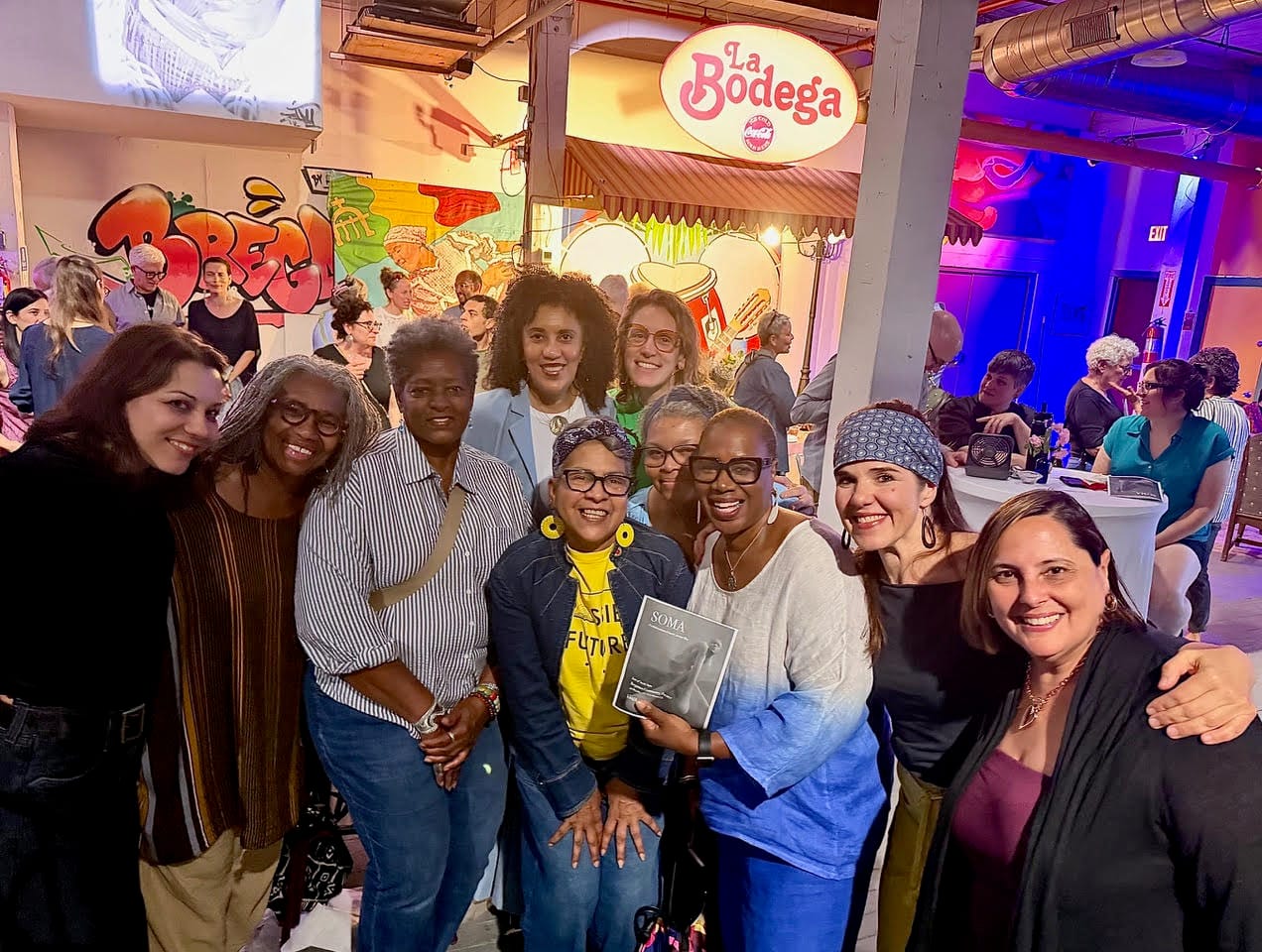
The beautifully designed program for the SOMA event, with poignant essays by Prado, is a work of art in its own right. It neatly describes the musical architecture of Prado’s composition: “SOMA opens with a chorale-a code-and returns to it at its close, transformed. The journey between is cyclical: from code to scream, from dream to passage, from passage back to code. The audience enters in darkness and pure sound, travels through a life, and arrives back at the beginning, changed.”
"The audience enters in darkness and pure sound, travels through a life, and arrives back at the beginning, changed.”
The concept of intergenerational trauma at the core of Clinard's sculptural series is one several underpinnings of the SOMA composition mentioned in the program:
"The work emerged from a constellation of ideas: the science of epigenetics, which has revealed that trauma can alter how our genes function -- changes then passed to our children; the poetry of Nora Lil Ortega Palés, the composer's mother and niece of the Puerto Rican poet Luis Pales Matos; the pre-Socratic philosophy of Heraclitus, whose fragments on the cyclical transformation of soul, water, and earth run through the piece like an underground river; and the conviction that in a time of rising authoritarianism and eroded dignity, art has an obligation to remember.”
At center stage, the introduction of video imagery flickered to life on a darkened screen at the first musical interlude … a countdown clock signaling a jarring detonation; an abrupt, shift of musical tone and tenor. The visual static and graphics of silent movie subtitles describe a harrowing ordeal of blindness and darkness. Relief arrives. The urgency relents.
In the third SOMA movement, Danza Puertorriqueña, with accompanying Spanish text, provides stanzas of Prado’s mother’s poetry recalling the spirit of a most beautiful Island. In his composer’s notes, Prado sounds a concerning alarm about Puerto Rico’s rising, existential crisis today: “As this music is being performed tonight, the beaches where this rhythm was born are being fenced off and privatized. Entire coastal communities are being displaced so that resort developments can serve investors who have never heard a Danza in their lives. Under the provisions of Act 60, the Puerto Rican government offers extraordinary tax incentives to wealthy newcomers while local families-families who have lived on that land for generations-can no longer afford to stay. SOMA is a work about the body that remembers. Puerto Rico is a body-a living body, with a history, a culture, a rhythm, a coastline-that is being made to forget what it is.”
In the video imagery of the forth movement, “The Weight We Carry,” kinetic montages of Clinard's weighted figures are layered with speeding, shadowy landscapes; the passage of time as if viewed from the window of a speeding night train. The SOMA journey, guided by the masterful composer and string quartet of The Knights, reached its destination after only 30 minutes, and untold generations.
A post-concert Q&A /talk-back provided necessary decompression and a riveting, extemporaneous explanation of epigenetics by Yale geneticist Antonio Giraldez, who talked about advances in our understanding of genetics and how information is transferred generationally. In referring to DNA, the building blocks of our human genome, he noted, "There is an emergent theory that this information that we though was set in stone, can actually be modified by our lived experiences and that of our parents and grandparents.”
Stefanie Kilpatrick is a specialist in trauma centered psychotherapy (TCP) at West Rock Wellness/Holistic Mental Health and Wellness Center in Westville. Contacted after the program, Kilpatrick reflected on the SOMA presentation: "What resonated with me is the exhibit's refusal to forget. As a psychologist working primarily with trauma at West Rock Wellness and The Post-Traumatic Stress Center, I am continually reminded that trauma exerts its greatest influence when it remains hidden or unspoken. SOMA beautifully captures the truth that remembering, mourning, and sharing our stories are not signs of weakness; they are acts of courage that restore our humanity."
For queries and information about SOMA contact the producer, Yaira Matyakubova, at Yairama@gmail.com or call 203-809-1180,