
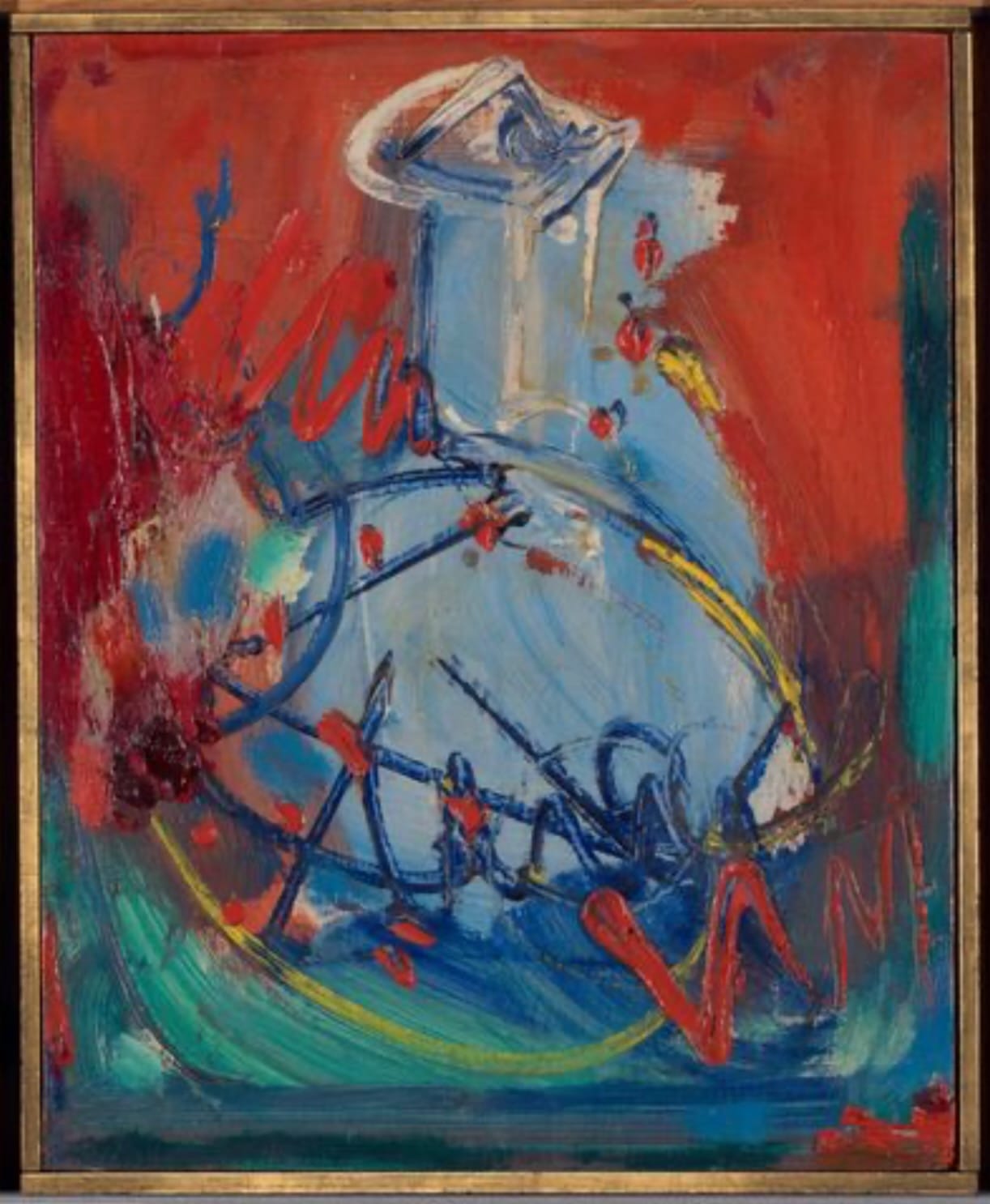
Hans Hofmann
Yale University Art Gallery
New Haven
Through June 28
Hans Hofmann's Carafe retains some of the form of the original object, but it's not the point. The lines, the colors, the brushstrokes, are what matter — what energy they can convey, what they can evoke in the viewer.
Carafe also has something to teach, as Hofmann was himself a teacher. As an accompanying note states, he "set up elaborate still-life arrangements for his students to observe how light, color, and spatial relationships contribute to compositional form. With its strong color contrasts in red, blue, green, and yellow," Carafe "is an example of the artist's famous 'push and pull' concept, in which opposing colors create the illusion of space, depth, and movement: soft colors, like the light blue of the bottle, seemingly recede into space, while bold ones, like the vibrant red and blue, push to the foreground."
Carafe is part of "Hans Hofmann," a show at Yale University Art Gallery running through June 28 that offers a sharp portrait of the artist and influential instructor. Along the way, it offers viewers a way to see into abstract art. By understanding more of the language of it, we gain a greater appreciation for how it works — and for how color and form, the things we see, affect us, whether we know it or not.
Hofmann (1880-1966), "a German émigré who moved to the United States in 1932, was among the most progressive and influential artists and art teachers in America in the 20th century," the exhibition's text relates. "As a teacher, Hofmann is credited with shaping the development of abstraction in the United States, and many of his students would become Abstract Expressionism's greatest innovators. From 1934 to 1935, when he founded his schools in New York City and Provincetown, Massachusetts, to 1957, when he closed them to devote himself to painting, Hofmann's legendary approach to instruction provided his students with artistic strategies that fueled their creative impulses."
Meanwhile, "Hofmann's interests as an artist were tightly focused on nature — not on depicting it literally but on translating its energy, structure, and spirit into visual form. While his work is indebted to the traditions of European Modernism and was informed by the artists alongside whom he worked in Paris in the early decades of the 1900s — including Henri Matisse, Pablo Picasso, and Robert Delauney — it is also marked by the radical innovation that was so alluring to his students."
Without diminishing Hofmann's influence as a teacher, the exhibition makes a case for lifting up Hofmann's art. "Hofmann's legacy as a teacher has often overshadowed his own work as an artist," the accompanying text states. The small collection of vibrant work on the gallery walls "represents the long arc of his career in the United States and offers a rare opportunity to study his creative evolution in depth."
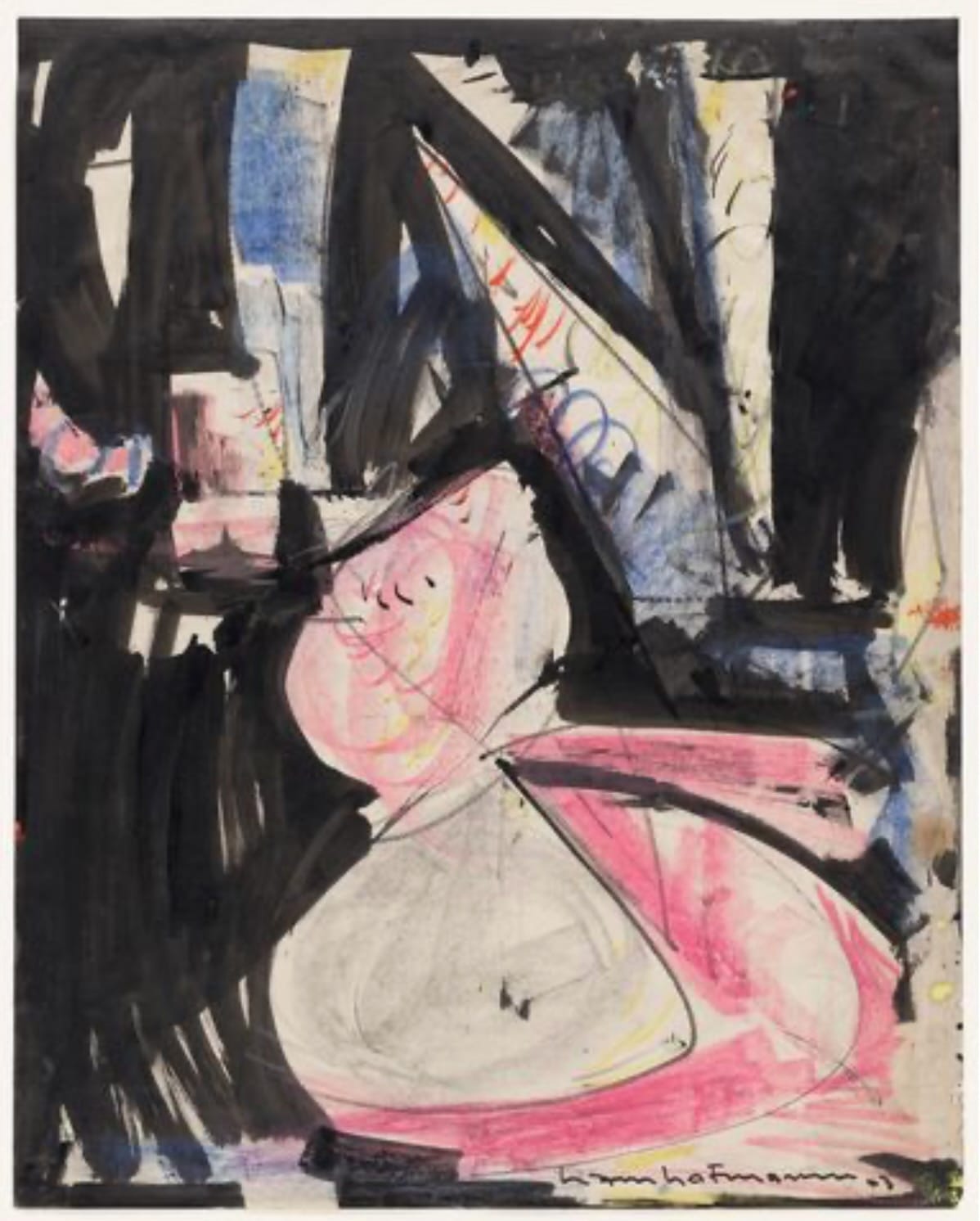
Making the case for Hofmann as an artist isn't hard, as his pieces all convey a searching, vibrant energy without being repetitive. Each fits comfortably into the whole of Hofmann's work, as it's represented in the show; each has its own statement to make. Hofmann made Untitled in 1943, during World War II, "when art materials were scarce" and gasoline rations kept Hofmann from making too many trips to do landscapes. So — lesson one — he made do with what he had, switching to crayons instead of paint, and continued to pursue his practice. "Drawings like this one, for instance, helped him work out color relationships and resulted in his statement that, in a work of art, 'it is not the form that dictates the color, but the color that brings out the form.'"
Pithy statements like that, in turn, convey how Hofmann was a good teacher. People often fall back on the easy criticism of abstract paintings that anyone can make them, without any formal training. The quotes from Hofmann sprinkled through the exhibition show that there's more to it, that making successful abstract painting involves an understanding not just of technique and color theory, but the ways we are so quick to try to make sense of what we see. We see fields of colors and make them into shapes. Taken a step further, we put even more meaning on them, making them into faces, buildings, trees, cars. An abstract painter understands that these are meanings viewers impose on the information their eyes receive, when really, in the end, we're all just looking at clouds and finding animals in the sky. A painter can play with that impulse, making paintings that tease, or defy, or simply call attention, to what we're doing when we look at things. Hofmann was not only good at doing that as a painter, but good at teaching others to do it.
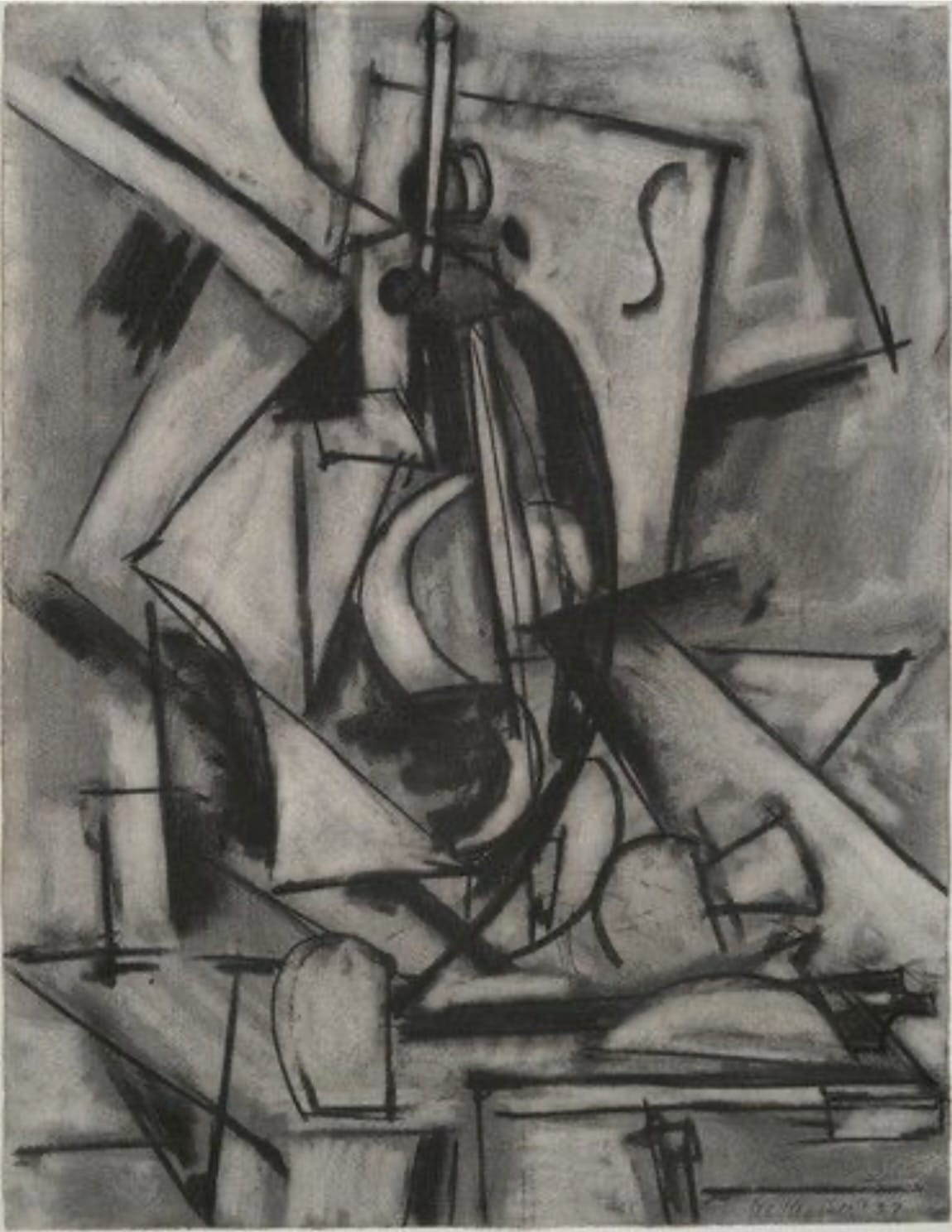
As proof, the show includes a piece by one of Hofmann's more famous students, Lee Krasner, who in 1937 "won a scholarship to study with Hofmann," an accompanying note states. "She made this drawing just one year into her studies with him and later claimed that the Cubist tendencies in her work were a result of Hofmann's teaching. In this drawing, Krasner embraced the fractured geometry of Cubism but pushed beyond it with her use of gestural, expressive charcoal marks." Krasner's piece is placed next to a drawing gf Hofmann's to show the closeness and clear direction of influence. The Yale show is intended to show the work of Hofmann the artist, not Hofmann the teacher, but this tantalizing glimpse into what Hofmann was able to do for his students — who included artists Krasner, Helen Frankenthaler, and many others — makes one wonder what an expanded Hofmann student section would look like. How far did the influence go for a man who taught a generation of painters how to see?


