
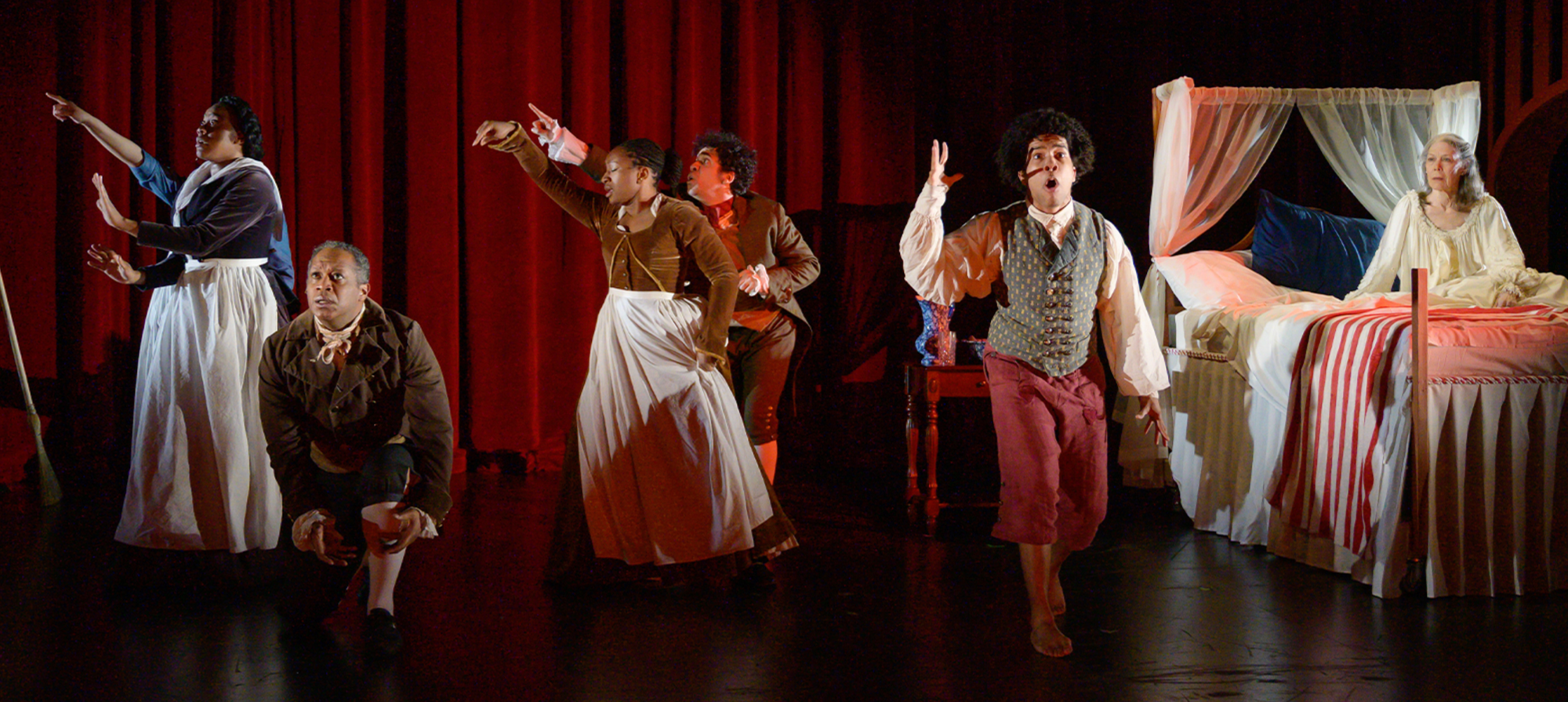
The Most Spectacularly Lamentable Trial of Miz Martha Washington
The Wilma
265 S Broad St.
Philadelphia
April 4, 2026
The American founding family is on trial and George Washington is called to the stand. Sauntering on stage in a Gucci-lined cape, when asked if he owned slaves he answers, “Nah man, real talk, I married into that.” Martha Washington interjects, “I’m a woman, I can’t own a teacup!” bringing into question the distinct role of white women and denial in the history of enslavement.
Now playing at the Wilma Theater, The Most Spectacularly Lamentable Trial of Miz Martha Washington seeks to understand our country’s origins with a thorough examination of its first First Lady. Although this James Ijames play was written in 2014, it still brings a fresh perspective to the media probing our past ahead of the America 250 campaign. The satire in this show emphasizes contradictions inherent in the founding of the United States. It testifies to how when we fail to emancipate all, the dream of freedom becomes a laughable hallucination.
After the death of George Washington in his will and testament, he declared that upon Martha’s death, “It is my Will & desire that all the Slaves which I hold in my own right, shall receive their freedom” (this would have included around 150 enslaved individuals). The knowledge of this fact, and Martha’s feverish sickness, are what set the stage for the play. The inevitability of emancipation at the crux of this story propels the narrative into the present, where the gulf widens between Martha’s ideas about herself and the reality of the freedoms she stands in the way of.
She believes she is a generous and kind provider who couldn’t possibly live without enslaved help. The humor of the play often comes from the absurdity of this claim; scenes move between the reality of her household and a hallucinated journey through the legacy of slavery, making clear her delusion. We see her degrade individuals and try to exert her power and “remind them of their station” as the dreams upend her sense of control. She is small and out of step with the rest of the ensemble, often placed on furniture too large or too small.
Unlike Hamilton’s previous attempts to recast founding fathers, this show is not interested in asking the audience to suspend their disbelief as Black actors sing/rap the stories of slave-owning presidents. Instead, the show makes this contradiction front and center; the same actors who play the enslaved characters also play campy exaggerated Abigail Adams, Betsy Ross, Thomas Jefferson, and King George. Martha and the audience are unable to separate these historical figures from their enslaved counterparts as both will emerge and overlap in her dreams. This wove a complex web of past, present, and future realities further emphasized by a modern soundtrack and a mix of dance styles.
This intertwined future is not one Martha is willing to fully acknowledge or comprehend. As a woman, she benefits from the social and economic freedoms the death of her husband provides: “I’m every woman, I’m free," Martha says of her ability to make choices for herself and her household after George’s death. A solemn silence follows Pricilla and Doll’s prompting, “What’s that feel like?” and Martha answers from her childishly small chair: “It feels correct, it’s the most natural of feelings.”
When asked to draw a conclusion between her own freedoms and the freedoms of others, the mother of America and the mother of white womanhood remains firm in her willful ignorance. Though the trial does not reach a formal conclusion if the audience is the jury, the verdict rings out loud and clear. Martha asks, “Do you think I’m going to have to answer for this on judgement day?” and an audience member replies with a resounding, “Yes!”


