
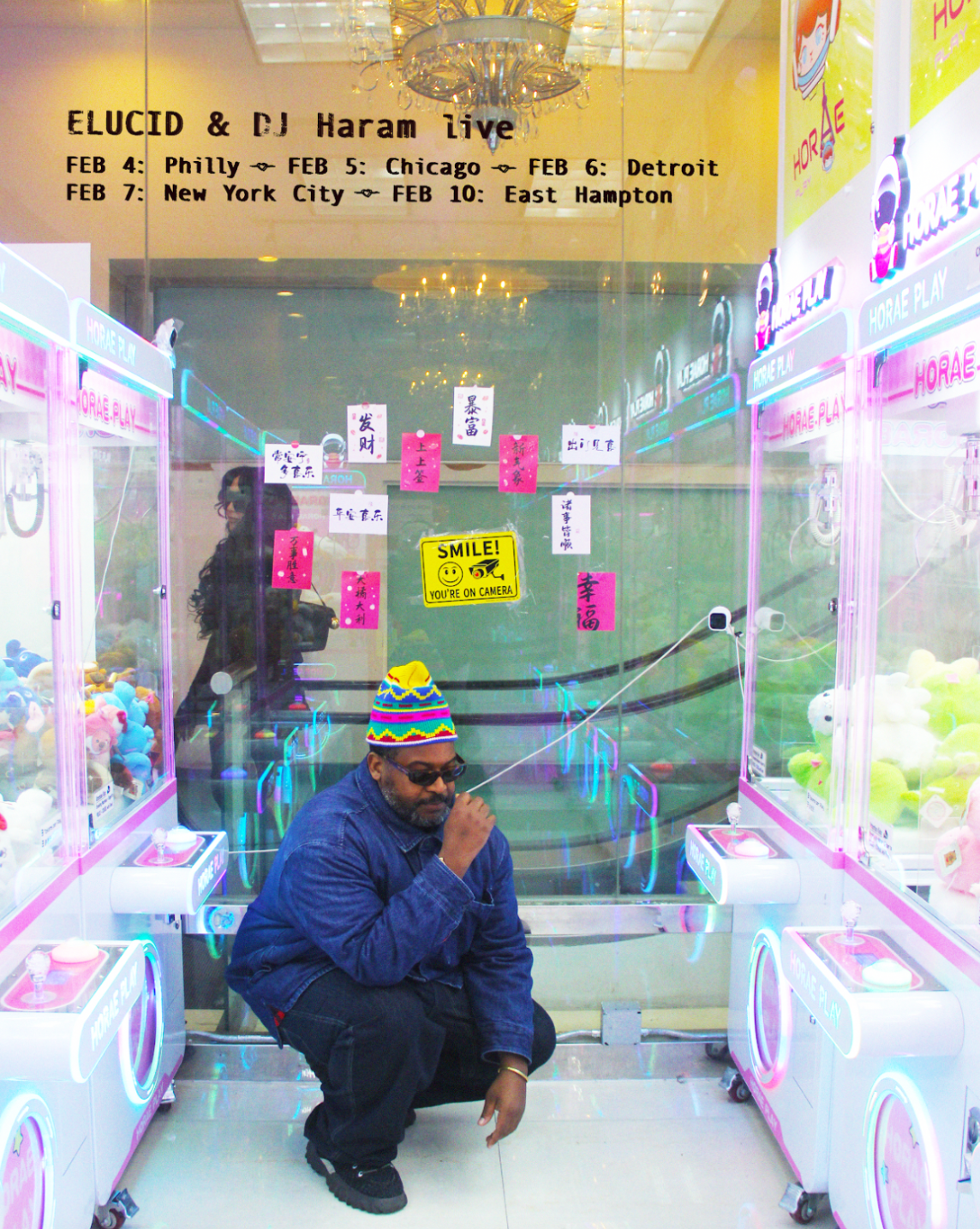
Elucid and DJ Haram
Cratediggaz Records
628 South St.
Philadelphia
Feb. 4, 2026
If you’re like me, South Street is a single destination area. I’m not really one to go there, or anywhere really, to loiter, hangout, and people-watch. I’m often on South Street for shows or to drink for as little money as possible, and I don’t really deviate from any one location, or the places I already frequent. That being said, I need to tap in more with Cratediggaz. The two-story record store is known to host my friend Q’s monthly beatmaking event while also possessing a pretty cool collection of records, vintage clothes, art, and even a few arcade games. On Feb. 4, I took a trip there to see DJ Haram and NYC rapper ELUCID hold a last-minute show. If they keep hosting stuff like this, you, dear reader, will probably see me up in there.
I could see myself doing a much longer and more in-depth review of Elucid and Armand Hammer down the road, so I’m going to keep it brief on him. Elucid raps (and Billy Woods too, for real) in a way that literally took me years to begin to understand, and I wouldn’t say I even fully get it now. It falls into a style that I like to refer to as “outside.” “Rustic” is another word that could work, but in my mind it’s a difficult one to apply to music that’s made with computers.
“Outside” music reflects the sound and experience of the world beyond our front door not just sonically, but emotionally. “Outside” is where uncurated interactions between different kinds of people happen, where we are (or should be) equally likely to experience conflict or harmony. Outside music isn’t necessarily always made for gatherings, but it reflects the natural sounds and evokes the feeling of when people do get around each other. There are artists I can name that leave me with this feeling, but when I try to describe it in terms of their sounds, it gets subjective fast. That aside, the same feeling comes from Elucid’s raps. For me, the group most similar to Armand Hammer is Cannibal Ox, whose abstract style single-handledly changed my entire understanding of rap music.
Like them, Elucid is a true griot; his use of extended metaphors imparts valuable information about himself, his worldview, and his experience, but to understand you have to use the powers of inference you once developed to understand the people who only speak to you in lies, euphemisms, and half-truths. It’s how I imagine the news would be if it was delivered as honest poetry instead of politically coded doublespeak. As I watched the dude rap with two mics, a stage move I myself like, I was amazed as I always am, by his skill as a writer and the power of his gravelly, yet booming voice.
I’ve known DJ Haram for longer than a decade. In our time as Philadelphia musicians, promoters and regulars at the once-punk-but-not-defunct West Philly venue LAVA Space, and as supporters of each other’s work, DJ Haram and I cultivated a friendship that’s influenced the musician that I am now. I would describe a lot of her music as “deconstructed club,” but even that isn’t really a thorough enough explanation.
There’s always been heavy noise elements in her work, often paired with warped samples of various Western Asian music that result in an incomparable sound. She then either turns these into original instrumental compositions, produces them in collaboration with other artists, or more recently, adds her own vocal performance. Through her, I’ve met many different people and artists, and she, in part, got me into DJ’ing and electronic music production. As such, it’s been endlessly rewarding and (as she’d say) cute to see her as half of hip-hop duo 700 Bliss as well as one of the in-house producers and DJ’s of underground rap powerhouse Backwoodz Studioz.
Having seen her perform in the variety of settings that I have, I can truly say I was surprised and excited by her choice to convert the counter and its glass display into a surface that somehow simultaneously served as a home for her instruments and as a stage. Her instruments; a mic, a laptop running Ableton, an Akai MPC, and (inexplicably) a tambourine, lay strewn around her as she knelt on top of the counter for nearly the entirety of her performance. The ease with which she made this choice and stuck to it has been fixed in my mind as a sort of visual metaphor for the concept I’m about to discuss in the paragraph after next.
While alternating between sitting and kneeling in a position that I could scarcely imagine was comfortable, DJ Haram delivered a set oscillating between instrumentals, songs she has with other artists like Chattanooga legend Bbymutha and San Francisco’s Sha Ray, and new songs that she sings herself. Haram likes to sing in a low, hypnotic murmur that makes her already dark-ass beats sound downright spectral. This is a side of her music that is very new to me, but as someone who knows her interests and belief system, her lyrics probably range from fire to earth-shattering.
DJ Haram ft. Armand Hammer-Stenography
I was affected by her discussion of the title of her song “Distress Resistance,” and I can best describe the feeling as “ripples after the drop.” At another point in her set she simply uttered, “Long love the resistance,” and I, as I often privately do, sneered at my own pessimism. I find myself saying the phrase “We will never be free,” once a day. I think about the current online rumors I’m hearing of the presence of a certain Federal Agency that may be, as I literally type this, in a nearby part of my neighborhood. I think about how I am continuing to just sit on my couch finishing this piece, trying not to think to myself, “We will never be free.” I look at memes like this and I wonder what the point of our freedom even is if we’re still asking to be saved.
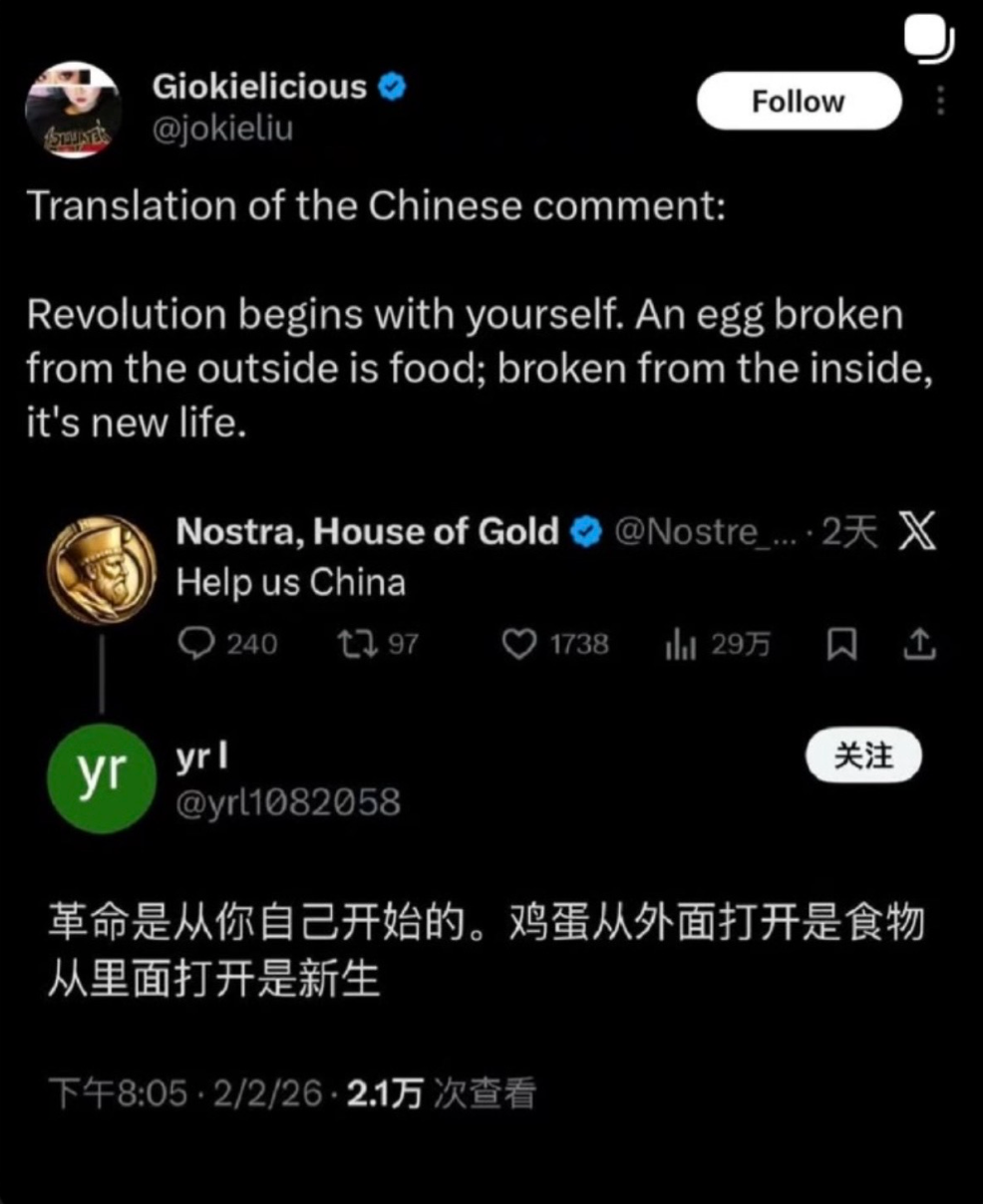
A lot of us could stand to take DJ Haram’s words to heart. Fuck the coping, we need to start fucking winning. We need to strike, in every possible definition of the word. A lot of us, who have been marginalized in some ways but privileged in others, need to take on a bit more responsibility in our interactions with the violence of our culture. I am a marginalized member of the most socially dominant group. The structural violence trickles down into our interpersonal dynamics. This interpersonal violence deafens us to the cries of those around us. It blinds us from seeing our true individual and collective power. We can’t resist anything if we don’t see and resist this within ourselves. Fuck this shit. I’m going outside.


