
Fragments
City Gallery
New Haven
Through Feb. 1
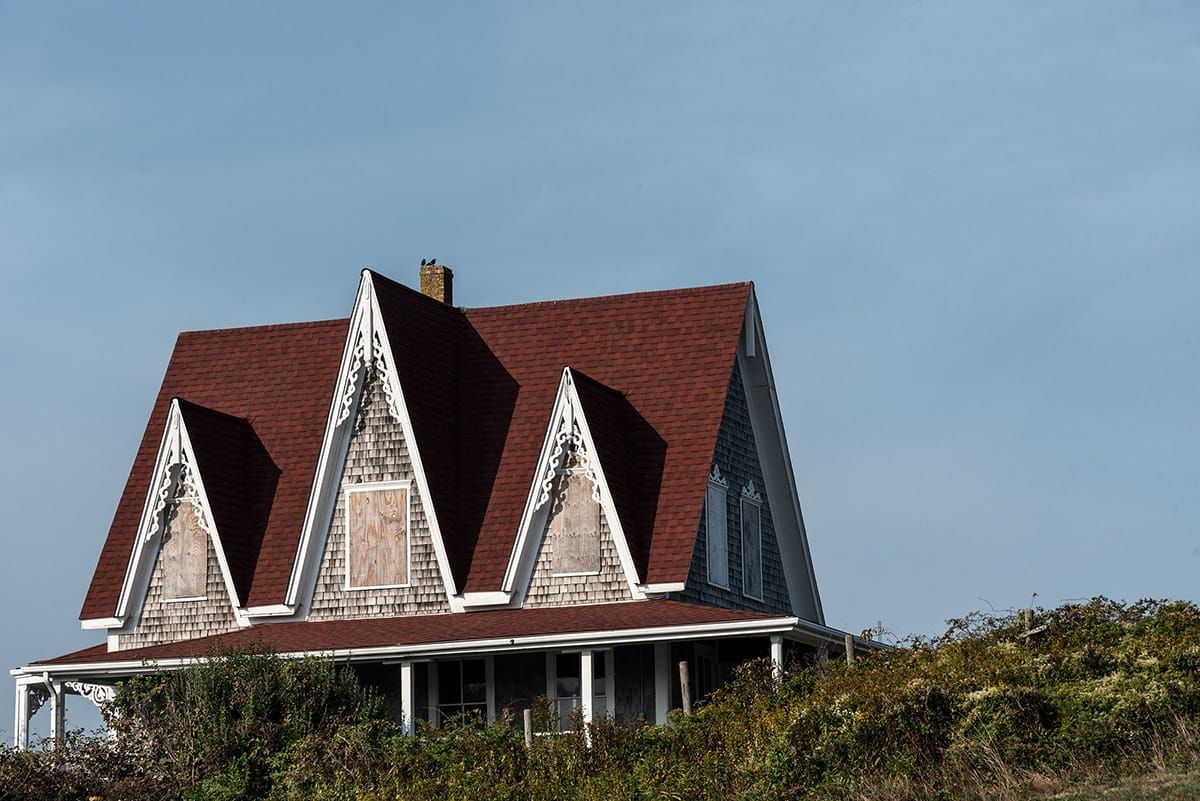
Joy Bush's contributions to "Fragments" — a group show of artwork by Bush, Phyllis Crowley, and Meg Bloom running now at City Gallery through Feb. 1 — are a series of photographs of houses that, through Bush's lens, appear to be partially hiding in their surroundings. They peek through foliage. They maintain a healthy distance from the street. They peer over hedgerows. In their appearance, houses say something about their own history and their current owners, but as Bush's photographs point out, they hide things, too. We may think we know something from the curb. But we might be wrong, and we don't know everything.
That said, the above reading of Bush's photographs is informed by the images' context: the title of the show, and Crowley's and Bloom's works. All of it creates a frame to approach the whole show, and that brings the artists' disparate works closer together, in conversation with each other. That's just how the artists want it.
The theme for the show came about when Bush, Crowley, and Bloom got together to talk about what they wanted to exhibit. "We all had certain feelings" about pieces they wanted to include, Bush said, "and it sounded a little fragmented." That began with key differences among the three artists' work. Bush's photographs worked in a realist mode, even if a little off-kilter. Bloom dealt in abstract sculpture. Crowley's photographs functioned more like abstract paintings.
For Bloom, the theme also fit with "our lives and what things feel like right now," she said, "trying to put things together and things aren't necessarily going together... The world is such a crazy place right now, and it feels like we're constantly being bombarded." And, she added, "what's going on for me personally is very different from what's going on around me, and so I feel like I'm in a million different pieces."
At the same time, Bloom said, creating things from pieces has always been part of her art making. "I'm walking through the woods, and I'm looking at the water, or the sky, or a pod, or an eaten-out something, and when I go to make the art, I'm not thinking of one image." It comes from "a much less conscious place, and I think those things piece together."
The theme resonated with Bush as well, as she put together her photographs of houses. "Houses are places where we are" and "part of our personality," but "it's a fragment — it doesn't mean it's entirely what we're about." As she took pictures of houses and wondered what their occupants did, she also thought: "who would I be if I lived there?" Would her politics and values be the same? "So it felt a little fragmented there."
But the three artists also noted the ways in which their work connected, starting with using much of the same color palette. "It was a nice surprise," Bush said. "It was really clear when we were picking pieces to hang what absolutely should not be there" — and what belonged in the show.
"We had a really good time discovering that it could work together," Bloom said.
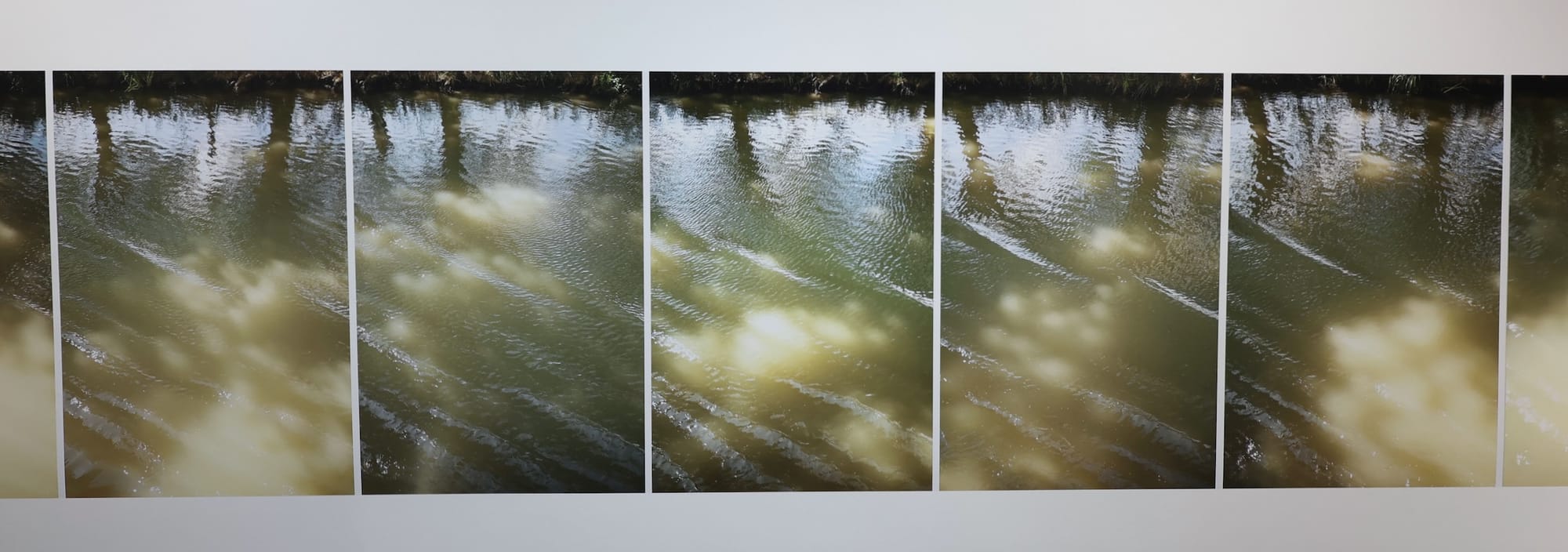
Bush's photographs call attention to the idea that we, as passersby, are only catching one moment in the long life of a house. Phyllis Crowley's images capture moments that are even more fleeting. A series of pictures that might read first as quickly executed abstract paintings or turn out to be deftly done photographs of the sun's reflection off moving waves. The forms of those reflections suggest calligraphy; one interpretation is the romantic idea that the sun is writing messages on the water, though of course that's not true.
On another wall, the piece Clouds Falling in Water is a long series of photographs that shows how the movement of light, shadow, and current changes, and changes again. We only get to see snapshots of it. In a sense, the same would still be true if we had been there with Crowley, witnessing all the moments in between when the pictures were taken. We would still have missed everything that happened before we arrived, and we're not there for whatever's happening now.
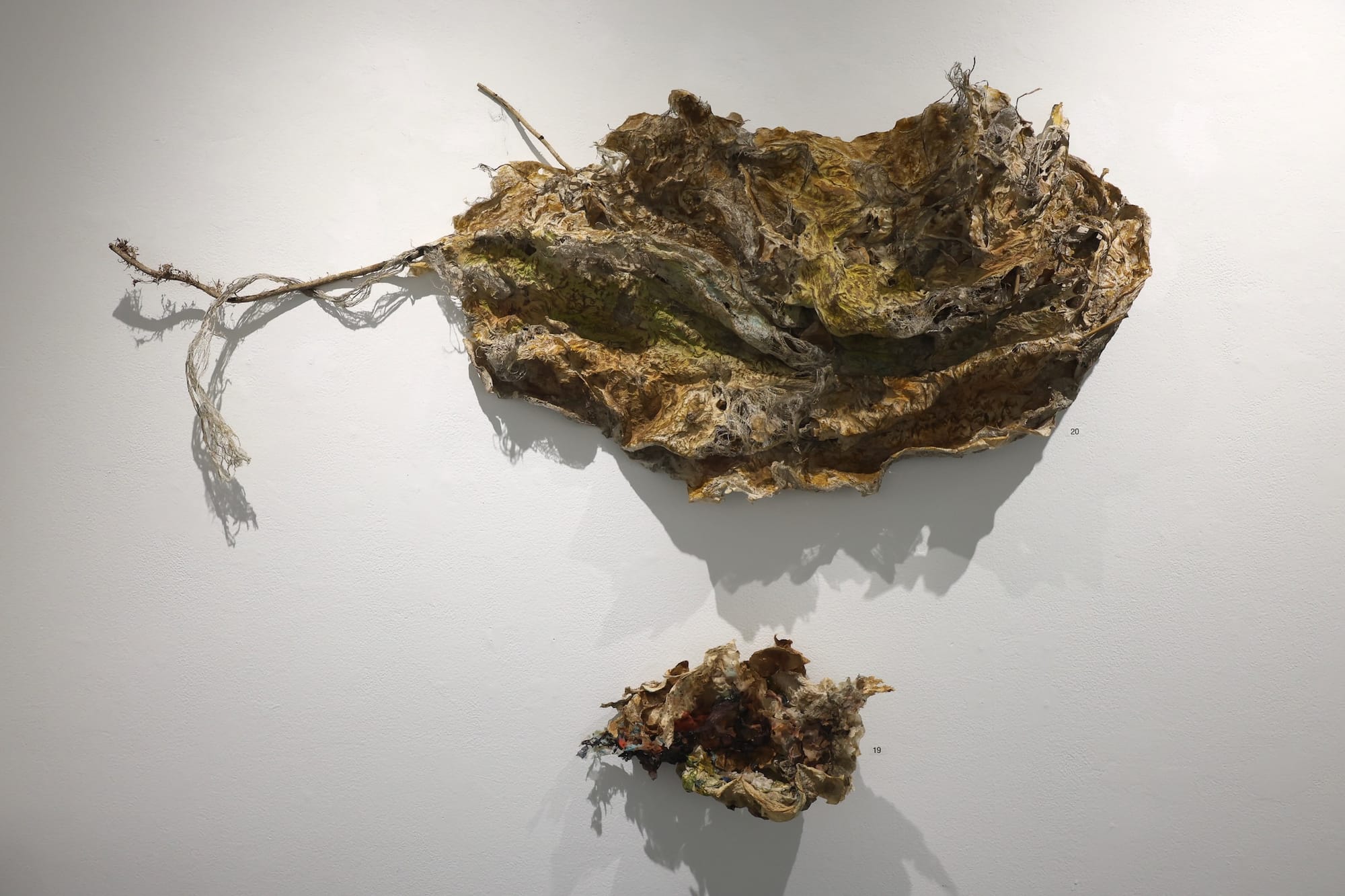
Crowley's attention to visual ephemera finds an echo in Meg Bloom's airy sculptures, which appear to float off the walls. The shadows they cast become part of the piece. With Bush's and Crowley's pieces there to put us in a certain frame of mind, of understanding that we're seeing just a glimpse of moving, changing things, it's easy to imagine we're seeing Bloom's sculptures in the same state. To indulge in some magical thinking, it's possible to see Bloom's pieces as animals that could swim across the gallery when we're not looking.
Bush felt the sense of artistic camaraderie when she first visited the gallery after the pieces were on the walls. "It just felt so good walking in here," she said. "It felt very elegant to me." Perhaps, she added, it was because "they all have a connection with nature." Each piece is a fragment, but "it doesn't feel that way, seeing it up on the wall."
"They start talking to each other," Bloom said. That can add "another layer," Bush said, that "provokes some kind of feeling." Piecing the show together, "you find something that works."
For Bush, the show made her look at her own house differently. "I realized everything is fragments, because I'm constantly bringing home little pieces of things" from somewhere else.


