
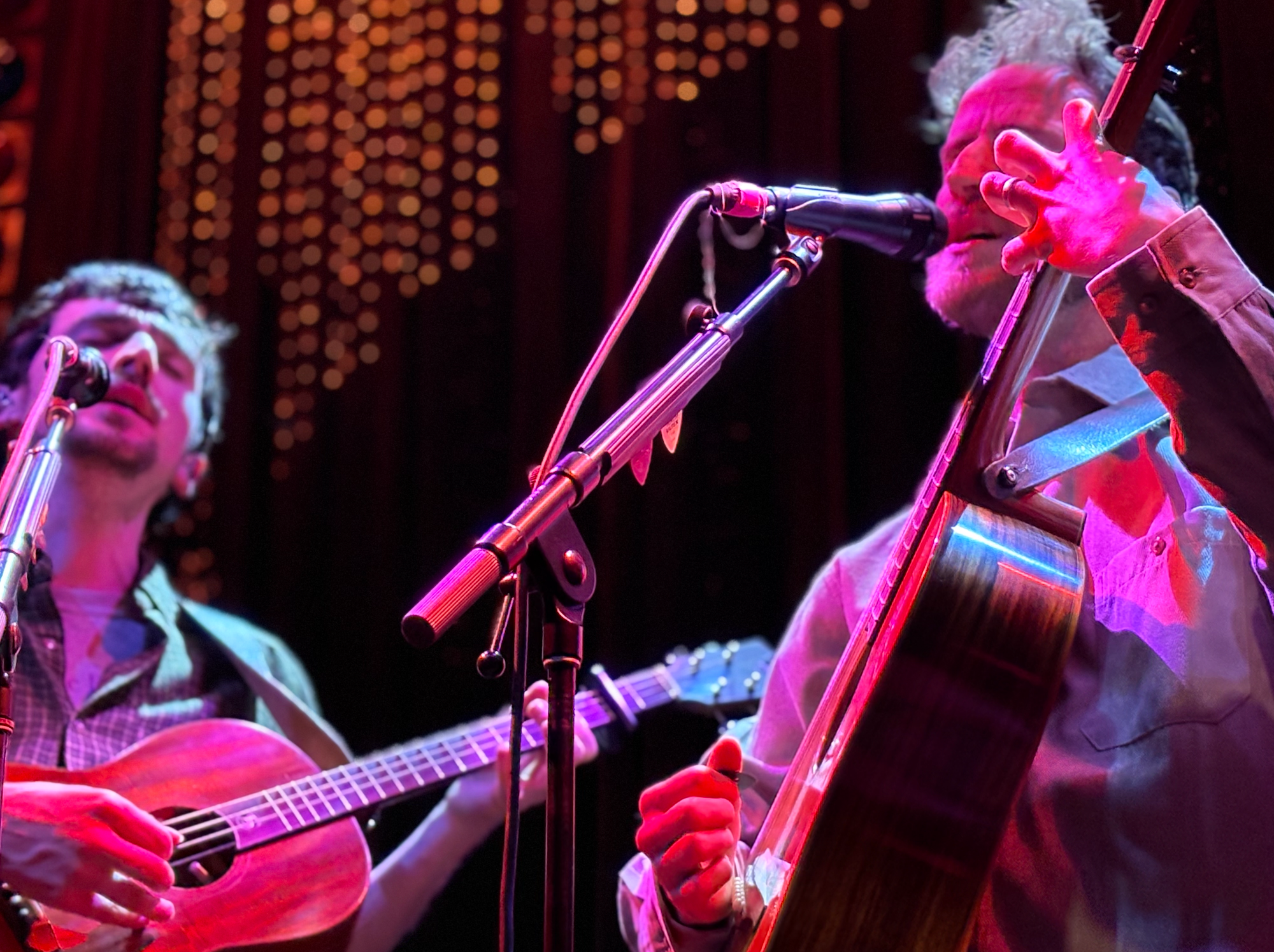
Ye Vagabonds, Daphne Ellen
Johnny Brenda’s
1201 Frankford Ave.
Feb. 2, 2026
Philadelphia
It’s true that folk revivals, in the 1960’s Greenwich Village sense, are cyclical: we see it come around and again for different generations, for reasons and motivations specific to the time and the moment. (And it’s equally true that it never actually goes away, that folk revival is mostly a marketing term anyway.) At times it’s been the political, activist-leaning side of folksingers like Woody Guthrie, Pete Seeger and (young, cap-wearing) Dylan that takes center stage, though those artists contained multitudes; other times it’s been an ecological, back-to-the-land desire for simpler, more communal living and music-making; it’s even been the weirder, scratchier aspects of Harry Smith’s old 78s and the gnarled intonation of long-gone singers and fiddle-scrapers, inspiring the whole freak folk scene of the early aughts. And sometimes, it’s a toothless nostalgia for vests. The times are always changing, and it seems folk genre’s heyday as the main musical means of protest are gone and ain’t coming back; but one never knows. But beauty-making is itself an essential bulwark, and with a packed room last night at Johnny Brenda’s, there was plenty of that on hand.
Up first was the young local songwriter Daphne Ellen, who I’ve shouted out in Midbrow recently. (Again, full disclosure, I played banjo on a couple songs on her 2025 album.) Ellen is a smart, perceptive artist with a lovely voice, and not only a great ear for melody and rhyme but for telling details. Lyrically, her songs are vivid, filled with precise, colorful images, and she’s got an unselfconscious, genial way of writing; I’m convinced she’d produce a wonderful novel or short story collection someday, should the ambition ever strike her. In particular, her fascination with language and people yields songs that stand firm even when presented with nothing but guitar and voice. She sang a new song, “Circle Back," that incorporated a litany of corporate jargon and common office buzzwords – you know, stuff like bandwidth and synergy and hope this email finds you well – that achieved its goal of making all that language feel and sound ridiculous. She said (I’m paraphrasing) “it’s validating to hear that you all feel this way too, and we’re just pretending not to,” and it’s that tension between what we pretend to think and feel and how we really feel that Ellen is so adept at interrogating. Before singing “Nanny Song," she told the crowd that it was written at a songwriter’s workshop based on the prompt of writing the lyrics as if no one would ever hear them; I’d venture that in general, Ellen proceeds with that level of fearlessness and sincerity of commitment. Even the earnestness of covering Dylan’s “Blowing In The Wind” was transformative in Ellen’s plainspoken, direct manner: here, a song we all learned as grade school children, with a simple, ageless beauty that ceaselessly speaks for itself.
Headliners Ye Vagabonds, on tour from Ireland, were a good bit more boisterous, and brought an amazing, enveloping sound to the stage, a lush and cinematic take on session-ready Irish trad. The quartet, formed around the brother pair of Brían and Diarmuid Mac Gloinn, came replete with an array of mandolins and bouzoukis, varieties of guitars and small synthesizers, a harmonium and an upright bass rigged with effects pedals, and toting new, barely-road-tested original songs, with the occasional traditional sean-nós singing or tune set thrown in. The brothers’ blood harmony is astonishing to hear in the flesh, especially in a room that sounds as good as JB’s, with that particular way that Irish melodies are ornamented; memories of years of listening to singers like Paul Brady, Declan O’Rourke, John Francis Flynn and Iarla Ó Lionáird all came to mind. The group is on tour in support of their new album All Tied Together, released only days ago, and one easily gleaned – from their sweet rapport, both among themselves and with the crowd, and from direct statements, speaking out against ICE and for the essential value of community – that for them, music is a social thing, a binding agent for the soul. I couldn’t help but marvel at times at the fullness of their music, the harmonium and bowed bass and effect-laden acoustic instruments somehow conjuring the sounds of fiddles and whistles that weren’t there but were nonetheless heard. Diarmuid spoke at one point about how neuroscientists have observed how when a group of people sing a song together, their heartbeats and brain waves begin to synchronize – “but of course, we already knew that.”


